Berlanga-Acosta Jorge, Abreu-Cruz Angel, Herrera Diana García-Del Barco, Mendoza-Marí Yssel, Rodríguez-Ulloa Arielis, García-Ojalvo Ariana, Falcón-Cama Viviana, Hernández-Bernal Francisco, Beichen Qu, Guillén-Nieto Gerardo
Center for Genetic Engineering and Biotechnology, Cubanacán, Playa, Havana, Cuba.
Cardiology Unit, Center for Medical and Surgical Research, Siboney, Playa, Havana, Cuba.
Clin Med Insights Cardiol. 2017 Mar 2;11:1179546817694558. doi: 10.1177/1179546817694558. eCollection 2017.
Growth hormone-releasing peptides (GHRPs) constitute a group of small synthetic peptides that stimulate the growth hormone secretion and the downstream axis activity. Mounting evidences since the early 1980s delineated unexpected pharmacological cardioprotective and cytoprotective properties for the GHRPs. However, despite intense basic pharmacological research, alternatives to prevent cell and tissue demise before lethal insults have remained as an empty niche in the clinical armamentarium. Here, we have rigorously reviewed the investigational development of GHRPs and their clinical niching perspectives.
PubMed/MEDLINE databases, including original research and review articles, were explored. The search design was date escalated from 1980 and included articles in English only.
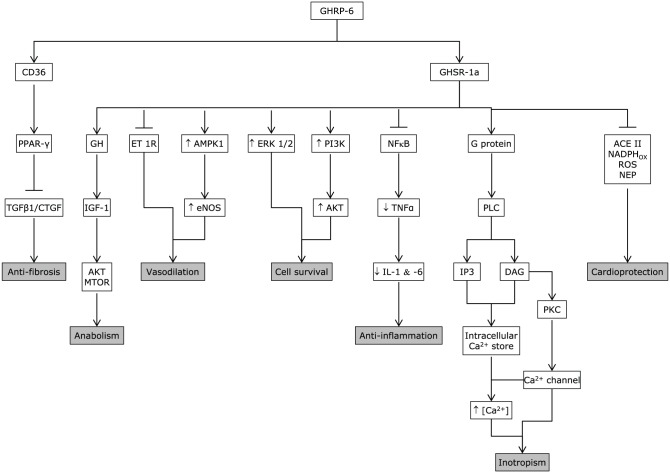
GHRPs bind to two different receptors (GHS-R1a and CD36), which redundantly or independently exert relevant biological effects. GHRPs' binding to CD36 activates prosurvival pathways such as PI-3K/AKT1, thus reducing cellular death. Furthermore, GHRPs decrease reactive oxygen species (ROS) spillover, enhance the antioxidant defenses, and reduce inflammation. These cytoprotective abilities have been revealed in cardiac, neuronal, gastrointestinal, and hepatic cells, representing a comprehensive spectrum of protection of parenchymal organs. Antifibrotic effects have been attributed to some of the GHRPs by counteracting fibrogenic cytokines. In addition, GHRP family members have shown a potent myotropic effect by promoting anabolia and inhibiting catabolia. Finally, GHRPs exhibit a broad safety profile in preclinical and clinical settings. Despite these fragmented lines incite to envision multiple pharmacological uses for GHRPs, especially as a myocardial reperfusion damage-attenuating candidate, this family of "drugable" peptides awaits for a definitive clinical niche.
生长激素释放肽(GHRPs)是一类能刺激生长激素分泌及下游轴活性的小分子合成肽。自20世纪80年代初以来,越来越多的证据表明GHRPs具有意想不到的药理心脏保护和细胞保护特性。然而,尽管进行了深入的基础药理学研究,但在临床治疗手段中,在致命性损伤前预防细胞和组织死亡的替代方法仍是一个空白领域。在此,我们严格回顾了GHRPs的研究进展及其临床应用前景。
检索了PubMed/MEDLINE数据库,包括原始研究和综述文章。检索设计的时间范围从1980年开始,仅包括英文文章。
GHRPs与两种不同的受体(GHS-R1a和CD36)结合,它们通过冗余或独立的方式发挥相关生物学效应。GHRPs与CD36的结合激活了诸如PI-3K/AKT1等促生存途径,从而减少细胞死亡。此外,GHRPs减少活性氧(ROS)溢出,增强抗氧化防御,并减轻炎症。这些细胞保护能力已在心脏、神经元、胃肠道和肝细胞中得到证实,代表了对实质器官的全面保护。一些GHRPs通过对抗促纤维化细胞因子而具有抗纤维化作用。此外,GHRP家族成员通过促进合成代谢和抑制分解代谢表现出强大的促肌效应。最后,GHRPs在临床前和临床环境中显示出广泛的安全性。尽管这些零散的线索促使人们设想GHRPs有多种药理用途,尤其是作为减轻心肌再灌注损伤的候选药物,但这一“可药用”肽家族仍有待明确的临床应用领域。