Jeanneret Valerie, Yepes Manuel
Department of Neurology & Center for Neurodegenerative Disease, Emory University School of Medicine, Atlanta, GA, USA.
Department of Neurology, Veterans Affairs Medical Center, Atlanta, GA, USA.
Neural Regen Res. 2017 Mar;12(3):362-365. doi: 10.4103/1673-5374.202924.
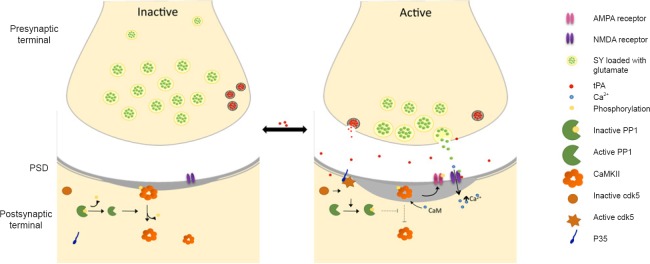
Membrane depolarization induces the release of the serine proteinase tissue-type plasminogen activator (tPA) from the presynaptic terminal of cerebral cortical neurons. Once in the synaptic cleft this tPA promotes the exocytosis and subsequent endocytic retrieval of glutamate-containing synaptic vesicles, and regulates the postsynaptic response to the presynaptic release of glutamate. Indeed, tPA has a bidirectional effect on the composition of the postsynaptic density (PSD) that does not require plasmin generation or the presynaptic release of glutamate, but varies according to the baseline level of neuronal activity. Hence, in inactive neurons tPA induces phosphorylation and accumulation in the PSD of the Ca/calmodulin-dependent protein kinase IIα (pCaMKIIα), followed by pCaMKIIα-induced phosphorylation and synaptic recruitment of GluR1-containing α-amino-3-hydroxy-5-methyl-4-isoxazolepropionic acid (AMPA) receptors. In contrast, in active neurons with increased levels of pCaMKIIα in the PSD tPA induces pCaMKIIα and pGluR1 dephosphorylation and their subsequent removal from the PSD. These effects require active synaptic N-methyl-D-aspartate (NMDA) receptors and cyclin-dependent kinase 5 (Cdk5)-induced phosphorylation of the protein phosphatase 1 (PP1) at T320. These data indicate that tPA is a homeostatic regulator of the postsynaptic response of cerebral cortical neurons to the presynaptic release of glutamate via bidirectional regulation of the pCaMKIIα /PP1 switch in the PSD.
膜去极化诱导丝氨酸蛋白酶组织型纤溶酶原激活剂(tPA)从大脑皮质神经元的突触前末端释放。一旦进入突触间隙,这种tPA会促进含谷氨酸的突触小泡的胞吐作用及随后的内吞回收,并调节突触后对突触前释放谷氨酸的反应。实际上,tPA对突触后致密物(PSD)的组成具有双向作用,这一作用不需要纤溶酶的生成或谷氨酸的突触前释放,而是根据神经元活动的基线水平而变化。因此,在不活跃的神经元中,tPA诱导钙/钙调蛋白依赖性蛋白激酶IIα(pCaMKIIα)在PSD中磷酸化并积累,随后pCaMKIIα诱导含GluR1的α-氨基-3-羟基-5-甲基-4-异恶唑丙酸(AMPA)受体的磷酸化和突触募集。相反,在PSD中pCaMKIIα水平升高的活跃神经元中,tPA诱导pCaMKIIα和pGluR1去磷酸化,并随后将它们从PSD中去除。这些作用需要活跃的突触N-甲基-D-天冬氨酸(NMDA)受体以及细胞周期蛋白依赖性激酶5(Cdk5)诱导的蛋白磷酸酶1(PP1)在T320处的磷酸化。这些数据表明,tPA是大脑皮质神经元对突触前释放谷氨酸的突触后反应的稳态调节剂,通过对PSD中pCaMKIIα /PP1开关的双向调节来实现。