Čoh Milan, Peharec Stanislav, Bačić Petar, Mackala Krzyszfof
University of Ljubljana, Faculty of Sport, Ljubljana, Slovenia.
Polyclinic for Physical Medicine and Rehabilitation "PEHAREC", Pula, Croatia.
J Hum Kinet. 2017 Mar 12;56:29-38. doi: 10.1515/hukin-2017-0020. eCollection 2017 Feb.
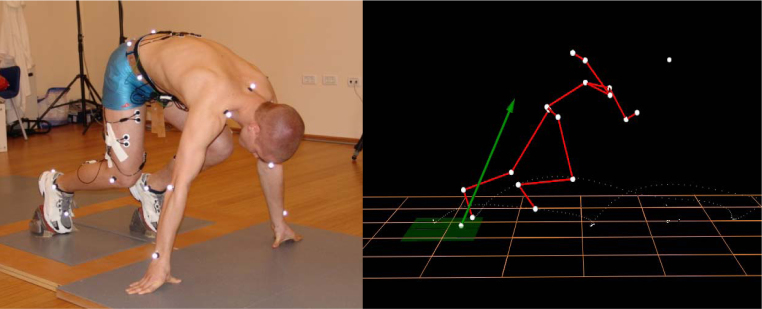
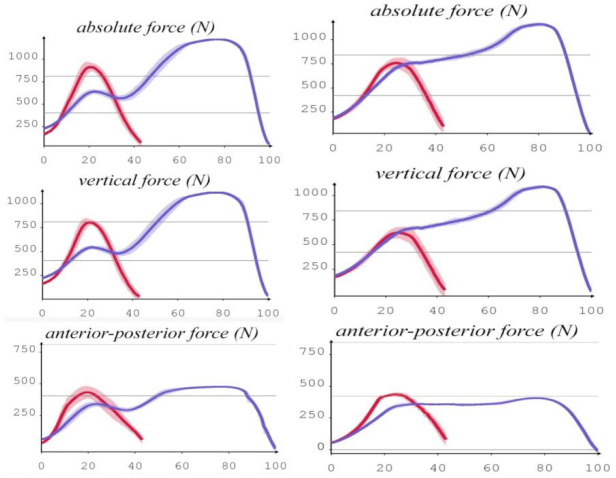
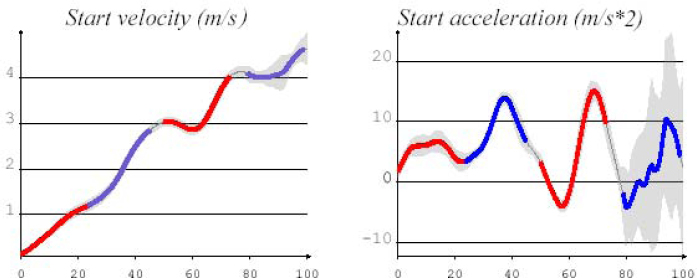
The purpose of this study was to examine the kinematic and kinetic differences of the sprint start and first two steps between faster and slower high-level sprinters. Twelve male sprinters were dichotomized according to personal best 60- and 100-m times. Each participant performed five starts under constant conditions. An eight-camera system was used for 3-D kinematic analysis. Dynamic forces at the start were determined with starting blocks mounted on bipedal force plates. Measures of front and rear block total force, front and rear block maximal force, time to front and rear block peak force, total force impulse, total horizontal and vertical impulse, front and rear block force impulse, time of block clearance, block leaving velocity and block leaving acceleration were collected. Between-group comparisons were made using independent samples t tests (p < 0.05) and by calculating effect sizes (Cohen's d). Spearman's correlation coefficients were used to examine the relationships between sprint start kinematics, kinetic measures and sprint performance. Significant between-group differences were observed in rear block total force (p = 0.0059), rear block maximal vertical force (p = 0.0037) and total force impulse (p = 0.0493). Only front block total force significantly correlated with 100 m sprint performance in both the slower and faster groups (r = 0.94 and 0.54, respectively; p = 0.05). Our findings suggest that faster sprinters show enhanced sprint start motor performance with greater force development than slower sprinters.
本研究的目的是考察高水平短跑运动员中速度较快者与较慢者在短跑起跑及前两步的运动学和动力学差异。根据个人60米和100米的最佳成绩,将12名男性短跑运动员分为两组。每位参与者在恒定条件下进行五次起跑。使用八台摄像机系统进行三维运动学分析。通过安装在双足测力板上的起跑器测定起跑时的动力。收集前后起跑器的总力、前后起跑器的最大力、前后起跑器达到峰值力的时间、总力冲量、总水平和垂直冲量、前后起跑器的力冲量、起跑器离地时间、起跑器离地速度和起跑器离地加速度等测量数据。采用独立样本t检验(p < 0.05)和计算效应量(科恩d值)进行组间比较。使用斯皮尔曼相关系数来考察短跑起跑运动学、动力学测量与短跑成绩之间的关系。在起跑器后总力(p = 0.0059)、起跑器后最大垂直力(p = 0.0037)和总力冲量(p = 0.0493)方面观察到显著的组间差异。在较慢组和较快组中,只有起跑器前总力与100米短跑成绩显著相关(分别为r = 0.94和0.54;p = 0.05)。我们的研究结果表明,与速度较慢的短跑运动员相比,速度较快的短跑运动员在短跑起跑时表现出更强的运动能力,发力更强。