Applied Sports, Technology, Exercise and Medicine Research Centre, Swansea University, Bay Campus, Crymlyn Burrows, SA1 8EN, UK.
Institute of Biomechanics and Orthopaedics, German Sport University Cologne, Am Sportpark Müngersdorf 6, 50933, Cologne, Germany.
Sports Med. 2019 Sep;49(9):1345-1364. doi: 10.1007/s40279-019-01138-1.
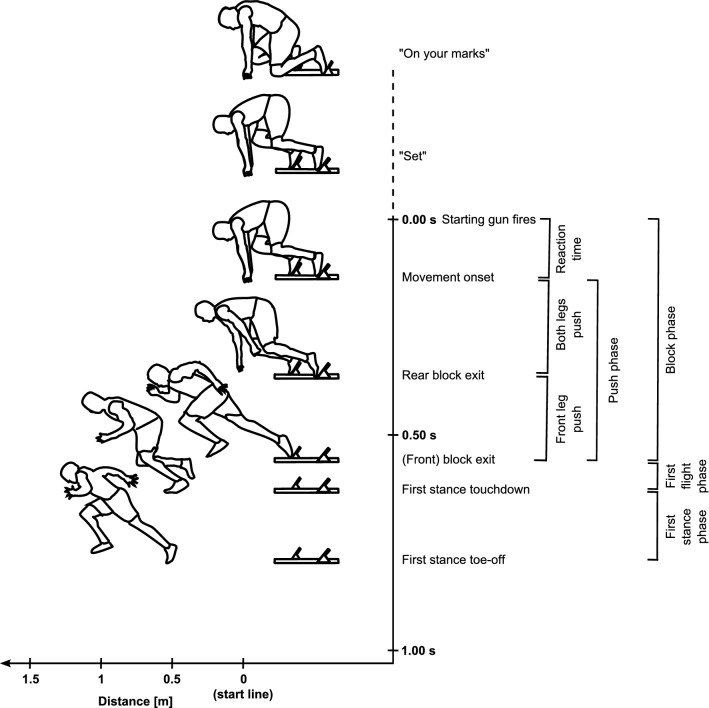
The start from blocks is a fundamental component of all track and field sprint events (≤ 400 m). This narrative review focusses on biomechanical aspects of the block phase and the subsequent first flight and stance phases. We discuss specific features of technique and how they may be important for a high level of performance during the start. The need to appropriately quantify performance is discussed first; external power has recently become more frequently adopted because it provides a single measure that appropriately accounts for the requirement to increase horizontal velocity as much as possible in as little time as possible. In the "set" position, a relatively wide range of body configurations are adopted by sprinters irrespective of their ability level, and between-sprinter differences in these general positions do not appear to be directly associated with block phase performance. Greater average force production during the push against the blocks, especially from the rear leg and particularly the hip, appears to be important for performance. Immediately after exiting the blocks, shorter first flight durations and longer first stance durations (allowing more time to generate propulsive force) are found in sprinters of a higher performance level. During the first stance phase, the ankle and knee both appear to play an important role in energy generation, and higher levels of performance may be associated with a stiffer ankle joint and the ability to extend the knee throughout stance. However, the role of the sprinter's body configuration at touchdown remains unclear, and the roles of strength and anatomy in these associations between technique and performance also remain largely unexplored. Other aspects such as the sex, age and performance level of the studied sprinters, as well as issues with measurement and comparisons with athletes with amputations, are also briefly considered.
起跑器起动是所有田径短跑项目(≤400 米)的基本组成部分。本综述重点讨论起跑器阶段和随后的第一腾空阶段与支撑阶段的生物力学方面。我们讨论了技术的具体特征以及它们如何可能对起跑时的高水平表现很重要。首先讨论了需要适当量化表现;外部功率最近越来越多地被采用,因为它提供了一个单一的措施,适当考虑到在尽可能短的时间内尽可能提高水平速度的要求。在“预备”位置,短跑运动员无论其能力水平如何,都会采用相对较宽的身体姿势范围,并且这些一般姿势之间的运动员差异似乎与起跑器阶段的表现没有直接关系。在起跑器上推离时产生更大的平均力,特别是来自后腿,特别是臀部的力量,似乎对表现很重要。在离开起跑器后,表现水平较高的短跑运动员的第一腾空时间更短,第一支撑时间更长(允许更多的时间产生推进力)。在第一支撑阶段,踝关节和膝关节似乎都在能量产生中发挥重要作用,表现水平较高可能与踝关节僵硬以及在支撑阶段伸展膝关节的能力有关。然而,短跑运动员在触地时的身体姿势的作用仍然不清楚,在这些技术和表现之间的关联中,力量和解剖结构的作用也在很大程度上尚未得到探索。其他方面,如研究短跑运动员的性别、年龄和表现水平,以及与截肢运动员的测量和比较问题,也进行了简要讨论。