Wang Chengzhong, Geng Hua, Liu Weidong, Zhang Guiqin
Department of Pediatrics, Maternal and Child Health Hospital of Yancheng, Yancheng City, Jiangsu Province, P.R. China.
Medicine (Baltimore). 2017 May;96(18):e6696. doi: 10.1097/MD.0000000000006696.
The aim of this meta-analysis was to investigate the prenatal, perinatal, and postnatal risk factors for children autism.
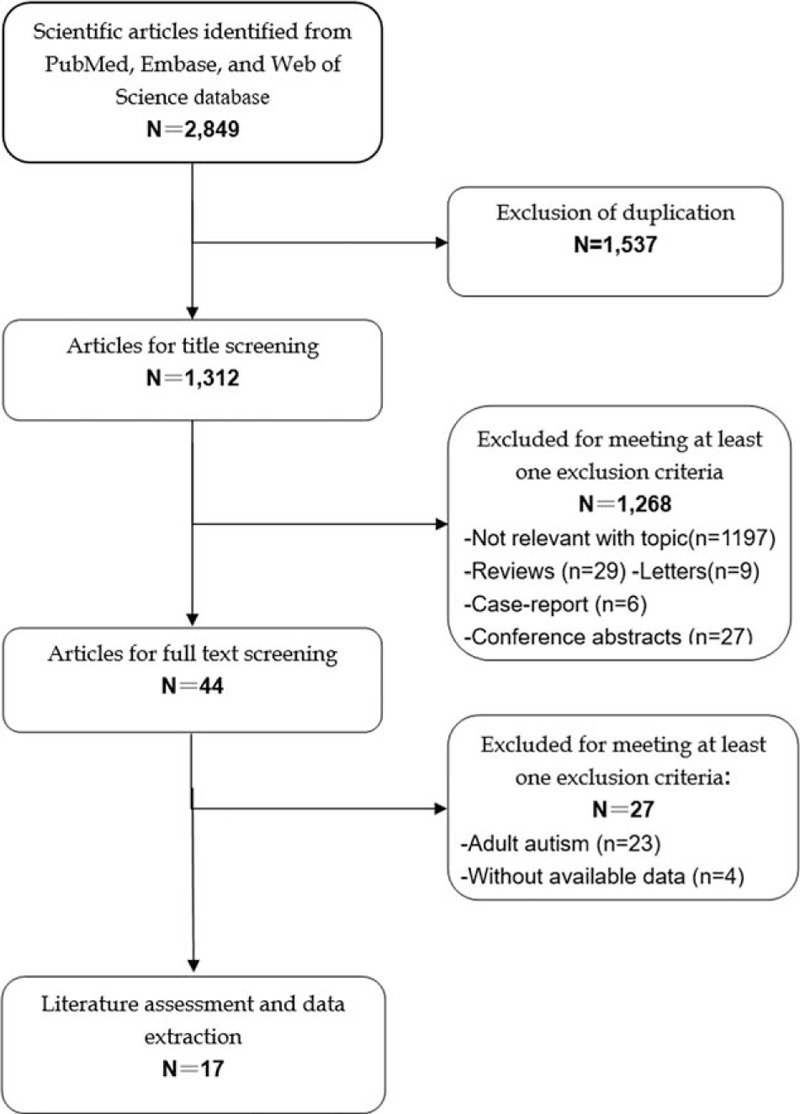
PubMed, Embase, Web of Science were used to search for studies that examined the prenatal, perinatal, and postnatal risk factors for children autism. A fixed-effects model or random-effects model was used to pool the overall effect estimates.
Data from 37,634 autistic children and 12,081,416 nonautistic children enrolled in 17 studies were collated. During the prenatal period, the factors associated with autism risk were maternal and paternal age≥35 years, mother's and father's race: White and Asian, gestational hypertension, gestational diabetes, maternal and paternal education college graduate+, threatened abortion, and antepartum hemorrhage. During perinatal period, the factors associated with autism risk were caesarian delivery, gestational age≤36 weeks, parity≥4, spontaneous labor, induced labor, no labor, breech presentation, preeclampsia, and fetal distress. During the postnatal period, the factors associated with autism risk were low birth weight, postpartum hemorrhage, male gender, and brain anomaly. Parity≥4 and female were associated with a decreased risk of autism. In addition, exposure to cigarette smoking, urinary infection, mother's and father's race: Black and Hispanic, mother's country of birth outside Europe and North America, umbilical cord around neck, premature membrane rupture, 5-minutes Apgar score<7, and respiratory infection were not associated with increased risk of autism.
The present meta-analysis confirmed the relation between some prenatal, perinatal, and postnatal factors with autism. All these factors were examined individually, thus it was still unclear that whether these factors are causal or play a secondary role in the development of autism. Further studies are needed to verify our findings, and investigate the effects of multiple factors on autism, rather than the single factor.
本荟萃分析旨在研究儿童自闭症的产前、围产期及产后危险因素。
使用PubMed、Embase、Web of Science检索研究儿童自闭症产前、围产期及产后危险因素的研究。采用固定效应模型或随机效应模型汇总总体效应估计值。
整理了纳入17项研究的37634名自闭症儿童和12081416名非自闭症儿童的数据。在产前阶段,与自闭症风险相关的因素有父母年龄≥35岁、父母种族:白种人和亚洲人、妊娠期高血压、妊娠期糖尿病、父母学历为大学及以上、先兆流产和产前出血。在围产期,与自闭症风险相关的因素有剖宫产、孕周≤36周、产次≥4、自然分娩、引产、未分娩、臀位、子痫前期和胎儿窘迫。在产后阶段,与自闭症风险相关的因素有低出生体重、产后出血、男性性别和脑异常。产次≥4和女性与自闭症风险降低相关。此外,接触吸烟、泌尿系统感染、父母种族:黑种人和西班牙裔、母亲出生于欧洲和北美以外国家、脐带绕颈、胎膜早破、5分钟阿氏评分<7以及呼吸道感染与自闭症风险增加无关。
本荟萃分析证实了一些产前、围产期和产后因素与自闭症之间的关系。所有这些因素均单独进行了研究,因此尚不清楚这些因素在自闭症发展过程中是因果关系还是起次要作用。需要进一步研究来验证我们的发现,并研究多种因素而非单一因素对自闭症的影响。