Ortiz-Montero Paola, Londoño-Vallejo Arturo, Vernot Jean-Paul
Cellular and Molecular Physiology Group, Instituto de Investigaciones Biomédicas, Facultad de Medicina, Universidad Nacional de Colombia, Bogotá D.C., 111311, Colombia.
Institut Curie, PSL Research University, CNRS, UMR3244, Telomeres & Cancer lab, 75005, Paris, France.
Cell Commun Signal. 2017 May 4;15(1):17. doi: 10.1186/s12964-017-0172-3.
There is compelling evidence associating senescent cells with the malignant progression of tumours. Of all senescence-related mechanisms, the so-called senescence-associated secretory phenotype (SASP) has attracted much attention. Since the pro-inflammatory cytokines IL-6 and IL-8 are consistently present in the SASP, and secreted by highly aggressive breast cancer cell lines, we aimed at elucidating their role on the less aggressive breast cancer cell line MCF-7, which does not secret these cytokines.
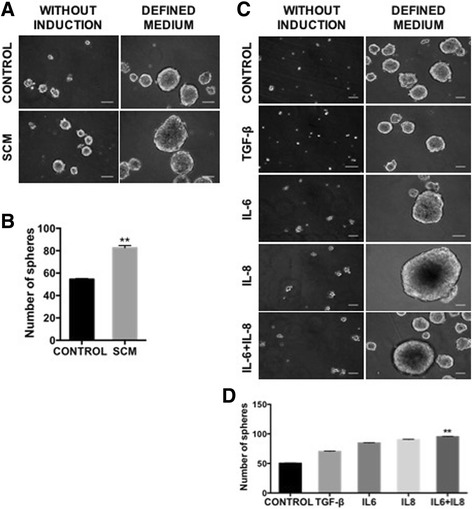
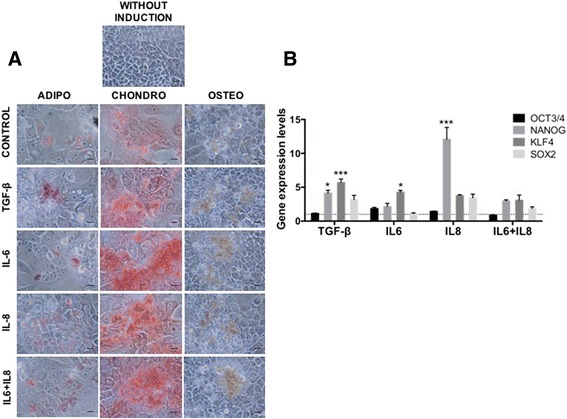
The MCF-7 cell line was treated with either senescence-conditioned medium (SCM), IL-6 or IL-8 and then evaluated for phenotypic (CD44 and CD24 by FACS) and functional changes associated with an EMT program (migration/invasion) and for the acquisition of stem cell properties: mammosphere-forming capacity, expression of reprogramming factors (by qRT-PCR) and multilineage differentiation potential. We also evaluated the role of IL6 and IL8 in the cytokine-secreting, highly tumorigenic cell line MDA-MB-231.
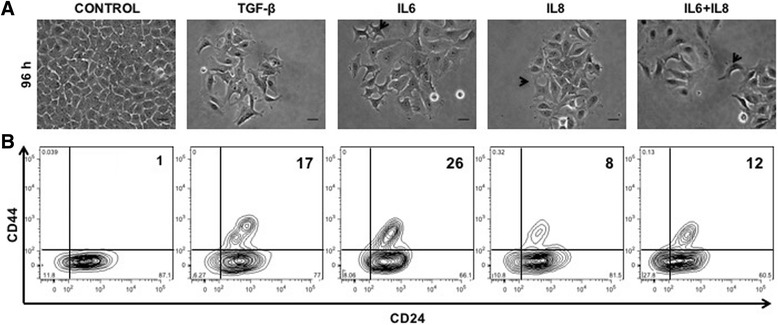
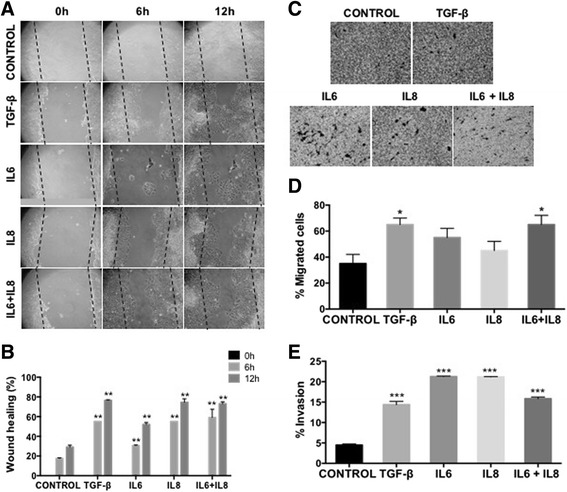
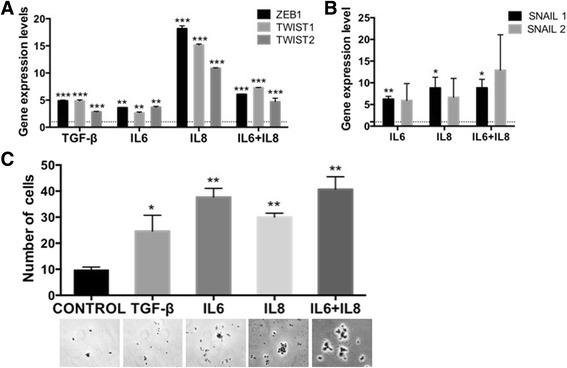
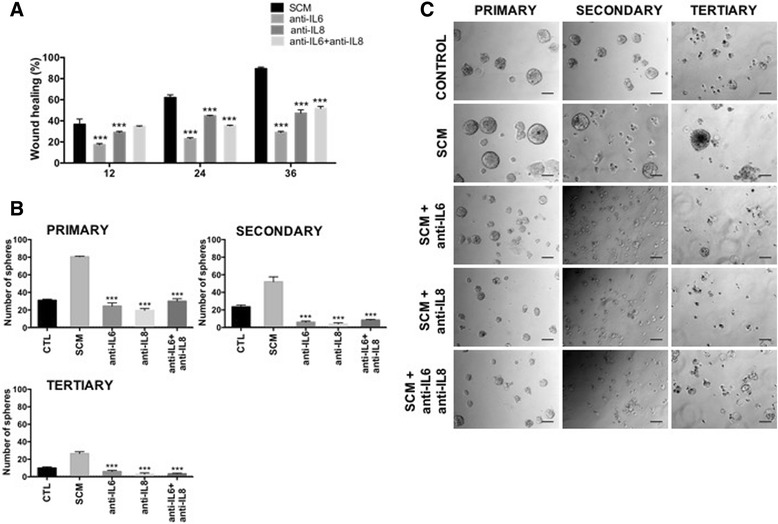
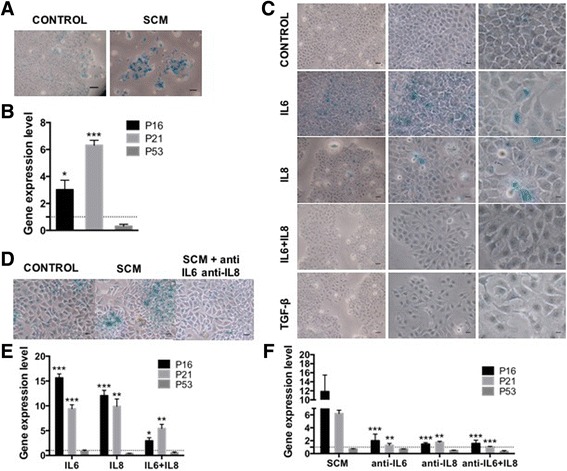
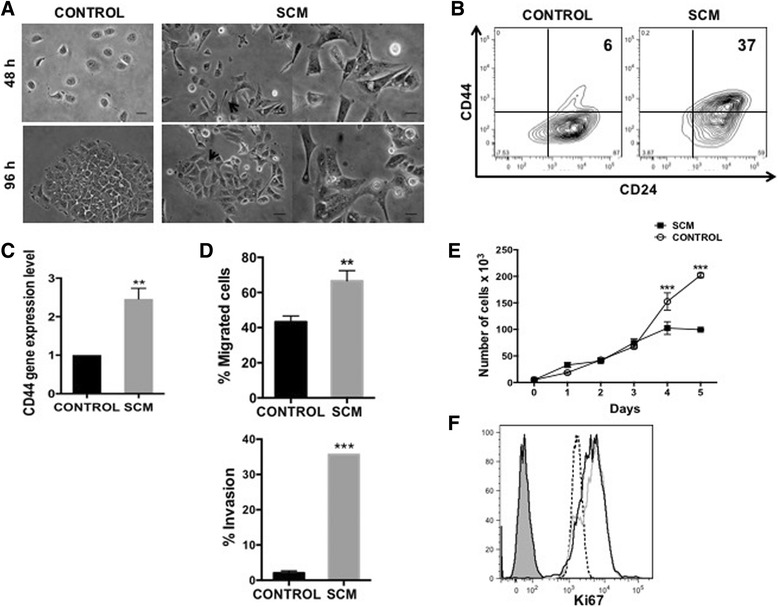
Our results show that treatment of MCF-7 cells with IL6 and IL8, alone or together, induced the appearance of cells with fibroblastoid morphology, increased CD44 expression and migration, self-renewal and multilineage differentiation capacity, all characteristics compatible with an EMT program and stemness. These changes closely resembled those induced by a SCM. Interestingly, SCM treatments further increased IL6 and IL8 secretion by MCF-7 cells, thus suggesting the participation of an autocrine loop. Indeed, neutralizing antibodies against IL6 and IL8 reversed the effects of SCM on MCF-7, pinpointing these cytokines as major mediators of EMT and stemness-related effects associated with the senescent microenvironment. Additionally, prolonged exposure of MCF cells to IL6 or IL8 induced the appearance of senescent cells, suggesting a mechanism by which senescence and inflammation are reinforced favouring the acquisition of EMT and stem-like features at the population level, thus increasing tumour aggressiveness. Strikingly, our results also show that both IL6 and IL8 are important to maintain aggressive traits in MDA-MB-231 cells, a highly tumorigenic cell line, which appears to be devoid of stemness-related features.
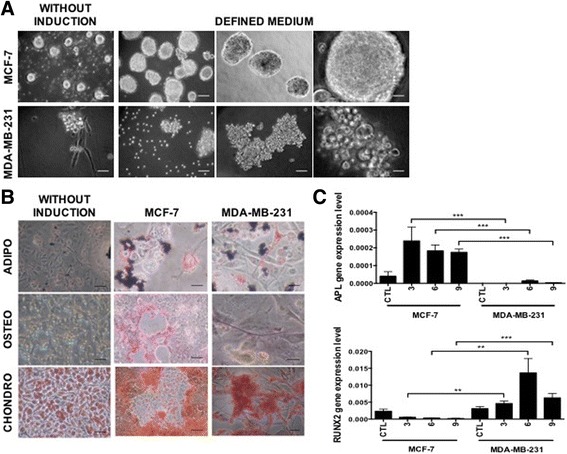
This study demonstrates that, similar to what is observed with a senescent microenvironment, purified IL6 and IL8 induce a self- and cross-reinforced senescence/inflammatory milieu responsible for the emergence of epithelial plasticity and stemness features, thus conferring more aggressive phenotypes to a luminal breast cancer cell line. On the other hand, the basal-like MDA-MB-231 cells, whose aggressiveness-related features depend on IL6 and IL8 secretion, almost completely lack mammosphere formation and differentiation capacities, suggesting that tumour aggressiveness is not always related to stemness.
有确凿证据表明衰老细胞与肿瘤的恶性进展相关。在所有与衰老相关的机制中,所谓的衰老相关分泌表型(SASP)备受关注。由于促炎细胞因子白细胞介素-6(IL-6)和白细胞介素-8(IL-8)始终存在于SASP中,并由高侵袭性乳腺癌细胞系分泌,我们旨在阐明它们对侵袭性较低的乳腺癌细胞系MCF-7的作用,该细胞系不分泌这些细胞因子。
用衰老条件培养基(SCM)、IL-6或IL-8处理MCF-7细胞系,然后评估其表型变化(通过流式细胞术检测CD44和CD24)以及与上皮-间质转化(EMT)程序相关的功能变化(迁移/侵袭),并评估其干细胞特性的获得情况:乳腺球形成能力、重编程因子的表达(通过定量逆转录聚合酶链反应)和多谱系分化潜能。我们还评估了IL-6和IL-8在分泌细胞因子的高致瘤性细胞系MDA-MB-231中的作用。
我们的结果表明,单独或联合用IL-6和IL-8处理MCF-7细胞,会诱导出现具有成纤维细胞样形态的细胞,增加CD44表达、迁移能力、自我更新能力和多谱系分化能力,所有这些特征都与EMT程序和干性相符。这些变化与SCM诱导的变化非常相似。有趣的是,SCM处理进一步增加了MCF-7细胞分泌IL-6和IL-8,从而提示存在自分泌环。事实上,针对IL-6和IL-8的中和抗体可逆转SCM对MCF-7的作用,明确这些细胞因子是与衰老微环境相关的EMT和干性相关效应的主要介质。此外,MCF细胞长时间暴露于IL-6或IL-8会诱导衰老细胞出现,提示一种在群体水平上强化衰老和炎症从而有利于获得EMT和干细胞样特征的机制,进而增加肿瘤侵袭性。引人注目的是,我们的结果还表明,IL-6和IL-8对于维持高致瘤性细胞系MDA-MB-231细胞的侵袭性特征都很重要,该细胞系似乎缺乏与干性相关的特征。
本研究表明,与衰老微环境中观察到的情况类似,纯化的IL-6和IL-8可诱导一种自我和交叉强化的衰老/炎症环境,导致上皮可塑性和干性特征的出现,从而赋予管腔型乳腺癌细胞系更具侵袭性的表型。另一方面,基底样MDA-MB-231细胞的侵袭性相关特征依赖于IL-6和IL-8的分泌,几乎完全缺乏乳腺球形成和分化能力,这表明肿瘤侵袭性并不总是与干性相关。