Department of Health Statistics, Second Military Medical University, No. 800 Xiangyin Road, Shanghai, 200433, China.
Unit of Biostatistics, Institute of Environmental Medicine, Karolinska Institutet, Nobelsväg 13, Box 210, Stockholm, 17 177, Sweden.
Nutr J. 2017 May 5;16(1):26. doi: 10.1186/s12937-017-0247-4.
The findings of prospective cohort studies are inconsistent regarding the association between dietary magnesium intake and serum magnesium concentration and the risk of hypertension. We aimed to review the evidence from prospective cohort studies and perform a dose-response meta-analysis to investigate the relationship between dietary magnesium intake and serum magnesium concentrations and the risk of hypertension.
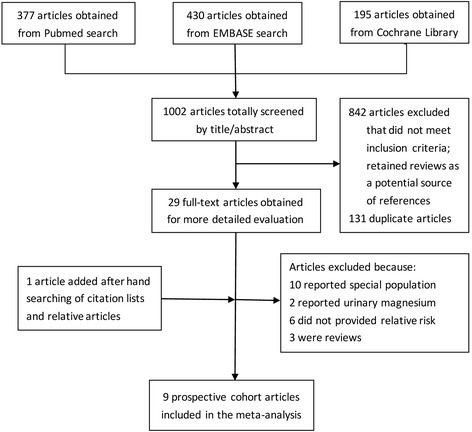
We searched systematically PubMed, EMBASE and the Cochrane Library databases from October 1951 through June 2016. Prospective cohort studies reporting effect estimates with 95% confidence intervals (CIs) for hypertension in more than two categories of dietary magnesium intake and/or serum magnesium concentrations were included. Random-effects models were used to combine the estimated effects.
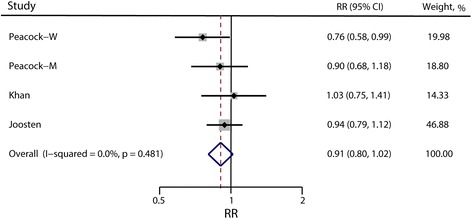
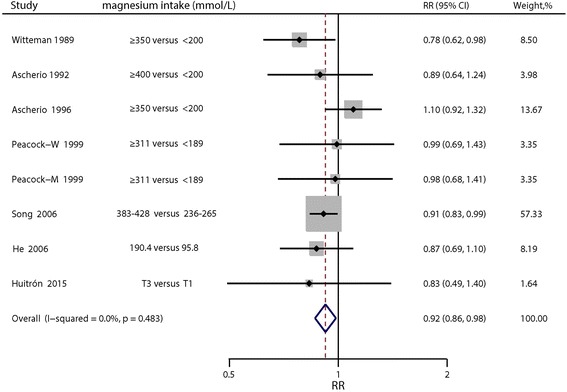
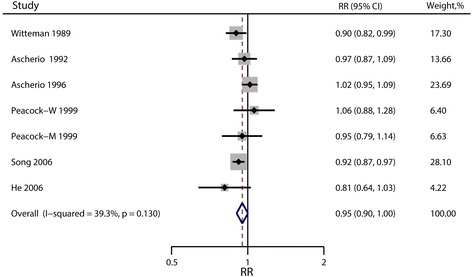
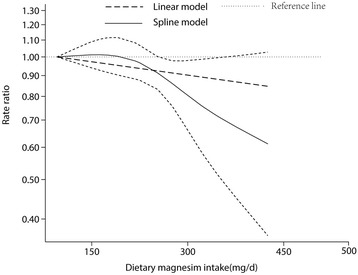
Nine articles (six on dietary magnesium intake, two on serum magnesium concentration and one on both) of ten cohort studies, including 20,119 cases of hypertension and 180,566 participates, were eligible for inclusion in the meta-analysis. We found an inverse association between dietary magnesium intake and the risk of hypertension [relative risk (RR) = 0.92; 95% CI: 0.86, 0.98] comparing the highest intake group with the lowest. A 100 mg/day increment in magnesium intake was associated with a 5% reduction in the risk of hypertension (RR = 0.95; 95% CI: 0.90, 1.00). The association of serum magnesium concentration with the risk of hypertension was marginally significant (RR = 0.91; 95% CI: 0.80, 1.02).
Current evidence supports the inverse dose-response relationship between dietary magnesium intake and the risk of hypertension. However, the evidence about the relationship between serum magnesium concentration and hypertension is limited.
前瞻性队列研究的结果对于饮食镁摄入量与血清镁浓度与高血压风险之间的关系不一致。我们旨在回顾前瞻性队列研究的证据,并进行剂量-反应荟萃分析,以调查饮食镁摄入量与血清镁浓度与高血压风险之间的关系。
我们系统地搜索了 PubMed、EMBASE 和 Cochrane 图书馆数据库,检索时间从 1951 年 10 月至 2016 年 6 月。纳入了报告超过两个类别的饮食镁摄入量和/或血清镁浓度与高血压的效应估计值,并具有 95%置信区间(CI)的前瞻性队列研究。使用随机效应模型来合并估计的效应。
十项队列研究中的九项(六项关于饮食镁摄入量,两项关于血清镁浓度,一项关于两者)的文章,包括 20119 例高血压病例和 180566 名参与者,符合纳入荟萃分析的条件。我们发现饮食镁摄入量与高血压风险之间存在负相关(相对风险[RR] = 0.92;95%CI:0.86,0.98),比较最高摄入量组与最低摄入量组。镁摄入量增加 100 毫克/天与高血压风险降低 5%相关(RR = 0.95;95%CI:0.90,1.00)。血清镁浓度与高血压风险的相关性具有边缘显著性(RR = 0.91;95%CI:0.80,1.02)。
目前的证据支持饮食镁摄入量与高血压风险之间的反向剂量-反应关系。然而,关于血清镁浓度与高血压之间关系的证据有限。