Laureate Institute for Brain Research, Tulsa, Oklahoma; Department of Psychiatry, University of Pittsburgh School of Medicine, Pittsburgh, Pennsylvania.
Laureate Institute for Brain Research, Tulsa, Oklahoma.
Biol Psychiatry. 2017 Oct 15;82(8):578-586. doi: 10.1016/j.biopsych.2017.03.013. Epub 2017 Mar 28.
In participants with major depressive disorder who are trained to upregulate their amygdalar hemodynamic responses during positive autobiographical memory recall with real-time functional magnetic resonance imaging neurofeedback (rtfMRI-nf) training, depressive symptoms diminish. This study tested whether amygdalar rtfMRI-nf also changes emotional processing of positive and negative stimuli in a variety of behavioral and imaging tasks.
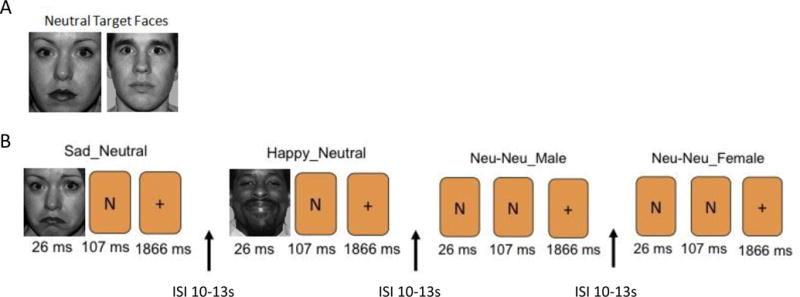
Patients with major depressive disorder completed two rtfMRI-nf sessions (18 received amygdalar rtfMRI-nf, 16 received control parietal rtfMRI-nf). One week before and following rtfMRI-nf training, participants performed tasks measuring responses to emotionally valenced stimuli including a backward-masking task, which measures the amygdalar hemodynamic response to emotional faces presented for traditionally subliminal duration and followed by a mask, and the Emotional Test Battery in which reaction times and performance accuracy are measured during tasks involving emotional faces and words.
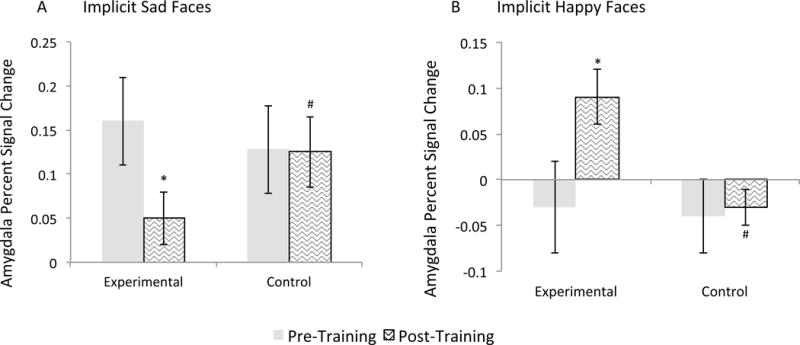
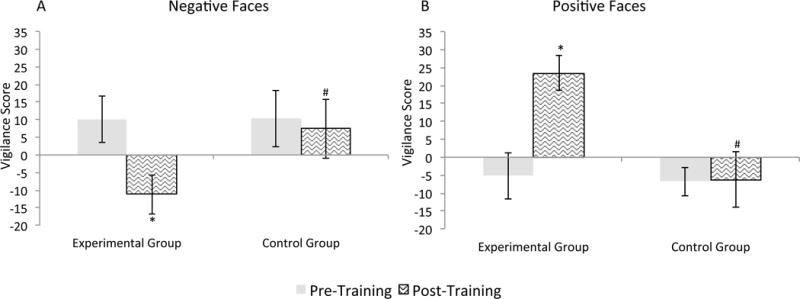
During the backward-masking task, amygdalar responses increased while viewing masked happy faces but decreased to masked sad faces in the experimental versus control group following rtfMRI-nf. During the Emotional Test Battery, reaction times decreased to identification of positive faces and during self-identification with positive words and vigilance scores increased to positive faces and decreased to negative faces during the faces dot-probe task in the experimental versus control group following rtfMRI-nf.
rtfMRI-nf training to increase the amygdalar hemodynamic response to positive memories was associated with changes in amygdalar responses to happy and sad faces and improved processing of positive stimuli during performance of the Emotional Test Battery. These results may suggest that amygdalar rtfMRI-nf training alters responses to emotional stimuli in a manner similar to antidepressant pharmacotherapy.
在接受过正向自传记忆回忆时增强杏仁核血流动力学反应的实时功能磁共振成像神经反馈(rtfMRI-nf)训练的重度抑郁症患者中,抑郁症状减轻。本研究测试了杏仁核 rtfMRI-nf 是否也会改变在各种行为和成像任务中对正性和负性刺激的情绪处理。
重度抑郁症患者完成了两次 rtfMRI-nf 训练(18 人接受杏仁核 rtfMRI-nf,16 人接受对照顶叶 rtfMRI-nf)。在 rtfMRI-nf 训练前一周和之后,参与者完成了测量对情绪刺激的反应的任务,包括一个后向掩蔽任务,该任务测量情绪面孔呈现传统上的阈下持续时间和掩蔽后杏仁核的血流动力学反应,以及情绪测试电池,在涉及情绪面孔和单词的任务中测量反应时间和绩效准确性。
在后向掩蔽任务中,实验组观看掩蔽的快乐面孔时杏仁核反应增加,但观看掩蔽的悲伤面孔时反应减少。在情绪测试电池中,实验组的反应时间在识别正性面孔和自我识别正性单词时减少,在面孔点探测任务中警觉分数在正性面孔时增加,在负性面孔时减少。
增加对正性记忆的杏仁核血流动力学反应的 rtfMRI-nf 训练与杏仁核对快乐和悲伤面孔的反应变化以及在执行情绪测试电池时改善对正性刺激的处理有关。这些结果可能表明,杏仁核 rtfMRI-nf 训练以类似于抗抑郁药药理学的方式改变对情绪刺激的反应。