Pollock James, Coffman Jon, Ho Sa V, Farid Suzanne S
Dept. of Biochemical Engineering, University College London, Gordon Street, London, WC1H 0AH, UK.
Pfizer Biotherapeutic Pharmaceutical Sciences, 1 Burtt Road, Andover, MA.
Biotechnol Prog. 2017 Jul;33(4):854-866. doi: 10.1002/btpr.2492. Epub 2017 Jun 2.
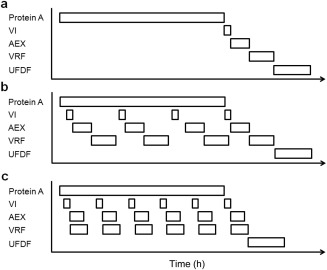
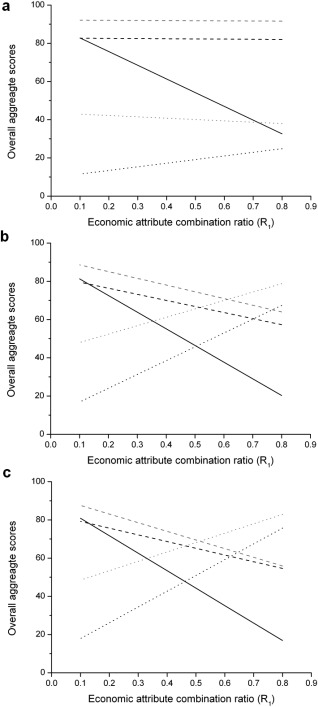
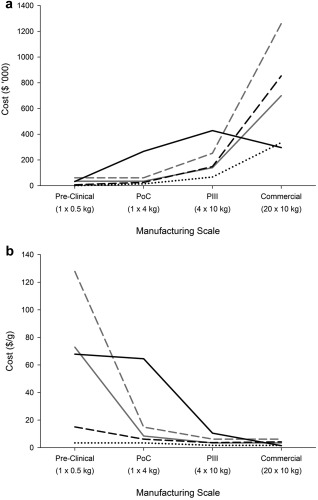
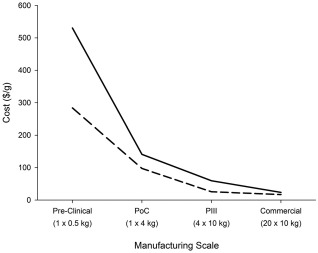
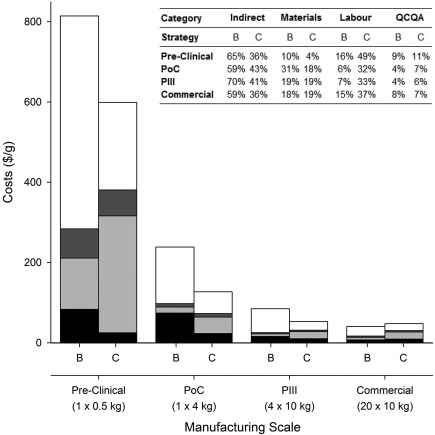
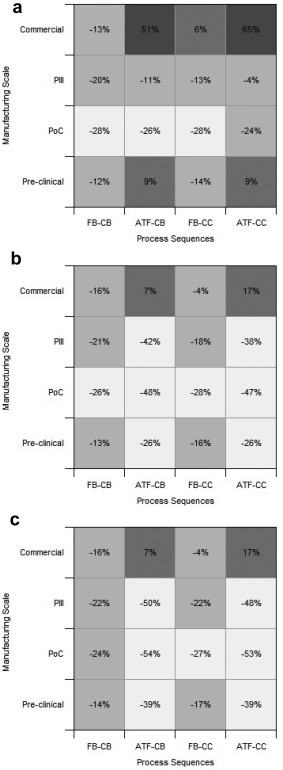
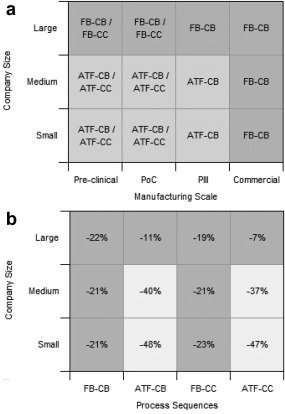
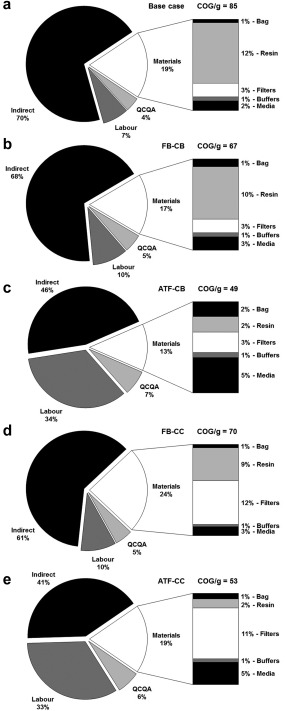
This paper presents a systems approach to evaluating the potential of integrated continuous bioprocessing for monoclonal antibody (mAb) manufacture across a product's lifecycle from preclinical to commercial manufacture. The economic, operational, and environmental feasibility of alternative continuous manufacturing strategies were evaluated holistically using a prototype UCL decisional tool that integrated process economics, discrete-event simulation, environmental impact analysis, operational risk analysis, and multiattribute decision-making. The case study focused on comparing whole bioprocesses that used either batch, continuous or a hybrid combination of batch and continuous technologies for cell culture, capture chromatography, and polishing chromatography steps. The cost of goods per gram (COG/g), E-factor, and operational risk scores of each strategy were established across a matrix of scenarios with differing combinations of clinical development phase and company portfolio size. The tool outputs predict that the optimal strategy for early phase production and small/medium-sized companies is the integrated continuous strategy (alternating tangential flow filtration (ATF) perfusion, continuous capture, continuous polishing). However, the top ranking strategy changes for commercial production and companies with large portfolios to the hybrid strategy with fed-batch culture, continuous capture and batch polishing from a COG/g perspective. The multiattribute decision-making analysis highlighted that if the operational feasibility was considered more important than the economic benefits, the hybrid strategy would be preferred for all company scales. Further considerations outside the scope of this work include the process development costs required to adopt continuous processing. © 2017 The Authors Biotechnology Progress published by Wiley Periodicals, Inc. on behalf of American Institute of Chemical Engineers Biotechnol. Prog., 33:854-866, 2017.
本文提出了一种系统方法,用于评估从临床前到商业化生产的整个产品生命周期中,集成连续生物加工生产单克隆抗体(mAb)的潜力。使用一个原型伦敦大学学院决策工具,对替代连续制造策略的经济、运营和环境可行性进行了全面评估,该工具集成了过程经济学、离散事件模拟、环境影响分析、运营风险分析和多属性决策。案例研究聚焦于比较在细胞培养、捕获色谱和精制色谱步骤中,使用分批、连续,或分批与连续技术混合组合的整个生物过程。在临床开发阶段和公司产品组合规模不同组合的一系列情景中,确定了每种策略的每克商品成本(COG/g)、E因子和运营风险得分。工具输出预测,对于早期生产和中小型公司而言,最优策略是集成连续策略(交替切向流过滤(ATF)灌注、连续捕获、连续精制)。然而,从COG/g角度来看,对于商业化生产和大型产品组合的公司,排名最高的策略变为补料分批培养、连续捕获和分批精制的混合策略。多属性决策分析强调,如果认为运营可行性比经济效益更重要,那么对于所有公司规模而言,混合策略将是首选。这项工作范围之外的进一步考虑因素包括采用连续加工所需的工艺开发成本。© 2017作者 生物技术进展 由Wiley Periodicals, Inc.代表美国化学工程师学会出版 生物技术进展,33:854 - 866,2017年。