LeBlanc Jean Guy, Chain Florian, Martín Rebeca, Bermúdez-Humarán Luis G, Courau Stéphanie, Langella Philippe
Centro de Referencia para Lactobacilos (CERELA-CONICET), San Miguel de Tucumán, Argentina.
Commensals and Probiotics-Host Interactions Laboratory, Micalis Institute, INRA, AgroParisTech, Université Paris-Saclay, 78350, Jouy-en-Josas, France.
Microb Cell Fact. 2017 May 8;16(1):79. doi: 10.1186/s12934-017-0691-z.
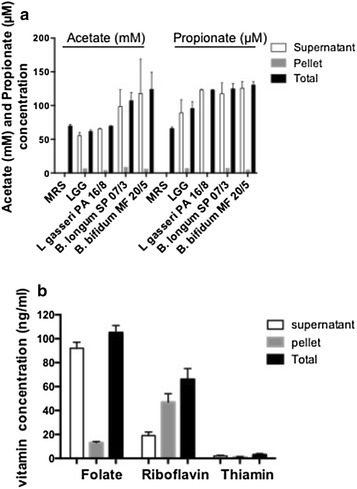
The aim of this review is to summarize the effect in host energy metabolism of the production of B group vitamins and short chain fatty acids (SCFA) by commensal, food-grade and probiotic bacteria, which are also actors of the mammalian nutrition. The mechanisms of how these microbial end products, produced by these bacterial strains, act on energy metabolism will be discussed. We will show that these vitamins and SCFA producing bacteria could be used as tools to recover energy intakes by either optimizing ATP production from foods or by the fermentation of certain fibers in the gastrointestinal tract (GIT). Original data are also presented in this work where SCFA (acetate, butyrate and propionate) and B group vitamins (riboflavin, folate and thiamine) production was determined for selected probiotic bacteria.
本综述的目的是总结共生菌、食品级细菌和益生菌产生的B族维生素和短链脂肪酸(SCFA)对宿主能量代谢的影响,这些细菌也是哺乳动物营养的参与者。将讨论这些细菌菌株产生的这些微生物终产物如何作用于能量代谢的机制。我们将表明,这些产生维生素和SCFA的细菌可作为工具,通过优化食物中的ATP产生或通过胃肠道(GIT)中某些纤维的发酵来恢复能量摄入。本文还展示了原始数据,其中测定了所选益生菌产生SCFA(乙酸、丁酸和丙酸)和B族维生素(核黄素、叶酸和硫胺素)的情况。