Xiao Yingping, Wu Choufei, Li Kaifeng, Gui Guohong, Zhang Guolong, Yang Hua
Institute of Quality and Standards for Agro-products, Zhejiang Academy of Agricultural Sciences, Hangzhou, 310021 China.
College of Life Sciences, Huzhou University, Huzhou, 313000 China.
J Anim Sci Biotechnol. 2017 May 5;8:43. doi: 10.1186/s40104-017-0170-8. eCollection 2017.
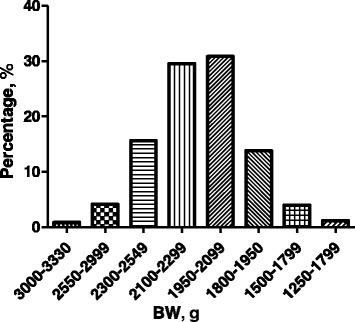
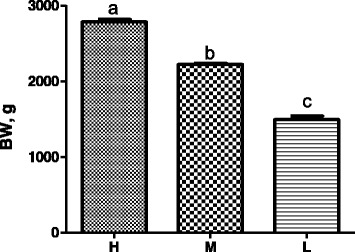
The growth rate often varies among individual broilers of the same breed under a common management condition. To investigate whether a variation in the growth rate is associated with a difference in hormone levels and myogenic gene expression profile in broilers, a feeding trial was conducted with 10,000 newly hatched Ross 308 chicks in a commercial production facility under standard management. At 38 d of age, 30 fast-, 30 medium-, and 30 slow-growing broilers were selected among 600 healthy male individuals. The levels of insulin-like growth factor-1 (IGF-1), triiodothyronine (T3), thyroxine (T4), and growth hormone in the serum or breast muscle were assayed by ELISA or RIA kits, and the expression levels of several representative pro- and anti-myogenic genes in the breast muscle were also measured by real-time PCR.
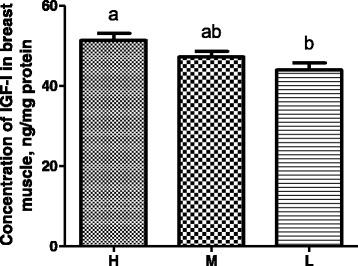
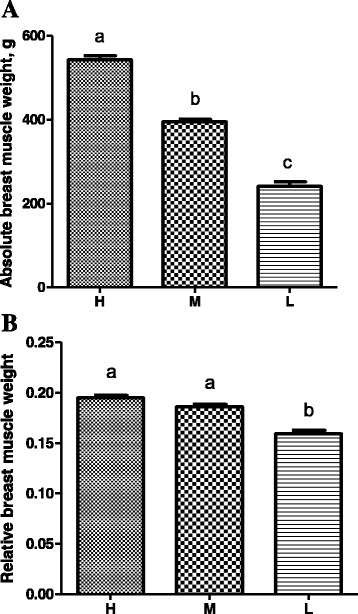
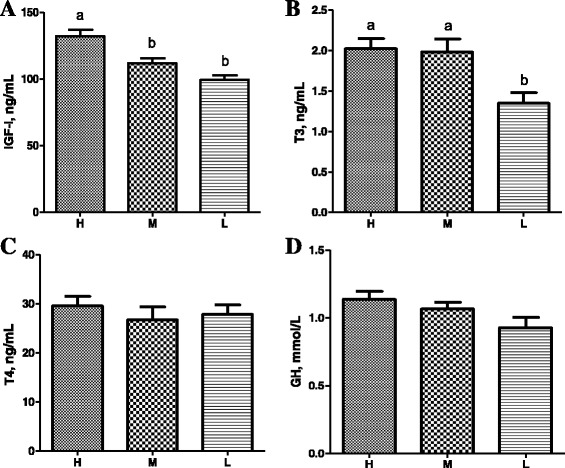
Results showed that both absolute and relative weights of the breast muscle were in linear positive correlations with the body weight of broilers ( < 0.001). Fast-growing broilers had higher concentrations of IGF-1 than slow-growing broilers ( < 0.05) in both the serum and breast muscle. The serum concentration of T3 was significantly higher in fast-growing birds than in slow-growing birds ( < 0.05). However, no difference was observed in growth hormone or T4 concentration among three groups of birds. Additionally, a decreased expression of an anti-myogenic gene () and increased expressions of pro-myogenic genes such as , and and were observed in fast-growing broilers ( < 0.05), relative to slow-growing broilers.
Collectively, these findings suggested that the growth rate is linked to the hormone and myogenic gene expression levels in broiler chickens. Some of these parameters such as serum concentrations of IGF-1 and T3 could be employed to breed for enhanced growth.
在相同管理条件下,同一品种的个体肉鸡生长速度往往存在差异。为了研究肉鸡生长速度的差异是否与激素水平和生肌基因表达谱的差异有关,在一家商业生产设施中,按照标准管理方式,对10000只新孵化的罗斯308雏鸡进行了饲养试验。在38日龄时,从600只健康雄性个体中挑选出30只生长快、30只生长中等和30只生长慢的肉鸡。采用ELISA或RIA试剂盒检测血清或胸肌中胰岛素样生长因子-1(IGF-1)、三碘甲状腺原氨酸(T3)、甲状腺素(T4)和生长激素的水平,并通过实时PCR检测胸肌中几种代表性的促生肌基因和抗生肌基因的表达水平。
结果表明,胸肌的绝对重量和相对重量均与肉鸡体重呈线性正相关(<0.001)。在血清和胸肌中,生长快的肉鸡IGF-1浓度均高于生长慢的肉鸡(<0.05)。生长快的鸡血清T3浓度显著高于生长慢的鸡(<0.05)。然而,三组鸡的生长激素或T4浓度未观察到差异。此外,相对于生长慢的肉鸡,生长快的肉鸡中抗生肌基因()的表达降低,而促生肌基因如、和的表达增加(<0.05)。
总体而言,这些发现表明肉鸡的生长速度与激素和生肌基因表达水平有关。其中一些参数,如血清IGF-1和T3浓度,可用于选育生长性能更好的品种。