Luo Jing, Tian Lingling, Luo Lei, Yi Hong, Wang Fahui
Hubei Provincial Key Laboratory for Geographical Process Analysis and Simulation, College of Urban and Environmental Science, Central China Normal University, Wuhan, Hubei 430079, China.
Department of Geography & Anthropology, Louisiana State University, Baton Rouge, LA 70808, USA.
Biomed Res Int. 2017;2017:2094654. doi: 10.1155/2017/2094654. Epub 2017 Apr 18.
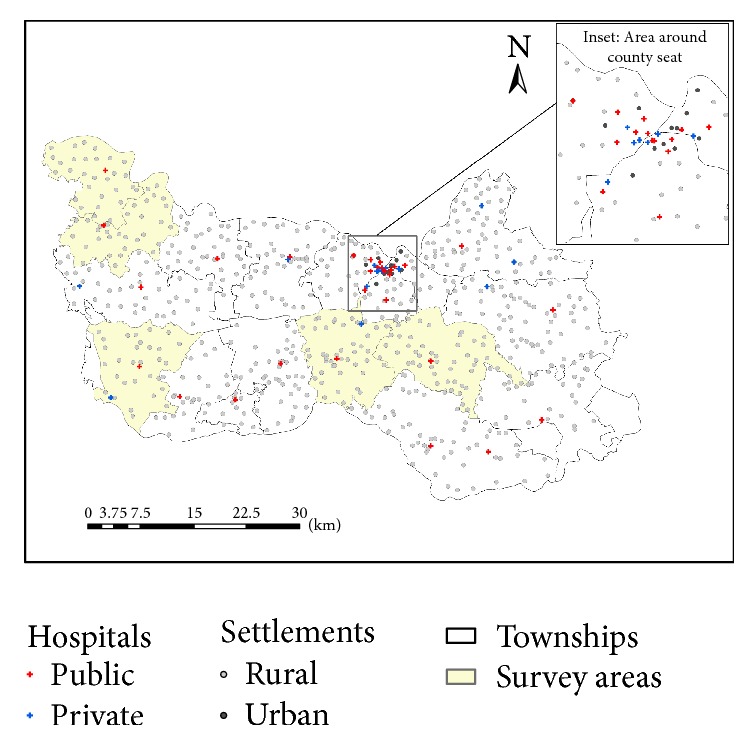
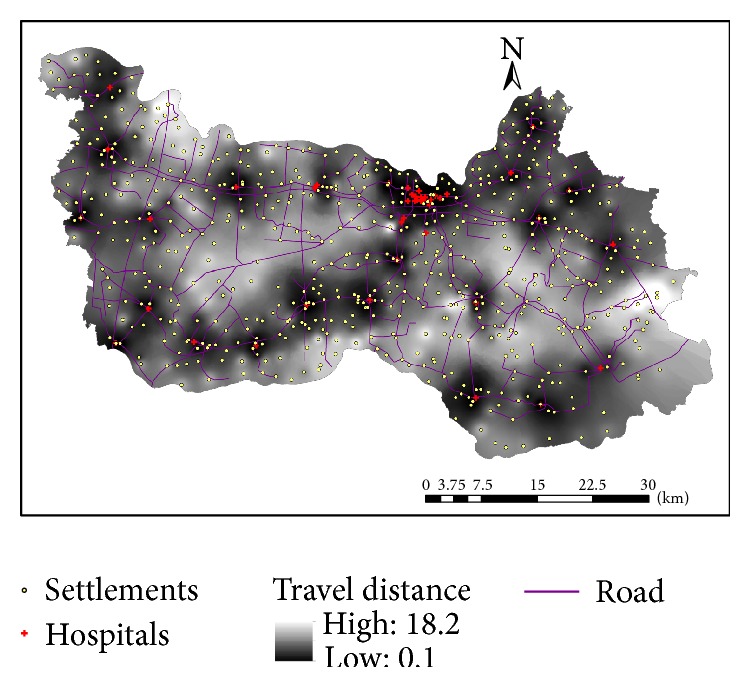
A recent advancement in location-allocation modeling formulates a two-step approach to a new problem of minimizing disparity of spatial accessibility. Our field work in a health care planning project in a rural county in China indicated that residents valued distance or travel time from the nearest hospital foremost and then considered quality of care including less waiting time as a secondary desirability. Based on the case study, this paper further clarifies the sequential decision-making approach, termed "two-step optimization for spatial accessibility improvement (2SO4SAI)." The first step is to find the best locations to site new facilities by emphasizing accessibility as proximity to the nearest facilities with several alternative objectives under consideration. The second step adjusts the capacities of facilities for minimal inequality in accessibility, where the measure of accessibility accounts for the match ratio of supply and demand and complex spatial interaction between them. The case study illustrates how the two-step optimization method improves both aspects of spatial accessibility for health care access in rural China.
区位配置建模的一项最新进展针对最小化空间可达性差异这一新问题制定了一种两步法。我们在中国一个乡村县的医疗保健规划项目中的实地工作表明,居民最看重到最近医院的距离或出行时间,其次才考虑包括等待时间较短在内的医疗质量。基于该案例研究,本文进一步阐明了这种顺序决策方法,即“改善空间可达性的两步优化法(2SO4SAI)”。第一步是通过强调可达性(即靠近最近设施)并考虑多个替代目标来找到新设施的最佳选址。第二步是调整设施容量以实现可达性方面的最小不平等,其中可达性的衡量考虑了供需匹配率以及它们之间复杂的空间相互作用。该案例研究说明了两步优化方法如何改善中国农村地区医疗保健可达性在空间可达性的两个方面。