Department of Cell Biology and Genetics, Environment and Genes Related to Diseases Key Laboratory of Education Ministry, School of Basic Medical Sciences, Xi'an Jiaotong University Health Science Center, Xi'an 710061, P. R. China.
Xi'an Child's Hospital of Medical College of Xi'an Jiaotong University, Xi'an Child's Hospital, Xi'an 710002, P. R. China.
Sci Rep. 2017 May 9;7:46041. doi: 10.1038/srep46041.
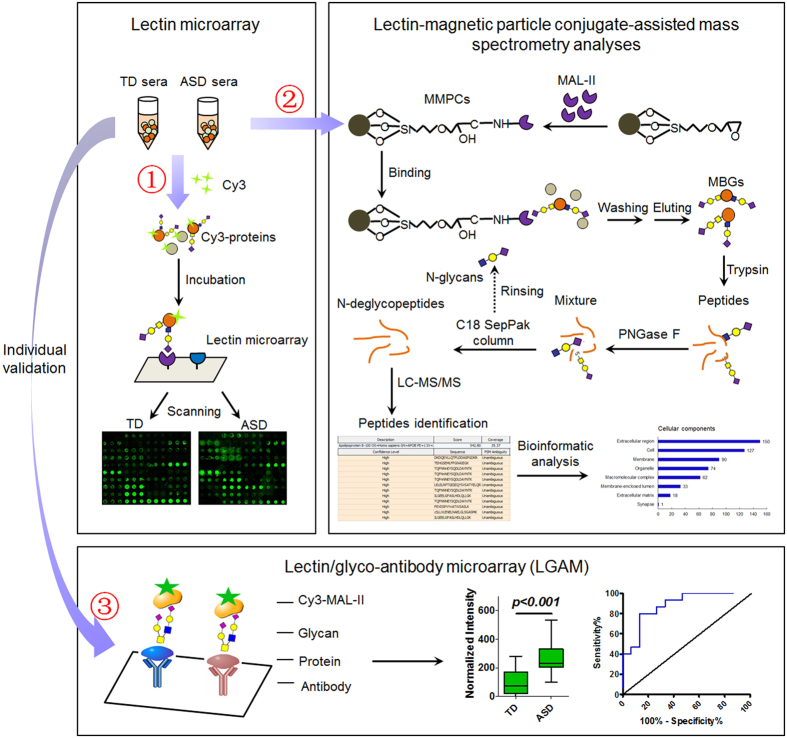
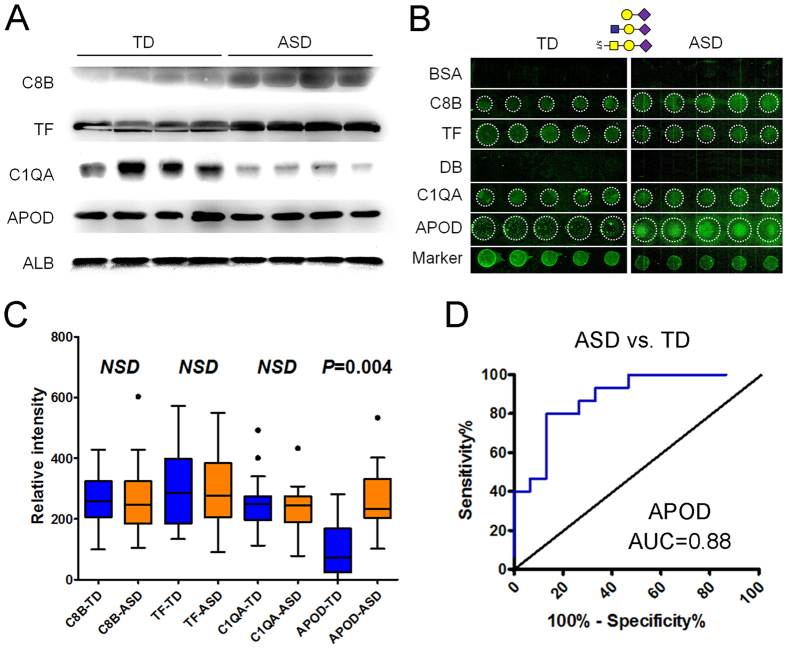
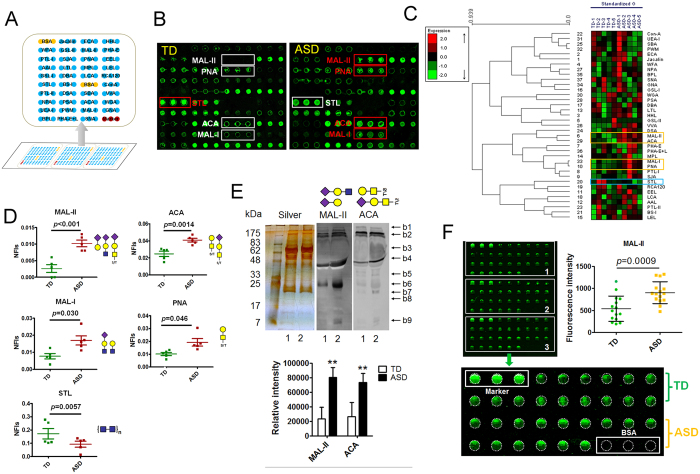
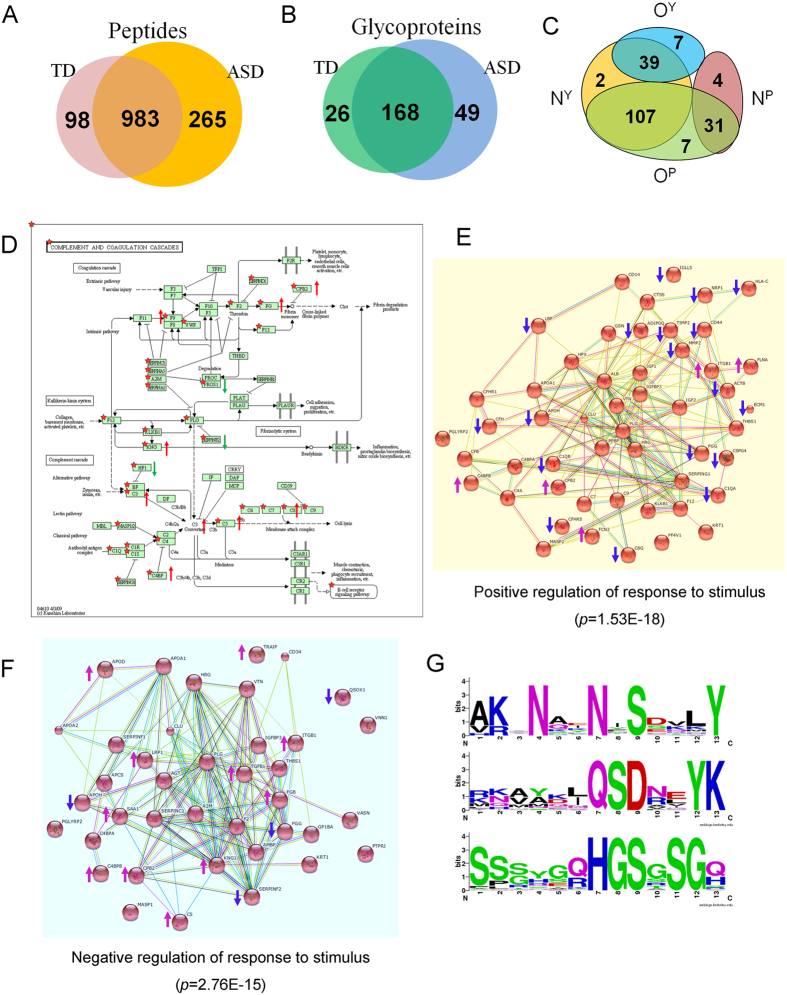
The pathophysiology of autistic spectrum disorder (ASD) is not fully understood and there are no diagnostic or predictive biomarkers. Glycosylation modified as many as 70% of all human proteins can sensitively reflect various pathological changes. However, little is known about the alterations of glycosylation and glycoproteins in ASD. In this study, serum glycopattern and the maackia amurensis lectin-II binding glycoproteins (MBGs) in 65 children with ASD and 65 age-matched typically developing (TD) children were compared by using lectin microarrays and lectin-magnetic particle conjugate-assisted LC-MS/MS analyses. Expression of Siaα2-3 Gal/GalNAc was significantly increased in pooled (fold change = 3.33, p < 0.001) and individual (p = 0.009) serum samples from ASD versus TD children. A total of 194 and 217 MGBs were identified from TD and ASD sera respectively, of which 74 proteins were specially identified or up-regulated in ASD. Bioinformatic analysis revealed abnormal complement cascade and aberrant regulation of response-to-stimulus that might be novel makers or markers for ASD. Moreover, increase of APOD α2-3 sialoglycosylation could sensitively and specifically distinguish ASD samples from TD samples (AUC is 0.88). In conclusion, alteration of MBGs expression and their sialoglycosylation may serve as potential biomarkers for diagnosis of ASD, and provide useful information for investigations into the pathogenesis of ASD.
自闭症谱系障碍(ASD)的病理生理学尚未完全阐明,也没有诊断或预测生物标志物。糖基化修饰了多达 70%的人类蛋白质,可以敏感地反映各种病理变化。然而,关于 ASD 中糖基化和糖蛋白的改变知之甚少。在这项研究中,使用凝集素微阵列和凝集素-磁性粒子缀合物辅助 LC-MS/MS 分析,比较了 65 名 ASD 儿童和 65 名年龄匹配的典型发育(TD)儿童的血清糖谱和马卡西亚豌豆凝集素-II 结合糖蛋白(MBGs)。与 TD 儿童相比,ASD 儿童的混合(fold change = 3.33,p < 0.001)和个体(p = 0.009)血清样本中 Siaα2-3 Gal/GalNAc 的表达显著增加。从 TD 和 ASD 血清中分别鉴定出 194 种和 217 种 MGBs,其中 74 种蛋白质在 ASD 中被特别鉴定或上调。生物信息学分析显示,补体级联和对刺激的反应异常调节可能是 ASD 的新标志物或标志物。此外,APODα2-3 唾液酸化糖基化的增加可以灵敏和特异地将 ASD 样本与 TD 样本区分开(AUC 为 0.88)。总之,MBGs 表达及其唾液酸化糖基化的改变可能作为 ASD 诊断的潜在生物标志物,并为 ASD 发病机制的研究提供有用信息。