School of Physics &Astronomy, University of Manchester, Manchester M13 9PL, UK.
National Graphene Institute, University of Manchester, Manchester M13 9PL, UK.
Nat Commun. 2017 May 9;8:15215. doi: 10.1038/ncomms15215.
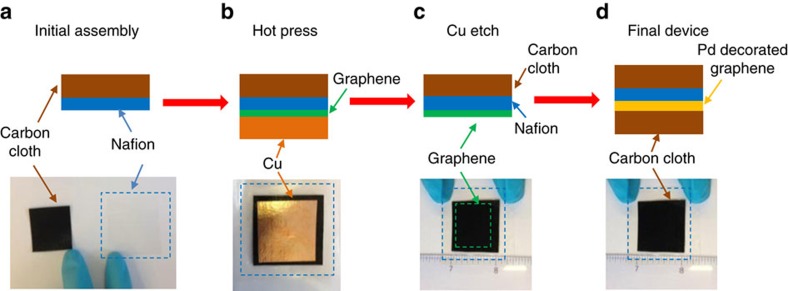
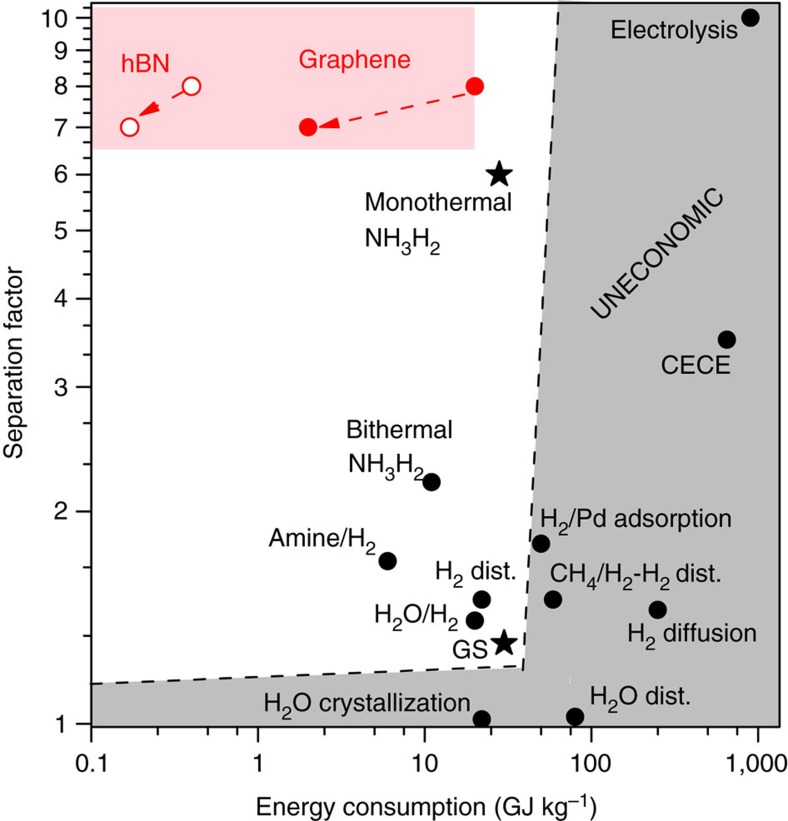
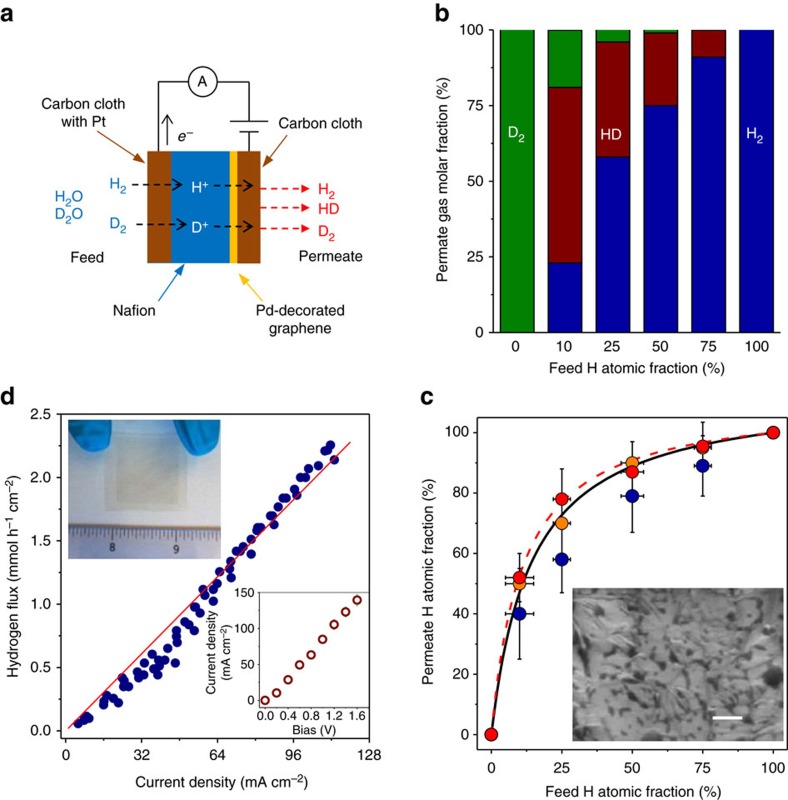
Thousands of tons of isotopic mixtures are processed annually for heavy-water production and tritium decontamination. The existing technologies remain extremely energy intensive and require large capital investments. New approaches are needed to reduce the industry's footprint. Recently, micrometre-size crystals of graphene are shown to act as efficient sieves for hydrogen isotopes pumped through graphene electrochemically. Here we report a fully-scalable approach, using graphene obtained by chemical vapour deposition, which allows a proton-deuteron separation factor of around 8, despite cracks and imperfections. The energy consumption is projected to be orders of magnitude smaller with respect to existing technologies. A membrane based on 30 m of graphene, a readily accessible amount, could provide a heavy-water output comparable to that of modern plants. Even higher efficiency is expected for tritium separation. With no fundamental obstacles for scaling up, the technology's simplicity, efficiency and green credentials call for consideration by the nuclear and related industries.
每年都有数千吨的同位素混合物被加工用于重水生产和氚去污。现有的技术仍然极其耗能,需要大量的资本投资。需要新的方法来减少该行业的足迹。最近,研究表明,微米级尺寸的石墨烯晶体在电化学泵送氢同位素时可以作为高效的筛子。在这里,我们报告了一种完全可扩展的方法,使用化学气相沉积得到的石墨烯,尽管存在裂缝和缺陷,但允许质子-氘分离因子约为 8。预计与现有技术相比,能耗要小几个数量级。基于 30 米石墨烯的膜(一种易于获得的量)可以提供与现代工厂相当的重水产量。对于氚的分离,预计效率更高。由于没有扩大规模的根本障碍,该技术的简单性、效率和环保资质呼吁核工业和相关行业考虑采用。