Coker Eric, Gunier Robert, Bradman Asa, Harley Kim, Kogut Katherine, Molitor John, Eskenazi Brenda
School of Public Health, University of California, Berkeley, CA 94703, USA.
College of Public Health and Human Sciences, Oregon State University, Corvallis, OR 97331, USA.
Int J Environ Res Public Health. 2017 May 9;14(5):506. doi: 10.3390/ijerph14050506.
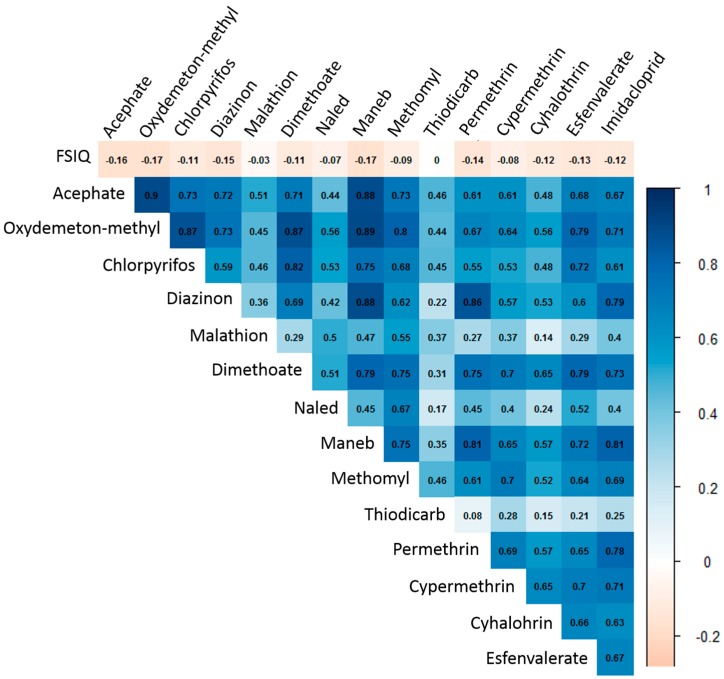
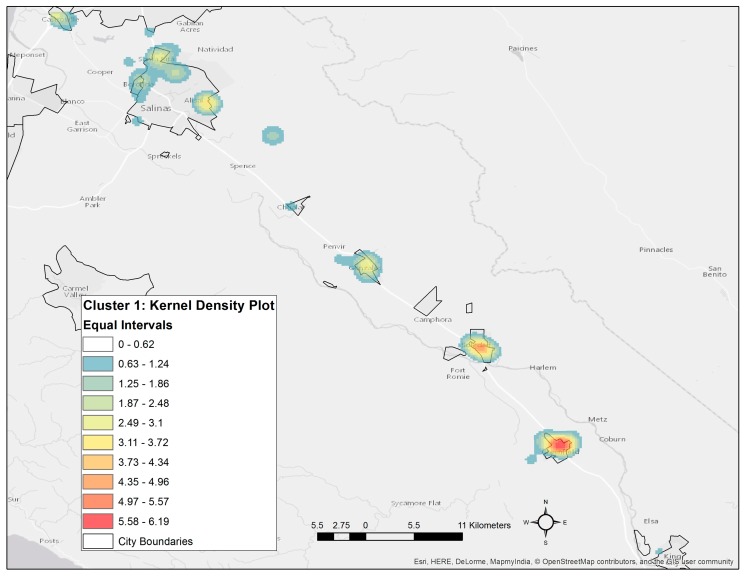
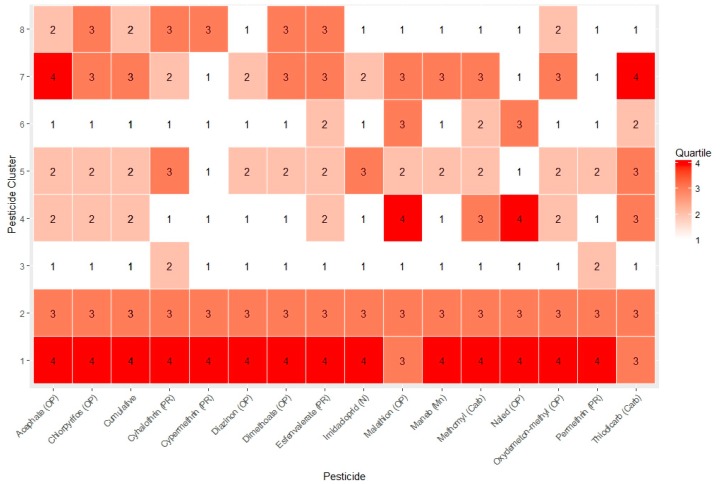
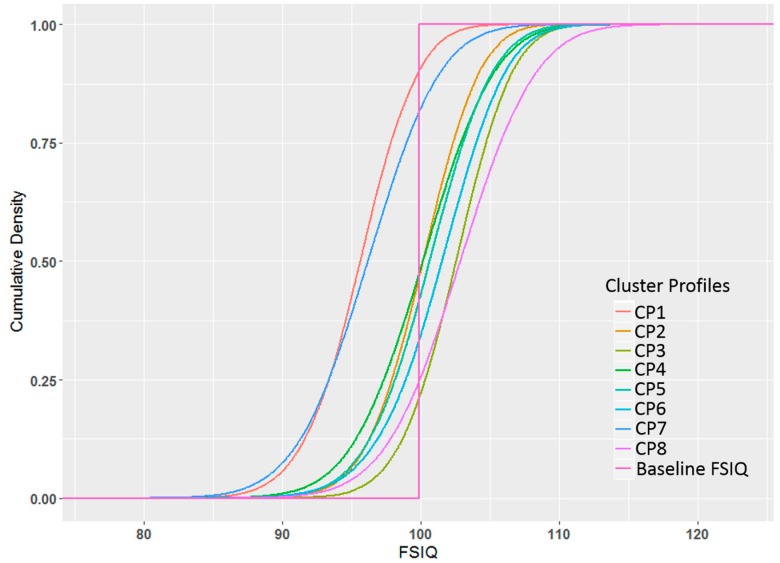
We previously showed that potential prenatal exposure to agricultural pesticides was associated with adverse neurodevelopmental outcomes in children, yet the effects of joint exposure to multiple pesticides is poorly understood. In this paper, we investigate associations between the joint distribution of agricultural use patterns of multiple pesticides (denoted as "pesticide profiles") applied near maternal residences during pregnancy and Full-Scale Intelligence Quotient (FSIQ) at 7 years of age. Among a cohort of children residing in California's Salinas Valley, we used Pesticide Use Report (PUR) data to characterize potential exposure from use within 1 km of maternal residences during pregnancy for 15 potentially neurotoxic pesticides from five different chemical classes. We used Bayesian profile regression (BPR) to examine associations between clustered pesticide profiles and deficits in childhood FSIQ. BPR identified eight distinct clusters of prenatal pesticide profiles. Two of the pesticide profile clusters exhibited some of the highest cumulative pesticide use levels and were associated with deficits in adjusted FSIQ of -6.9 (95% credible interval: -11.3, -2.2) and -6.4 (95% credible interval: -13.1, 0.49), respectively, when compared with the pesticide profile cluster that showed the lowest level of pesticides use. Although maternal residence during pregnancy near high agricultural use of multiple neurotoxic pesticides was associated with FSIQ deficit, the magnitude of the associations showed potential for sub-additive effects. Epidemiologic analysis of pesticides and their potential health effects can benefit from a multi-pollutant approach to analysis.
我们之前的研究表明,儿童在产前可能接触农业杀虫剂与不良神经发育结局有关,但对多种杀虫剂联合接触的影响却知之甚少。在本文中,我们调查了孕期母亲住所附近施用的多种杀虫剂的农业使用模式(称为“农药谱”)的联合分布与儿童7岁时的全量表智商(FSIQ)之间的关联。在居住于加利福尼亚州萨利纳斯山谷的一组儿童中,我们使用农药使用报告(PUR)数据来表征孕期母亲住所1公里范围内使用的来自五个不同化学类别的15种潜在神经毒性杀虫剂的潜在接触情况。我们使用贝叶斯谱回归(BPR)来检验聚类农药谱与儿童FSIQ缺陷之间的关联。BPR识别出八种不同的产前农药谱聚类。其中两个农药谱聚类表现出一些最高的累积农药使用水平,与使用农药水平最低的农药谱聚类相比,调整后的FSIQ分别降低了-6.9(95%可信区间:-11.3,-2.2)和-6.4(95%可信区间:-13.1,0.49)。尽管孕期母亲住所靠近多种神经毒性农药的高农业使用地区与FSIQ缺陷有关,但关联的程度显示出存在亚相加效应的可能性。对杀虫剂及其潜在健康影响的流行病学分析可受益于多污染物分析方法。