Kaufman Jessica, Ames Heather, Bosch-Capblanch Xavier, Cartier Yuri, Cliff Julie, Glenton Claire, Lewin Simon, Muloliwa Artur Manuel, Oku Afiong, Oyo-Ita Angela, Rada Gabriel, Hill Sophie
School of Psychology and Public Health, La Trobe University, Melbourne, Australia.
Norwegian Institute of Public Health, Oslo, Norway.
BMC Public Health. 2017 May 10;17(1):423. doi: 10.1186/s12889-017-4320-x.
Communication can be used to generate demand for vaccination or address vaccine hesitancy, and is crucial to successful childhood vaccination programmes. Research efforts have primarily focused on communication for routine vaccination. However, vaccination campaigns, particularly in low- or middle-income countries (LMICs), also use communication in diverse ways. Without a comprehensive framework integrating communication interventions from routine and campaign contexts, it is not possible to conceptualise the full range of possible vaccination communication interventions. Therefore, vaccine programme managers may be unaware of potential communication options and researchers may not focus on building evidence for interventions used in practice. In this paper, we broaden the scope of our existing taxonomy of communication interventions for routine vaccination to include communication used in campaigns, and integrate these into a comprehensive taxonomy of vaccination communication interventions.
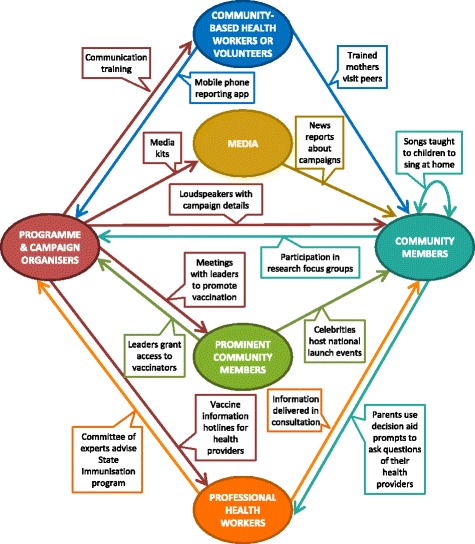
Building on our taxonomy of communication for routine vaccination, we identified communication interventions used in vaccination campaigns through a targeted literature search; observation of vaccination activities in Cameroon, Mozambique and Nigeria; and stakeholder consultations. We added these interventions to descriptions of routine vaccination communication and categorised the interventions according to their intended purposes, building from an earlier taxonomy of communication related to routine vaccination.
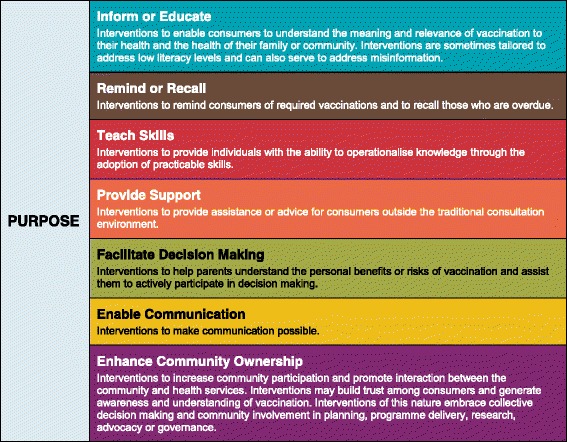
The comprehensive taxonomy groups communication used in campaigns and routine childhood vaccination into seven purpose categories: 'Inform or Educate'; 'Remind or Recall'; 'Enhance Community Ownership'; 'Teach Skills'; 'Provide Support'; 'Facilitate Decision Making' and 'Enable Communication'. Consultations with LMIC stakeholders and experts informed the taxonomy's definitions and structure and established its potential uses.
This taxonomy provides a standardised way to think and speak about vaccination communication. It is categorised by purpose to help conceptualise communication interventions as potential solutions to address needs or problems. It can be utilised by programme planners, implementers, researchers and funders to see the range of communication interventions used in practice, facilitate evidence synthesis and identify evidence gaps.
沟通可用于激发对疫苗接种的需求或解决疫苗犹豫问题,对成功实施儿童疫苗接种计划至关重要。研究工作主要集中在常规疫苗接种的沟通方面。然而,疫苗接种运动,尤其是在低收入或中等收入国家(LMICs),也以多种方式运用沟通手段。如果没有一个整合常规和运动背景下沟通干预措施的综合框架,就无法全面构想所有可能的疫苗接种沟通干预措施。因此,疫苗计划管理者可能意识不到潜在的沟通选项,而研究人员可能也不会专注于为实际应用的干预措施积累证据。在本文中,我们拓宽了现有常规疫苗接种沟通干预分类法的范围,将运动中使用的沟通纳入其中,并将这些内容整合为一个全面的疫苗接种沟通干预分类法。
基于我们的常规疫苗接种沟通分类法,我们通过有针对性的文献检索、对喀麦隆、莫桑比克和尼日利亚疫苗接种活动的观察以及利益相关者咨询,确定了疫苗接种运动中使用的沟通干预措施。我们将这些干预措施添加到常规疫苗接种沟通的描述中,并根据其预期目的对干预措施进行分类,这是在早期常规疫苗接种相关沟通分类法的基础上进行的。
这个综合分类法将运动和儿童常规疫苗接种中使用的沟通分为七个目的类别:“告知或教育”;“提醒或唤起记忆”;“增强社区自主性”;“传授技能”;“提供支持”;“促进决策”和“实现沟通”。与低收入和中等收入国家利益相关者及专家的磋商为分类法的定义和结构提供了信息,并确定了其潜在用途。
这个分类法提供了一种标准化的方式来思考和谈论疫苗接种沟通。它按目的进行分类,有助于将沟通干预措施概念化为满足需求或解决问题的潜在解决方案。计划制定者、实施者、研究人员和资助者可以利用它来了解实际使用的沟通干预措施的范围,促进证据综合,并识别证据差距。