Frohwitter Gesche, Buerger Horst, Korsching Eberhard, van Diest Paul J, Kleinheinz Johannes, Fillies Thomas
Institute of Pathology, Husener Str. 46a, 33098, Paderborn, Höxter, Germany.
Institute of Pathology, University of Utrecht, Utrecht, The Netherlands.
Head Face Med. 2017 May 10;13(1):6. doi: 10.1186/s13005-017-0138-0.
Squamous cell carcinomas (SCCs) are the most prevalent malignant tumours within the head and neck. Evidence exists that distinct genes are differentially regulated in SCCs of the oral cavity compared to other head and neck regions. Given this background, the aim of this study was to investigate whether such tumour site-specific gene expression can also be observed in different localizations within the oral cavity.
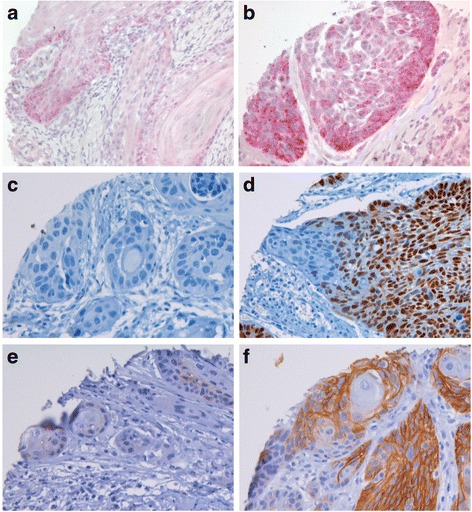
Using tissue microarrays (TMAs), we investigated 76 SCCs of the floor of the mouth, 49 SCCs of the tongue and 68 SCCs of other anatomic regions within the oral cavity. The expression of 17 genes involved in cell cycle and growth control (p16, p21, p27, p53, cyclin D1, EGFR, c-kit, bcl-6), cell adhesion (alpha-, beta-, and gamma-catenin), and apoptosis/stress response genes (Hif-1-alpha, Glut 1, CA IX, caspase, hsp70, XIAP) were investigated by means of immunohistochemistry. The data were subjected to chi, interdependency and Kaplan-Meier analysis.
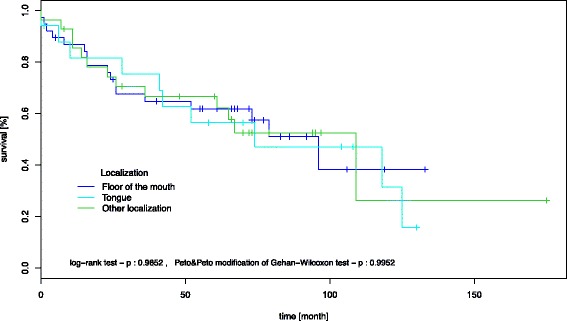
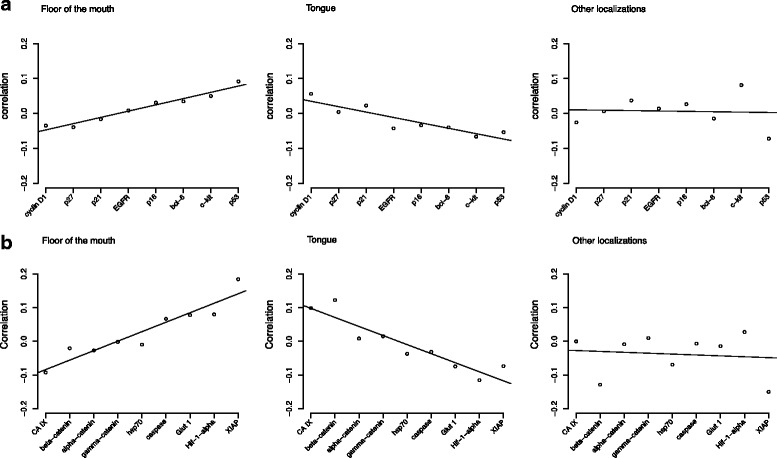
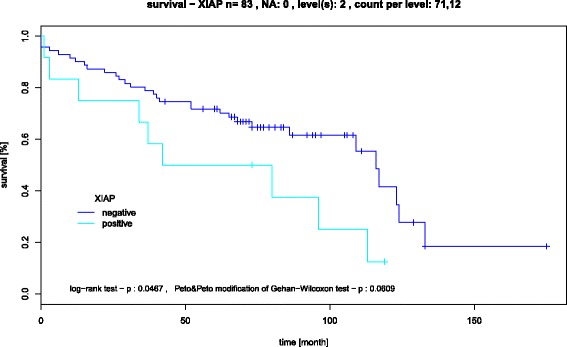
Our study suggests a remote difference in the site-specific gene expression patterns of oral cancer. X-linked inhibitor of apoptosis (XIAP) showed a significantly higher expression (p <0.05) in SCCs of the floor of the mouth compared to SCCs of the tongue and other locations within the oral cavity. The increased XIAP expression was further associated with significantly decreased overall survival in all cases of SCCs of the oral cavity (p <0.05). Expression levels of p53, CA IX, beta-catenin, Hif-1-alpha, and c-kit were also observed to be inversely related between SCCs of the floor of the mouth and those of the tongue respectively, although these differences did not reach statistical significance. Overall and event-free survival did not differ in patients with T1/T2/N0 SCCs according to tumour localization.
In summary, the protein expression patterns of SCCs of the oral cavity suggest the existence of a molecular and morphological spectrum of SCCs in the oral cavity. In particular the expression pattern of XIAP indicates distinct gene expression patterns between carcinomas of the floor of the mouth and oral tongue cancer. Further studies are needed to identify possible tumour site-specific factors that influence patient prognosis and management.
鳞状细胞癌(SCC)是头颈部最常见的恶性肿瘤。有证据表明,与头颈部其他区域相比,口腔鳞状细胞癌中不同基因的调控存在差异。在此背景下,本研究旨在探讨在口腔内的不同部位是否也能观察到这种肿瘤部位特异性基因表达。
我们使用组织微阵列(TMA)对76例口腔底部鳞状细胞癌、49例舌鳞状细胞癌以及口腔内其他解剖区域的68例鳞状细胞癌进行了研究。通过免疫组织化学方法研究了17个参与细胞周期和生长调控(p16、p21、p27、p53、细胞周期蛋白D1、表皮生长因子受体、c-kit、bcl-6)、细胞黏附(α-、β-和γ-连环蛋白)以及凋亡/应激反应基因(缺氧诱导因子-1α、葡萄糖转运蛋白1、碳酸酐酶IX、半胱天冬酶、热休克蛋白70、X连锁凋亡抑制蛋白)的表达。对数据进行卡方检验、相关性分析和Kaplan-Meier分析。
我们的研究表明口腔癌在部位特异性基因表达模式上存在显著差异。与舌部及口腔内其他部位的鳞状细胞癌相比,X连锁凋亡抑制蛋白(XIAP)在口腔底部鳞状细胞癌中的表达显著更高(p <0.05)。XIAP表达增加还与口腔鳞状细胞癌所有病例的总生存率显著降低相关(p <0.05)。虽然这些差异未达到统计学显著性,但也观察到口腔底部鳞状细胞癌和舌部鳞状细胞癌中p53、碳酸酐酶IX、β-连环蛋白、缺氧诱导因子-1α和c-kit的表达水平分别呈负相关。根据肿瘤定位,T1/T2/N0鳞状细胞癌患者的总生存率和无事件生存率无差异。
总之,口腔鳞状细胞癌的蛋白质表达模式表明口腔鳞状细胞癌存在分子和形态学谱。特别是XIAP的表达模式表明口腔底部癌和口腔舌癌之间存在不同的基因表达模式。需要进一步研究以确定可能影响患者预后和治疗的肿瘤部位特异性因素。