Eloranta Riikka, Vilén Suvi-Tuuli, Keinänen Arvi, Salo Tuula, Qannam Ahmed, Bello Ibrahim O, Snäll Johanna
Department of Oral and Maxillofacial Diseases, Clinicum, Faculty of Medicine, University of Helsinki, Helsinki University Hospital, Helsinki, Finland.
Department of Oral and Maxillofacial Diseases, Kymenlaakso Central Hospital Kotka, Kotka, Finland.
Tob Induc Dis. 2024 Jun 18;22. doi: 10.18332/tid/189303. eCollection 2024.
The underlying factors of oral squamous cell cancers (OSCC) have been elucidated, but studies have focused little on etiological differences in affected oral cavity sites. The aim of this retrospective study was to clarify the role of carcinogen exposure in OSCC of different oral cavity areas.
A cross-sectional study of patients with primary OSCC was conducted retrospectively, based on patient records from Helsinki University Hospital, Finland, between January 2016 and December 2020. The patients' self-reported history of tobacco smoking and alcohol use was explained by tumor site, age, sex, tumor size, and lymph node status in a logistic regression model. The information on smoking and alcohol use was compiled from a patient background form.
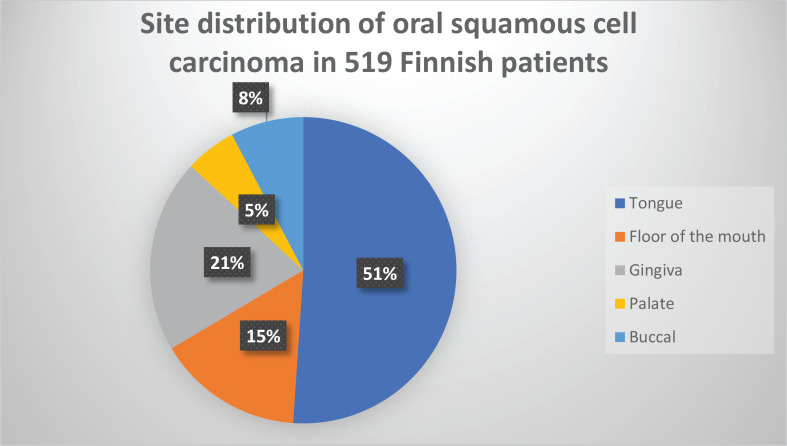
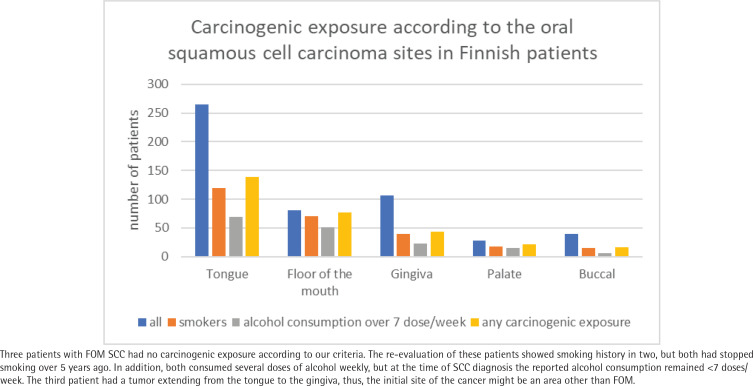
In 519 patients, tumors occurred most often in the tongue (51%), gingiva (21%), or floor of the mouth (FOM; 15%). FOM had 26-fold greater odds for a history of smoking and alcohol use than other tumor sites (OR=25.78; 95% CI: 8.02-82.95; p<0.001). Gingival and buccal sites were associated significantly less with smoking and alcohol use (OR=0.43, 95% CI: 0.28-0.67; p<0.001 and OR=0.47; 95% CI: 0.25-0.92; p<0.026, respectively). Patients of older age were less likely to have a history of smoking and alcohol use (AOR=0.95; 95% CI: 0.94-0.97; p<0.001) than younger patients. Tumor size (T3-4) and FOM increased the odds for history of smoking and alcohol use (AOR=1.73; 95% CI: 1.15-2.60; p=0.009 and AOR=26.15; 95% CI: 8.01-84.84; p<0.001, respectively).
OSCC of oral cavity sites has notable differences in etiology. FOM seems to be related almost exclusively to conventional smoking and heavy alcohol use.
口腔鳞状细胞癌(OSCC)的潜在因素已得到阐明,但研究很少关注受影响口腔部位的病因差异。这项回顾性研究的目的是阐明致癌物暴露在不同口腔区域OSCC中的作用。
基于芬兰赫尔辛基大学医院2016年1月至2020年12月的患者记录,对原发性OSCC患者进行了回顾性横断面研究。在逻辑回归模型中,根据肿瘤部位、年龄、性别、肿瘤大小和淋巴结状态对患者自我报告的吸烟和饮酒史进行了解释。吸烟和饮酒信息来自患者背景表格。
在519例患者中,肿瘤最常发生在舌部(51%)、牙龈(21%)或口底(FOM;15%)。与其他肿瘤部位相比,FOM有吸烟和饮酒史的几率高26倍(OR=25.78;95%CI:8.02-82.95;p<0.001)。牙龈和颊部部位与吸烟和饮酒的相关性明显较低(分别为OR=0.43,95%CI:0.28-0.67;p<0.001和OR=0.47;95%CI:0.25-0.92;p<0.026)。老年患者有吸烟和饮酒史的可能性低于年轻患者(AOR=0.95;95%CI:0.94-0.97;p<0.001)。肿瘤大小(T3-4)和FOM增加了吸烟和饮酒史的几率(分别为AOR=1.73;95%CI:1.15-2.60;p=0.009和AOR=26.15;95%CI:8.01-84.84;p<0.001)。
口腔部位的OSCC在病因上有显著差异。FOM似乎几乎只与传统吸烟和大量饮酒有关。