Rim Chai Hong, Ahn Sung-Ja, Kim Jin Hee, Yoon Won Sup, Chun Mison, Yang Dae Sik, Lee Jong-Hoon, Kim Kyubo, Kong Moonkyoo, Kim Suzy, Kim Juree, Park Kyung Ran, Shin Young-Joo, Ma Sun Young, Jeong Bae-Kwon, Kim Su Ssan, Kim Yong Bae, Lee Dong Soo, Cha Jaehyung
Department of Radiation Oncology, Yonsei Cancer Center, Yonsei University College of Medicine, Seoul, Republic of Korea.
Department of Radiation Oncology, Chonnam National Univiersity Hwasun Hospital, Hwasun, Jeollanam-do, Republic of Korea.
Health Qual Life Outcomes. 2017 May 10;15(1):96. doi: 10.1186/s12955-017-0673-1.
Quality of life (QoL) has become a major concern as the survival time of breast cancer increases. We investigated the changes in QoL through comprehensive categorical analysis, for the first three years after breast cancer treatment including radiotherapy.
A total of 1156 patients were enrolled from 17 institutions. All survivors were grouped according to a surveillance period of 9-15 months (first year), 21-27 months (second year), and 33-39 months (third year) from the end of radiotherapy. The 5-dimensional questionnaire by the EuroQol group (EQ-5D) and the EORTC Quality of Life Questionnaire; breast cancer specific module (QLQ-BR23) were checked by self-administrated method.
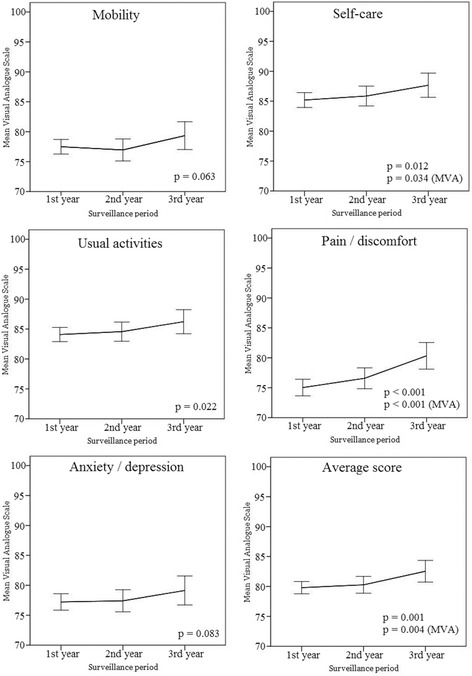
First, second and third year groups comprised 51.0, 28.9, and 21.0%. In EQ-5D-3 L (3-Likert scale) analysis, pain/discomfort and anxiety/depression categories showed lower QoL. In multivariate analyses of EQ-5D-VAS (visual-analogue scale), categories of pain/discomfort and self-care were improved with time; axillary dissection was a significant clinical factor deteriorates pain/discomfort, self-care and usual activities. In QLQ-BR23 analysis, the lowest scored category was sexual activity, followed by sexual enjoyment, future perspective, and hair loss, and the best scored category was breast symptoms. In multivariate analyses, arm symptoms, breast symptoms and body image were improved with time.
Categories of pain/discomfort and self-care in EQ-5D-VAS, arm/breast symptoms and body image in QLQ-BR23 were improved, while categories of anxiety/depression and future perspective BR23 were not, suggesting necessity of psychosocial support. This research provides comprehensive information on the categorical aspects of QoL and changes during early follow-up after breast cancer treatment.
随着乳腺癌患者生存时间的延长,生活质量(QoL)已成为一个主要关注点。我们通过全面的分类分析,研究了包括放疗在内的乳腺癌治疗后前三年生活质量的变化。
从17个机构招募了总共1156名患者。所有幸存者根据放疗结束后的监测期分为9至15个月(第一年)、21至2-7个月(第二年)和33至39个月(第三年)三组。采用自我管理的方法,使用欧洲生活质量五维度问卷(EQ-5D)和欧洲癌症研究与治疗组织生活质量问卷;乳腺癌特异性模块(QLQ-BR23)进行调查。
第一年、第二年和第三年组分别占51.0%、28.9%和21.0%。在EQ-5D-3L(3级李克特量表)分析中,疼痛/不适和焦虑/抑郁类别显示生活质量较低。在EQ-5D视觉模拟量表(VAS)的多变量分析中,疼痛/不适和自我护理类别随时间改善;腋窝淋巴结清扫是导致疼痛/不适、自我护理和日常活动恶化的一个重要临床因素。在QLQ-BR23分析中,得分最低的类别是性活动,其次是性享受、未来展望和脱发,得分最高的类别是乳房症状。在多变量分析中,手臂症状、乳房症状和身体形象随时间改善。
EQ-5D-VAS中的疼痛/不适和自我护理类别、QLQ-BR23中的手臂/乳房症状和身体形象有所改善,而焦虑/抑郁和未来展望BR23类别没有改善,这表明需要心理社会支持。本研究提供了关于乳腺癌治疗后早期随访期间生活质量分类方面及其变化的全面信息。