Lei Li, Zeng Qinghai, Lu Jianyun, Ding Shu, Xia Fang, Kang Jian, Tan Lina, Gao Lihua, Kang Liyang, Cao Ke, Zhou Jianda, Xiao Rong, Chen Jing, Huang Jinhua
Department of Dermatology, Third Xiangya Hospital of Central South University, Changsha, Hunan 410013, P.R. China.
Department of Oncology, Third Xiangya Hospital of Central South University, Changsha, Hunan 410013, P.R. China.
Mol Med Rep. 2017 Jun;15(6):3977-3982. doi: 10.3892/mmr.2017.6532. Epub 2017 Apr 28.
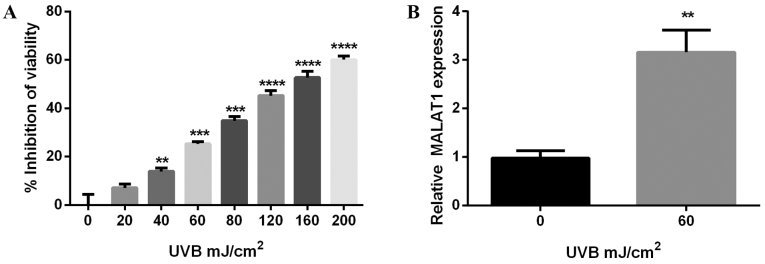
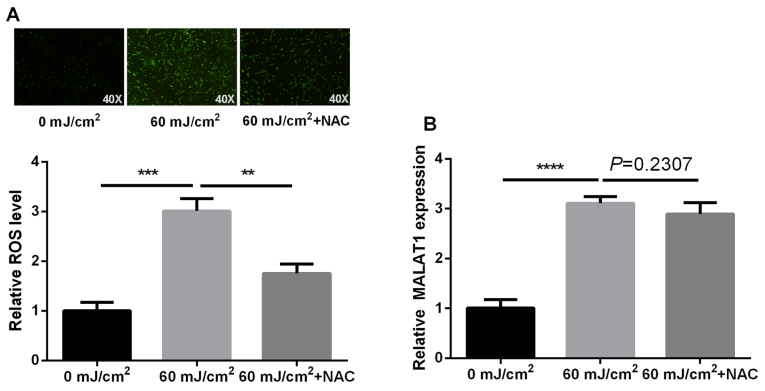
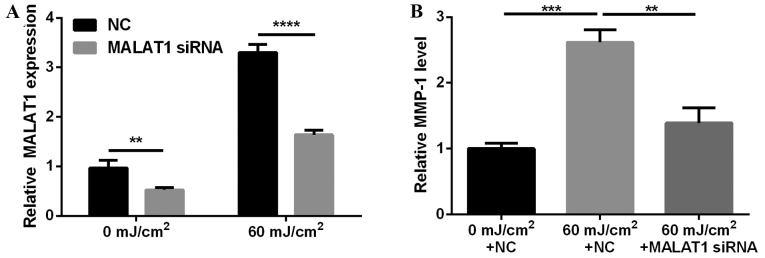
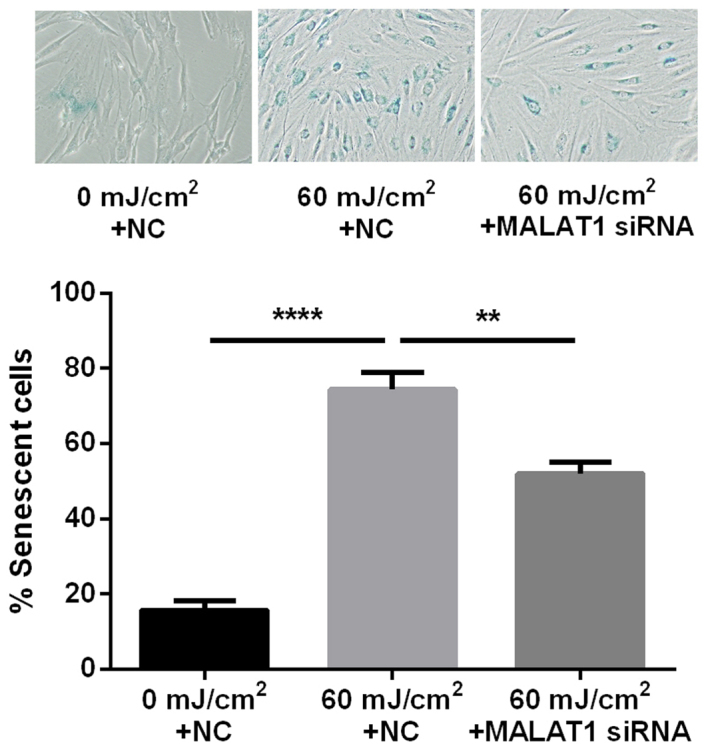
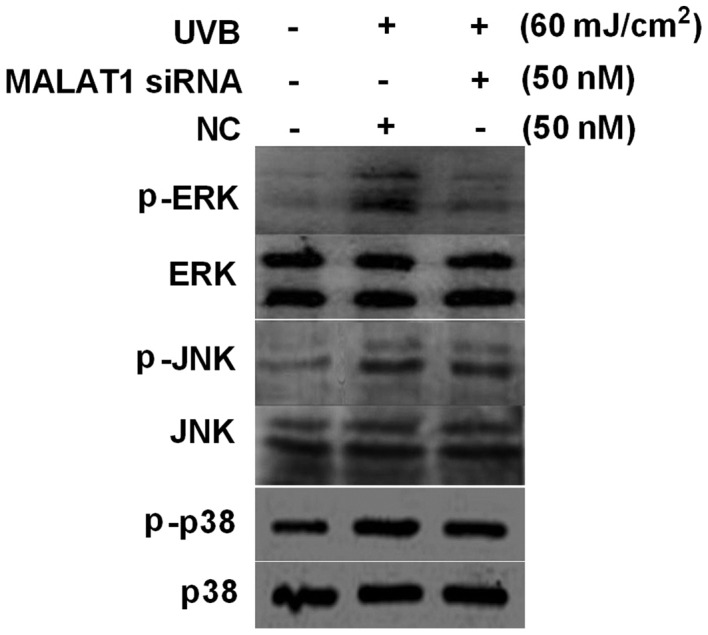
Long non-coding RNA (lncRNA), transcripts of >200 bp in length that do not appear to exhibit any coding capacity, are important in the occurrence and development of cancer, cardiovascular and neurological diseases. However, effects of lncRNAs on photo‑aging remain to be elucidated. To explore the potential effects of the lncRNA metastasis‑associated lung adenocarcinoma transcript 1 (MALAT1) on photo‑aging in fibroblasts, MALAT1 expression was silenced in fibroblasts using small interference RNA. Reverse transcription‑quantitative polymerase chain reaction (RT‑qPCR) was used to examine MALAT1 expression in normal and silenced fibroblasts following irradiation with 60 mJ/cm2 ultraviolet B (UVB) and an ELISA assay was used to identify matrix metalloproteinase‑1 (MMP‑1) content in the cellular supernatant. A β-galactosidase kit was applied to measure the number of senescent cells and a western blot assay was used to detect extracellular signal‑regulated kinase (ERK), c‑Jun N‑terminal kinase (JNK) and p38 phosphorylation levels. RT‑qPCR was additionally used to detect changes in MALAT1 expression following suppression of UVB‑induced reactive oxygen species (ROS) generation with N‑acetyl‑L‑cysteine (NAC). Fibroblasts irradiated with 60 mJ/cm2 UVB demonstrated increased MALAT1 expression, MMP‑1 secretory volume and number of senescent cells, and greater levels of ERK, p38 and JNK phosphorylation. Following silencing of MALAT1 expression in photo‑aged fibroblasts, decreases were observed in MMP‑1 secretory volume, number of senescent cells and phosphorylation levels of ERK. NAC reduced ROS content, however, it did not affect MALAT1 expression. Therefore, it was concluded that MALAT1 may participate in UVB‑induced photo‑aging via regulation of the ERK/mitogen‑activated protein kinase signaling pathway and UVB‑induced MALAT1 expression is independent of ROS generation.
长链非编码RNA(lncRNA)是长度超过200bp的转录本,似乎不具备任何编码能力,在癌症、心血管疾病和神经疾病的发生发展中起重要作用。然而,lncRNA对光老化的影响仍有待阐明。为了探究长链非编码RNA转移相关肺腺癌转录本1(MALAT1)对成纤维细胞光老化的潜在影响,使用小干扰RNA使成纤维细胞中的MALAT1表达沉默。采用逆转录-定量聚合酶链反应(RT-qPCR)检测60mJ/cm2紫外线B(UVB)照射后正常及沉默MALAT1表达的成纤维细胞中MALAT1的表达情况,并采用酶联免疫吸附测定(ELISA)法鉴定细胞上清液中基质金属蛋白酶-1(MMP-1)的含量。应用β-半乳糖苷酶试剂盒检测衰老细胞数量,并采用蛋白质免疫印迹法检测细胞外信号调节激酶(ERK)、c-Jun氨基末端激酶(JNK)和p38的磷酸化水平。另外,采用RT-qPCR检测用N-乙酰-L-半胱氨酸(NAC)抑制UVB诱导的活性氧(ROS)生成后MALAT1表达的变化。用60mJ/cm2 UVB照射的成纤维细胞显示MALAT1表达增加、MMP-1分泌量和衰老细胞数量增加,以及ERK、p38和JNK磷酸化水平更高。在光老化的成纤维细胞中沉默MALAT1表达后,观察到MMP-1分泌量、衰老细胞数量和ERK磷酸化水平降低。NAC降低了ROS含量,然而,它不影响MALAT1表达。因此,得出结论:MALAT1可能通过调节ERK/丝裂原活化蛋白激酶信号通路参与UVB诱导的光老化,且UVB诱导的MALAT1表达独立于ROS生成。