Janssens Sharon, Ciapaite Jolita, Wolters Justina C, van Riel Natal A, Nicolay Klaas, Prompers Jeanine J
Biomedical Nuclear Magnetic Resonance (NMR), Department of Biomedical Engineering, Eindhoven University of Technology, P.O. Box 513, 5600 MB Eindhoven, The Netherlands.
Center for Liver, Digestive and Metabolic Diseases, Department of Pediatrics, University of Groningen, University Medical Center Groningen, Hanzeplein 1, 9713 GZ Groningen, The Netherlands.
Nutrients. 2017 May 10;9(5):476. doi: 10.3390/nu9050476.
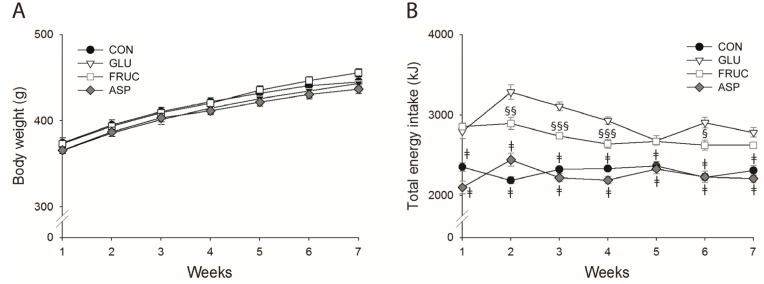
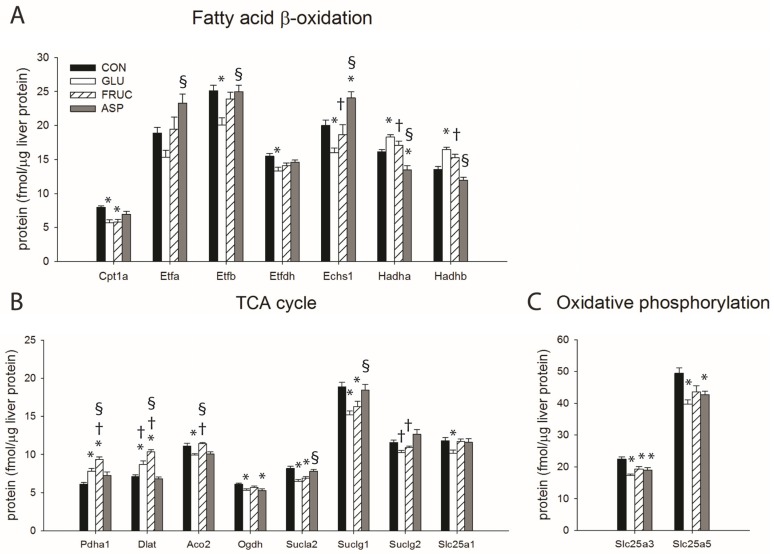
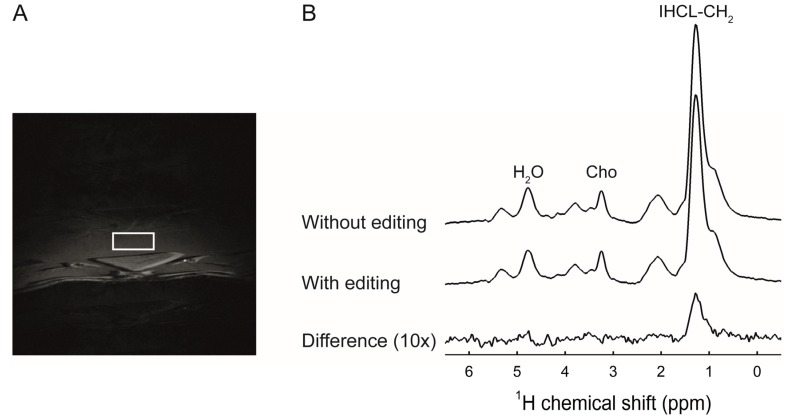
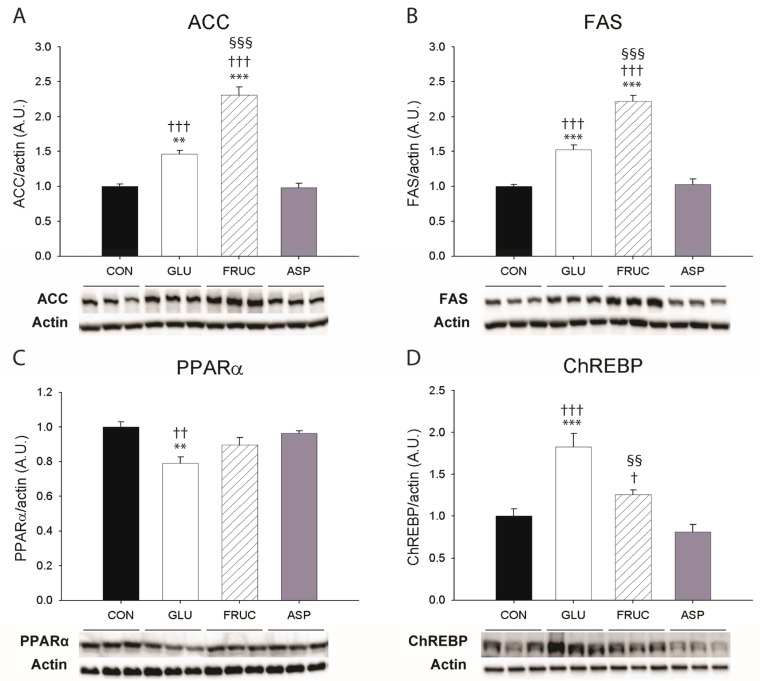
We aimed to elucidate the effects of caloric and non-caloric sweeteners on liver lipid metabolism in rats using in vivo magnetic resonance spectroscopy (MRS) and to determine their roles in the development of liver steatosis. Wistar rats received normal chow and either normal drinking water, or solutions containing 13% (/) glucose, 13% fructose, or 0.4% aspartame. After 7 weeks, in vivo hepatic dietary lipid uptake and de novo lipogenesis were assessed with proton-observed, carbon-13-edited MRS combined with C-labeled lipids and C-labeled glucose, respectively. The molecular basis of alterations in hepatic liver metabolism was analyzed in detail ex vivo using immunoblotting and targeted quantitative proteomics. Both glucose and fructose feeding increased adiposity, but only fructose induced hepatic lipid accumulation. In vivo MRS showed that this was not caused by increased hepatic uptake of dietary lipids, but could be attributed to an increase in de novo lipogenesis. Stimulation of lipogenesis by fructose was confirmed by a strong upregulation of lipogenic enzymes, which was more potent than with glucose. The non-caloric sweetener aspartame did not significantly affect liver lipid content or metabolism. In conclusion, liquid fructose more severely affected liver lipid metabolism in rats than glucose, while aspartame had no effect.
我们旨在利用体内磁共振波谱(MRS)阐明热量型和非热量型甜味剂对大鼠肝脏脂质代谢的影响,并确定它们在肝脂肪变性发展过程中的作用。Wistar大鼠分别给予正常饲料和正常饮用水,或含有13%(/)葡萄糖、13%果糖或0.4%阿斯巴甜的溶液。7周后,分别结合C标记脂质和C标记葡萄糖,通过质子观测、碳-13编辑的MRS评估体内肝脏膳食脂质摄取和从头脂肪生成。使用免疫印迹和靶向定量蛋白质组学在体外详细分析肝脏代谢改变的分子基础。喂食葡萄糖和果糖均会增加肥胖,但只有果糖会导致肝脏脂质积累。体内MRS显示,这不是由肝脏对膳食脂质摄取增加引起的,而是可归因于从头脂肪生成增加。果糖对脂肪生成的刺激通过生脂酶的强烈上调得到证实,这种上调比葡萄糖更有效。非热量型甜味剂阿斯巴甜对肝脏脂质含量或代谢没有显著影响。总之,液态果糖比葡萄糖更严重地影响大鼠肝脏脂质代谢,而阿斯巴甜则没有影响。