Groningen Biomolecular Sciences and Biotechnology Institute &Zernike Institute for Advanced Materials, University of Groningen, Nijenborgh 4, 9747 AG Groningen, The Netherlands.
Instituto de Tecnologia Química e Biológica António Xavier, Universidade Nova de Lisboa, Av. da República, 2780-157 Oeiras, Portugal.
Nat Commun. 2017 May 10;8:15214. doi: 10.1038/ncomms15214.
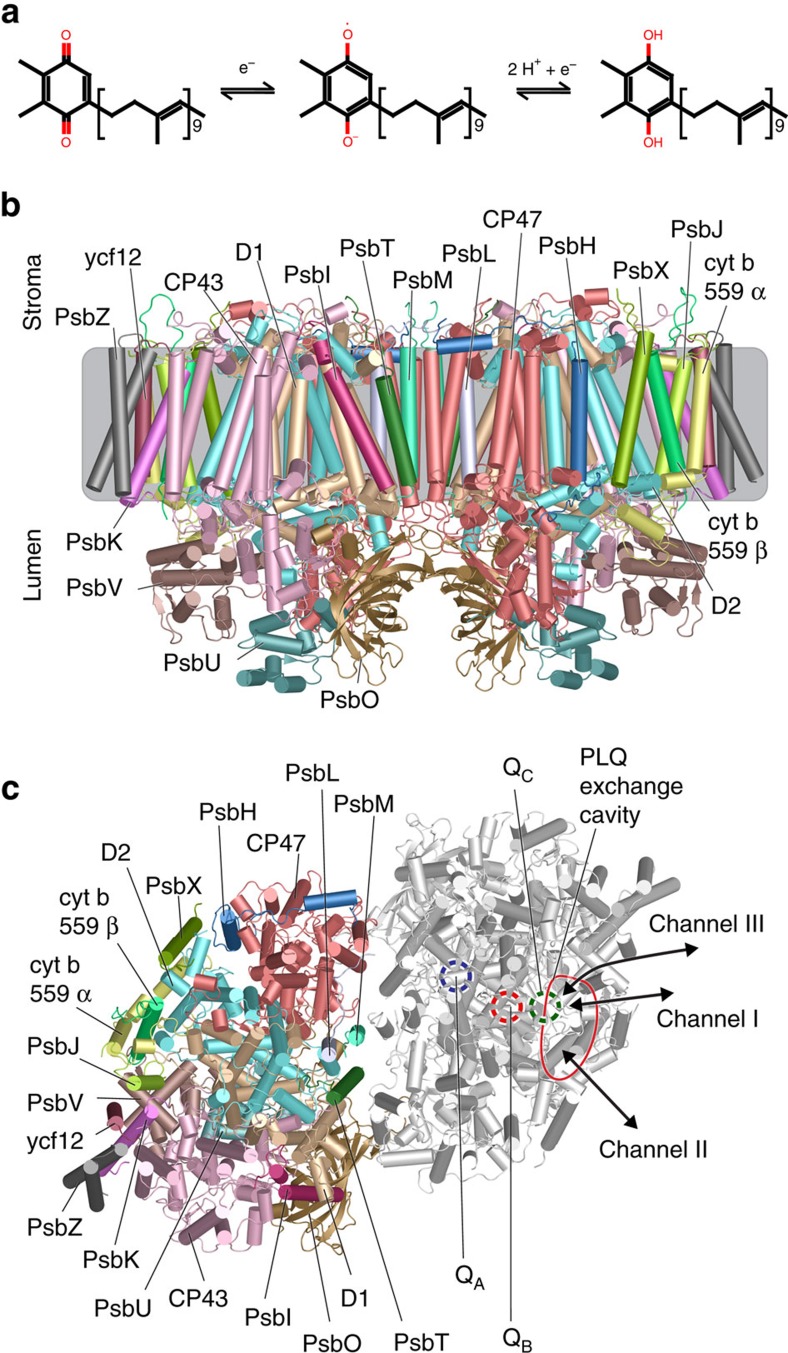
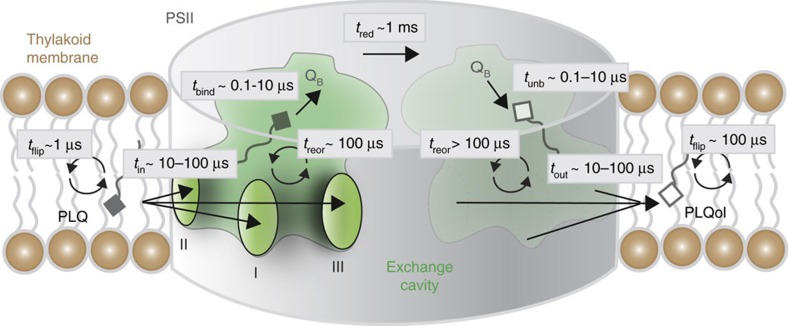
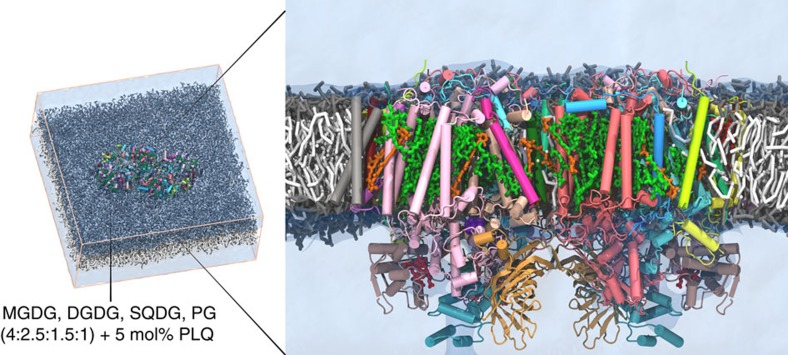
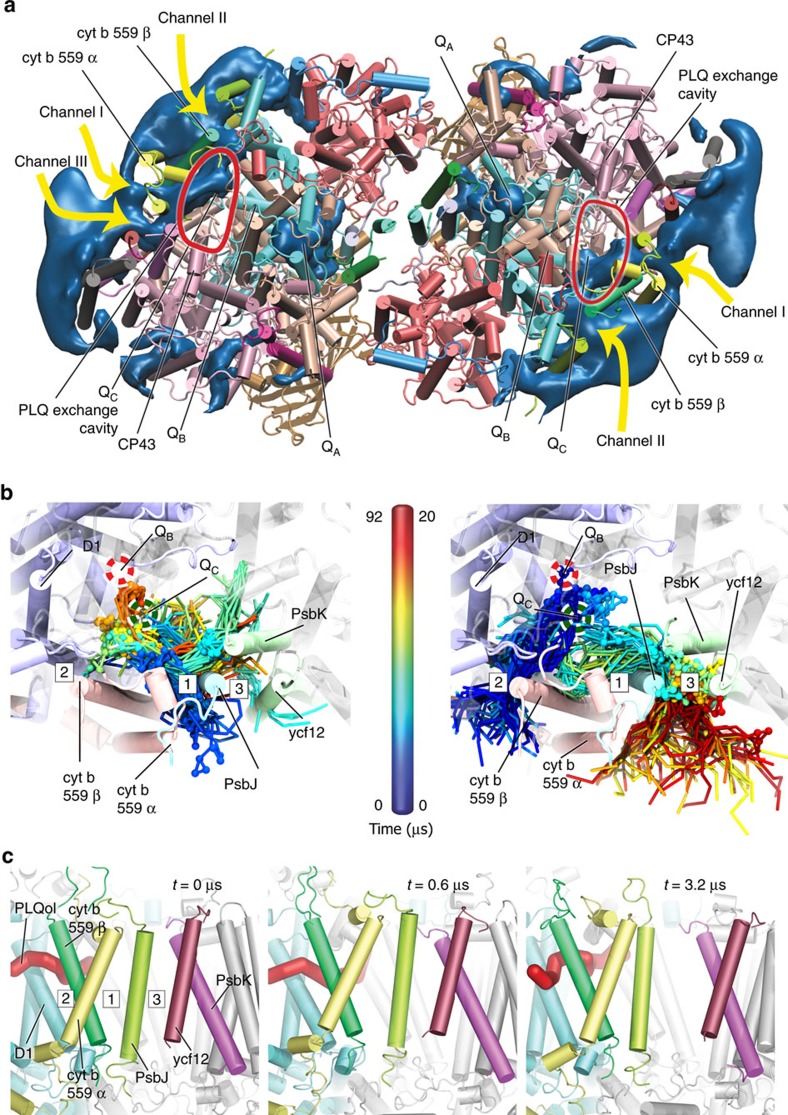
Plastoquinone (PLQ) acts as an electron carrier between photosystem II (PSII) and the cytochrome bf complex. To understand how PLQ enters and leaves PSII, here we show results of coarse grained molecular dynamics simulations of PSII embedded in the thylakoid membrane, covering a total simulation time of more than 0.5 ms. The long time scale allows the observation of many spontaneous entries of PLQ into PSII, and the unbinding of plastoquinol (PLQol) from the complex. In addition to the two known channels, we observe a third channel for PLQ/PLQol diffusion between the thylakoid membrane and the PLQ binding sites. Our simulations point to a promiscuous diffusion mechanism in which all three channels function as entry and exit channels. The exchange cavity serves as a PLQ reservoir. Our simulations provide a direct view on the exchange of electron carriers, a key step of the photosynthesis machinery.
质体醌(PLQ)在光合作用系统 II(PSII)和细胞色素 bf 复合物之间充当电子载体。为了了解 PLQ 如何进入和离开 PSII,我们在此展示了在类囊体膜中嵌入 PSII 的粗粒度分子动力学模拟的结果,总模拟时间超过 0.5ms。长时间尺度允许观察到许多 PLQ 自发进入 PSII 的情况,以及 plastoquinol(PLQol)从复合物中释放。除了两个已知的通道,我们还观察到 PLQ/PLQol 在类囊体膜和 PLQ 结合位点之间扩散的第三个通道。我们的模拟表明存在一种混杂的扩散机制,其中三个通道都作为进入和离开通道发挥作用。交换腔充当 PLQ 储库。我们的模拟提供了对电子载体交换的直接观察,这是光合作用机制的关键步骤。