Fregona Geisa, Cosme Lorrayne Belique, Moreira Cláudia Maria Marques, Bussular José Luis, Dettoni Valdério do Valle, Dalcolmo Margareth Pretti, Zandonade Eliana, Maciel Ethel Leonor Noia
Programa de Pós-Graduação em Saúde Coletiva. Hospital Universitário Cassiano Antônio de Moraes. Universidade Federal do Espírito Santo. Vitória, ES, Brasil.
Programa de Pós-Graduação em Saúde Coletiva. Universidade Federal do Espírito Santo. Vitória, ES, Brasil.
Rev Saude Publica. 2017 Apr 27;51(0):41. doi: 10.1590/S1518-8787.2017051006688.
To analyze the prevalence and factors associated with multidrug-resistant tuberculosis in Espírito Santo, Brazil.
This is a cross-sectional study of cases of tuberculosis tested for first-line drugs (isoniazid, rifampicin, pyrazinamide, ethambutol, and streptomycin) in Espírito Santo between 2002 and 2012. We have used laboratory data and registration of cases of tuberculosis - from the Sistema Nacional de Agravos de Notificação and Sistema para Tratamentos Especiais de Tuberculose. Individuals have been classified as resistant and non-resistant and compared in relation to the sociodemographic, clinical, and epidemiological variables. Some variables have been included in a logistic regression model to establish the factors associated with resistance.
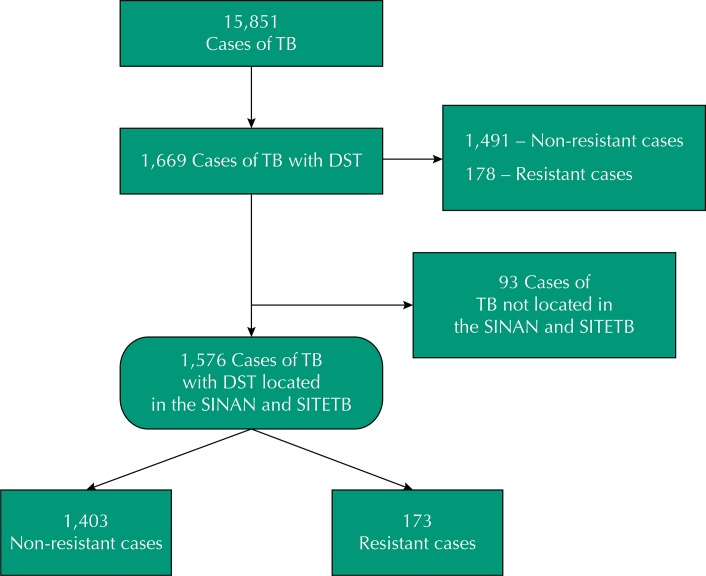
In the study period, 1,669 individuals underwent anti-tuberculosis drug susceptibility testing. Of these individuals, 10.6% showed resistance to any anti-tuberculosis drug. The rate of multidrug resistance observed, that is, to rifampicin and isoniazid, has been 5%. After multiple analysis, we have identified as independent factors associated with resistant tuberculosis: history of previous treatment of tuberculosis [recurrence (OR = 7.72; 95%CI 4.24-14.05) and re-entry after abandonment (OR = 3.91; 95%CI 1.81-8.43)], smoking (OR = 3.93; 95%CI 1.98-7.79), and positive culture for Mycobacterium tuberculosis at the time of notification of the case (OR = 3.22; 95%CI 1.15-8.99).
The partnership between tuberculosis control programs and health teams working in the network of Primary Health Care needs to be strengthened. This would allow the identification and monitoring of individuals with a history of previous treatment of tuberculosis and smoking. Moreover, the expansion of the offer of the culture of tuberculosis and anti-tuberculosis drug susceptibility testing would provide greater diagnostic capacity for the resistant types in Espírito Santo.
Analisar a prevalência e fatores associados à tuberculose resistente no Espírito Santo.
MÉTODOS: Estudo transversal dos casos de tuberculose testados para fármacos de primeira linha (isoniazida, rifampicina, pirazinamida, etambutol e estreptomicina) no Espírito Santo entre 2002 e 2012. Foram utilizados dados laboratoriais e de registro de casos de tuberculose - Sistema Nacional de Agravos de Notificação e Sistema para Tratamentos Especiais de Tuberculose. Os indivíduos foram classificados em resistentes e não resistentes, e comparados para variáveis sociodemográficas, clínicas e epidemiológicas. Algumas variáveis foram inclusas em um modelo de regressão logística para estabelecimento de fatores associados à resistência.
No período do estudo, 1.669 indivíduos tiveram o teste de sensibilidade aos fármacos antituberculose realizado. Destes, 10,6% apresentaram resistência a qualquer droga antituberculose. A taxa de multirresistência observada, isto é, à rifampicina e isoniazida, foi de 5%. Após a análise múltipla, foram identificados como fatores associados independentes para tuberculose resistente: história de tratamento prévio para tuberculose [Recidiva (OR = 7,72; IC95% 4,24-14,05) e reingresso após abandono (OR = 3,91; IC95% 1,81-8,43)], tabagismo (OR = 3,93; IC95% 1,98-7,79) e cultura positiva para Mycobacterium tuberculosis no momento da notificação do caso (OR = 3,22; IC95% 1,15-8,99).
CONCLUSÕES: É necessário o fortalecimento da parceria entre os programas de controle de tuberculose e as equipes de saúde que atuam na rede de Atenção Primária à Saúde. Isso possibilitaria identificar e acompanhar indivíduos com história de tratamento prévio para tuberculose e tabagismo. Além disso, a ampliação da oferta de cultura e Teste de Sensibilidade a fármacos antituberculose proporcionaria maior capacidade diagnóstica para as formas resistentes no Espírito Santo.
目的:分析巴西圣埃斯皮里图州耐多药结核病的患病率及相关因素。
方法:这是一项横断面研究,研究对象为2002年至2012年间在圣埃斯皮里图州接受一线药物(异烟肼、利福平、吡嗪酰胺、乙胺丁醇和链霉素)检测的结核病病例。我们使用了实验室数据以及结核病病例登记信息——来自国家法定疾病监测系统和结核病特殊治疗系统。将个体分为耐药和非耐药两类,并就社会人口统计学、临床和流行病学变量进行比较。一些变量被纳入逻辑回归模型以确定与耐药相关的因素。
结果:在研究期间,1669名个体接受了抗结核药物敏感性检测。其中,10.6%的个体对任何抗结核药物显示耐药。观察到的耐多药率,即对利福平和异烟肼的耐药率为5%。经过多因素分析,我们确定与耐药结核病相关的独立因素为:既往结核病治疗史[复发(比值比=7.72;95%置信区间4.24 - 14.05)和中断治疗后重新开始治疗(比值比=3.91;95%置信区间1.81 - 8.43)]、吸烟(比值比=3.93;95%置信区间1.98 - 7.79)以及病例报告时结核分枝杆菌培养阳性(比值比=3.22;95%置信区间1.15 - 8.99)。
结论:需要加强结核病控制项目与在初级卫生保健网络中工作的卫生团队之间的合作。这将有助于识别和监测有既往结核病治疗史和吸烟的个体。此外,扩大结核病培养和抗结核药物敏感性检测的服务范围将为圣埃斯皮里图州的耐药类型提供更强的诊断能力。
目的:分析圣埃斯皮里图州耐多药结核病的患病率及相关因素。
方法:对2002年至2012年间在圣埃斯皮里图州接受一线药物(异烟肼、利福平、吡嗪酰胺、乙胺丁醇和链霉素)检测的结核病病例进行横断面研究。使用了实验室数据以及结核病病例登记信息——国家法定疾病监测系统和结核病特殊治疗系统。将个体分为耐药和非耐药两类,并就社会人口统计学、临床和流行病学变量进行比较。一些变量被纳入逻辑回归模型以确定与耐药相关的因素。
结果:在研究期间,1669名个体进行了抗结核药物敏感性检测。其中,10.6%的个体对任何抗结核药物显示耐药。观察到的耐多药率,即对利福平和异烟肼的耐药率为5%。经过多因素分析,确定与耐药结核病相关的独立因素为:既往结核病治疗史[复发(比值比=7.72;95%置信区间4.24 - 14.05)和中断治疗后重新开始治疗(比值比=3.91;95%置信区间1.81 - 8.43)]、吸烟(比值比=3.93;95%置信区间1.98 - 7.79)以及病例报告时结核分枝杆菌培养阳性(比值比=3.22;95%置信区间1.15 - 8.99)。
结论:需要加强结核病控制项目与在初级卫生保健网络中工作的卫生团队之间的合作。这将有助于识别和监测有既往结核病治疗史和吸烟的个体。此外,扩大结核病培养和抗结核药物敏感性检测的服务范围将为圣埃斯皮里图州的耐药类型提供更强的诊断能力。