Macêdo Vilma Costa de, Lira Pedro Israel Cabral de, Frias Paulo Germano de, Romaguera Luciana Maria Delgado, Caires Silvana de Fátima Ferreira, Ximenes Ricardo Arraes de Alencar
Programa de Pós-Graduação em Saúde da Criança e Adolescente. Departamento de Enfermagem. Universidade Federal de Pernambuco. Recife, PE, Brasil.
Departamento de Nutrição. Universidade Federal de Pernambuco. Recife, PE, Brasil.
Rev Saude Publica. 2017 Aug 17;51:78. doi: 10.11606/S1518-8787.2017051007066.
To determine the sociodemographic, behavioral, and health care factors related to the occurrence of syphilis in women treated at public maternity hospitals.
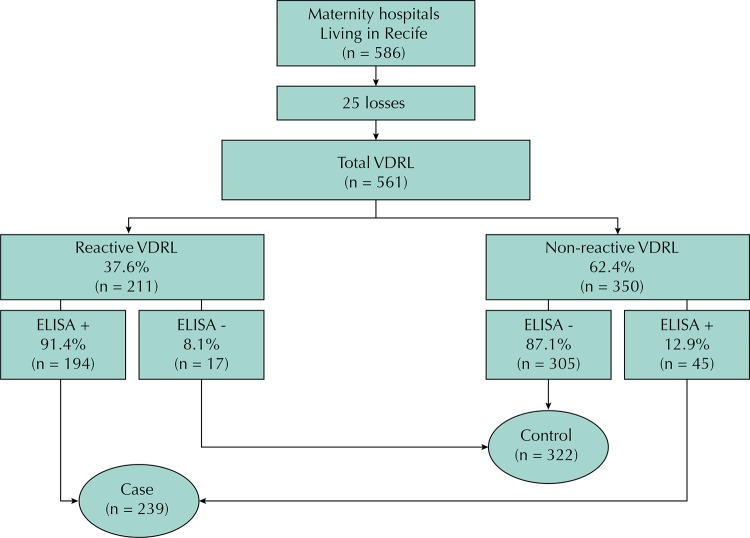
This is a case-control study (239 cases and 322 controls) with women admitted to seven maternity hospitals in the municipality of Recife, Brazil, from July 2013 to July 2014. Eligible women were recruited after the result of the VDRL (Venereal Disease Research Laboratory) under any titration. The selection of cases and controls was based on the result of the serology for syphilis using ELISA (enzyme-linked immunosorbent assay). The independent variables were grouped into: sociodemographic, behavioral, clinical and obstetric history, and health care in prenatal care and maternity hospital. Information was obtained by interview, during hospitalization, with the application of a questionnaire. Odds ratios and 95% confidence intervals were estimated using logistic regression to identify the predicting factors of the variable to be explained.
The logistic regression analysis identified as determinant factors for gestational syphilis: education level of incomplete basic education or illiterate (OR = 2.02), lack of access to telephone (OR = 2.4), catholic religion (OR = 1.70 ), four or more pregnancies (OR = 2.2), three or more sexual partners in the last year (OR = 3.1), use of illicit drugs before the age of 18 (OR = 3.0), and use of illicit drugs by the current partner (OR = 1.7). Only one to three prenatal appointments (OR = 3.5) and a previous history of sexually transmitted infection (OR = 9.7) were also identified as determinant factors.
Sociodemographic, behavioral, and health care factors are associated with the occurrence of syphilis in women and should be taken into account in the elaboration of universal strategies aimed at the prevention and control of syphilis, but with a focus on situations of greater vulnerability.
Determinar os fatores sociodemográficos, comportamentais e de assistência à saúde relacionados à ocorrência de sífilis em mulheres atendidas em maternidades públicas.
MÉTODOS: Trata-se de um estudo caso-controle (239 casos e 322 controles) com mulheres admitidas em sete maternidades do município do Recife, no período de julho de 2013 a julho de 2014. As mulheres elegíveis foram recrutadas após o resultado do VDRL (Venereal Disease Research Laboratory) sob qualquer titulação. A seleção dos casos e controles considerou o resultado da sorologia por ELISA (enzyme-linked immunosorbent assay), variável dependente utilizada como diagnóstico para sífilis neste estudo. As variáveis independentes foram agrupadas em: sociodemográficas; comportamentais; e antecedentes clínicos e obstétricos; e assistência à saúde no pré-natal e na maternidade. As informações foram obtidas por meio de entrevista, durante o internamento, por aplicação de um questionário. Foi calculado odds ratio (OR), intervalo de confiança de 95% e realizada análise de regressão logística para identificar os fatores preditores da variável a ser explicada.
A análise de regressão logística identificou como fatores determinantes para a sífilis gestacional: nível de escolaridade fundamental incompleto ou analfabeta (OR = 2,02), ausência de acesso a telefone (OR = 2,4), religião católica (OR = 1,70), quatro ou mais gestações (OR = 2,2), três ou mais parceiros sexuais no último ano (OR = 3,1), uso de drogas ilícitas antes dos 18 anos (OR = 3,0) e uso de drogas ilícitas por parte do atual companheiro (OR = 1,7). Além desses, foram observadas a ocorrência de apenas uma a três consultas ao pré-natal (OR = 3,5) e história anterior de infecção sexualmente transmissível (OR = 9,7).
CONCLUSÕES: Fatores sociodemográficos, comportamentais e de assistência à saúde estão associados à ocorrência de sífilis em mulheres e devem ser levados em consideração na elaboração de estratégias universais direcionadas à prevenção e controle da sífilis, porém com foco em situações de maior vulnerabilidade.
确定在公立妇产医院接受治疗的女性中,与梅毒发生相关的社会人口学、行为和医疗保健因素。
这是一项病例对照研究(239例病例和322例对照),研究对象为2013年7月至2014年7月期间入住巴西累西腓市七家妇产医院的女性。符合条件的女性在任何滴度的性病研究实验室(VDRL)检测结果出来后被招募。病例和对照的选择基于使用酶联免疫吸附测定(ELISA)进行的梅毒血清学检测结果,该变量在本研究中用作梅毒诊断的因变量。自变量分为:社会人口学、行为、临床和产科病史,以及产前护理和妇产医院的医疗保健。通过在住院期间进行访谈并应用问卷来获取信息。使用逻辑回归估计比值比和95%置信区间,以确定待解释变量的预测因素。
逻辑回归分析确定妊娠梅毒的决定因素为:基础教育不完全或文盲的教育水平(比值比=2.02)、无法使用电话(比值比=2.4)、天主教(比值比=1.70)、四次或更多次怀孕(比值比=2.2)、过去一年有三个或更多性伴侣(比值比=3.1)、18岁前使用非法药物(比值比=3.0)以及当前伴侣使用非法药物(比值比=1.7)。仅一至三次产前检查(比值比=3.5)和既往性传播感染史(比值比=9.7)也被确定为决定因素。
社会人口学、行为和医疗保健因素与女性梅毒的发生有关,在制定旨在预防和控制梅毒的通用策略时应予以考虑,但重点是更脆弱的情况。
确定在公立妇产医院接受治疗的女性中,与梅毒发生相关的社会人口学、行为和医疗保健因素。
这是一项病例对照研究(239例病例和322例对照),研究对象为2013年7月至2014年7月期间入住巴西累西腓市七家妇产医院的女性。符合条件的女性在任何滴度的性病研究实验室(VDRL)检测结果出来后被招募。病例和对照的选择基于使用酶联免疫吸附测定(ELISA)进行的梅毒血清学检测结果,该变量在本研究中用作梅毒诊断的因变量。自变量分为:社会人口学、行为、临床和产科病史,以及产前护理和妇产医院的医疗保健。通过在住院期间进行访谈并应用问卷来获取信息。计算比值比(OR)、95%置信区间,并进行逻辑回归分析以确定待解释变量的预测因素。
逻辑回归分析确定妊娠梅毒的决定因素为:基础教育不完全或文盲的教育水平(比值比=2.02)、无法使用电话(比值比=2.4)、天主教(比值比=1.70)、四次或更多次怀孕(比值比=2.2)、过去一年有三个或更多性伴侣(比值比=3.1)、18岁前使用非法药物(比值比=3.0)以及当前伴侣使用非法药物(比值比=1.7)。除此之外,还观察到仅进行一至三次产前检查(比值比=3.5)和既往性传播感染史(比值比=9.7)。
社会人口学、行为和医疗保健因素与女性梅毒的发生有关 在制定旨在预防和控制梅毒的通用策略时应予以考虑,但重点是更脆弱的情况。
