Xiao Feifan, Pu Jian, Wen Qiongxian, Huang Qin, Zhang Qinle, Huang Birong, Huang Shanshan, Lan Aihua, Zhang Yuening, Li Jiatong, Zhao Dong, Shen Jing, Wu Huayu, He Yan, Li Hongtao, Yang Xiaoli
Medical Scientific Research Center, Guangxi Medical University, Nanning, Guangxi, P.R. China.
First Clinical Academy, Guangxi Medical University, Nanning, Guangxi, P.R. China.
Oncotarget. 2017 Jul 18;8(29):48488-48506. doi: 10.18632/oncotarget.17290.
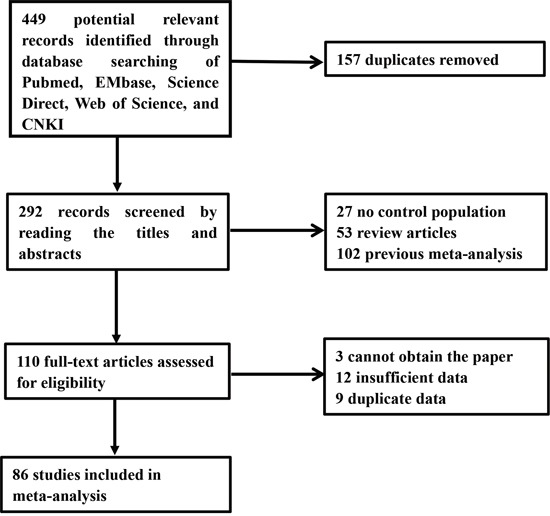
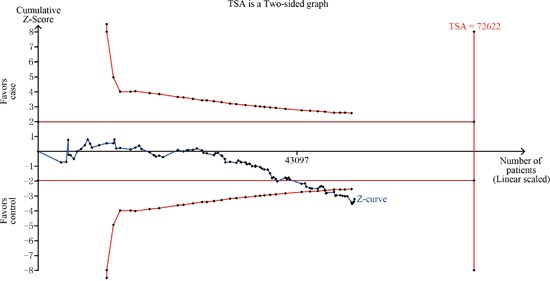
Cancer is the leading cause of death in economically developed countries and the second leading cause of death in developing countries. The relationship between genetic polymorphisms and the risk of cancers has been widely researched. Excision repair cross-complementing group 2 (ERCC2) gene plays important roles in the nucleotide excision repair pathway. There is contrasting evidence on the association between the ERCC2 Asp312Asn polymorphism and the risk of cancer. We conducted a comprehensive meta-analysis in order to assess the correlation between these factors. We searched the PubMed, EMBASE, Science Direct, Web of Science, and CNKI databases for studies published from January 1, 2005 to January 1, 2016. Finally, 86 articles with 38,848 cases and 48,928 controls were included in the analysis. The overall analysis suggested a significant association between the ERCC2 Asp312Asn polymorphism and cancer risk. Furthermore, control source, ethnicity, genotyping method, and cancer type were used for subgroup analysis. The result of a trial sequential analysis indicated that the cumulative evidence is adequate; hence, further trials were unnecessary in the overall analysis for homozygote comparison. In summary, our results suggested that ERCC2 Asp312Asn polymorphism is associated with increased cancer risk. A significantly increased cancer risk was observed in Asian populations, but not in Caucasian populations. Furthermore, the ERCC2 Asp312Asn polymorphism is associated with bladder, esophageal, and gastric cancers, but not with breast, head and neck, lung, prostate, and skin cancers, and non-Hodgkin lymphoma. Further multi-center, well-designed studies are required to validate our results.
癌症是经济发达国家的首要死因,在发展中国家则是第二大死因。基因多态性与癌症风险之间的关系已得到广泛研究。切除修复交叉互补基因2(ERCC2)在核苷酸切除修复途径中发挥着重要作用。关于ERCC2基因Asp312Asn多态性与癌症风险之间的关联,存在相互矛盾的证据。我们进行了一项全面的荟萃分析,以评估这些因素之间的相关性。我们在PubMed、EMBASE、Science Direct、Web of Science和中国知网数据库中检索了2005年1月1日至2016年1月1日发表的研究。最终,86篇文章纳入分析,共涉及38848例病例和48928例对照。总体分析表明,ERCC2基因Asp312Asn多态性与癌症风险之间存在显著关联。此外,我们还根据对照来源、种族、基因分型方法和癌症类型进行了亚组分析。序贯试验分析结果表明,累积证据充足;因此,在总体分析中进行纯合子比较时无需进一步试验。总之,我们的结果表明,ERCC2基因Asp312Asn多态性与癌症风险增加有关。在亚洲人群中观察到癌症风险显著增加,但在白种人群中未观察到。此外,ERCC2基因Asp312Asn多态性与膀胱癌、食管癌和胃癌有关,但与乳腺癌、头颈癌、肺癌、前列腺癌、皮肤癌和非霍奇金淋巴瘤无关。需要进一步开展多中心、精心设计的研究来验证我们的结果。