Fu Wen, Zhuo Zhen-Jian, Chen Yung-Chang, Zhu Jinhong, Zhao Zhang, Jia Wei, Hu Jin-Hua, Fu Kai, Zhu Shi-Bo, He Jing, Liu Guo-Chang
Department of Pediatric Urology, Department of Pediatric Surgery, Guangzhou Institute of Pediatrics, Guangzhou Women and Children's Medical Center, Guangzhou Medical University, Guangzhou 510623, Guangdong, China.
School of Chinese Medicine, Faculty of Medicine, The Chinese University of Hong Kong, Hong Kong 999077, China.
Oncotarget. 2017 Feb 7;8(6):9806-9822. doi: 10.18632/oncotarget.14190.
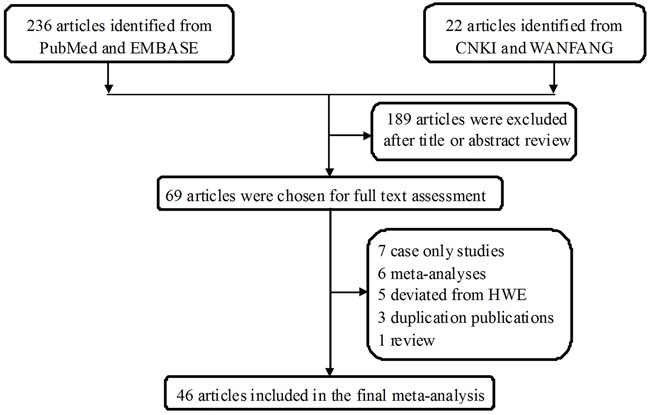
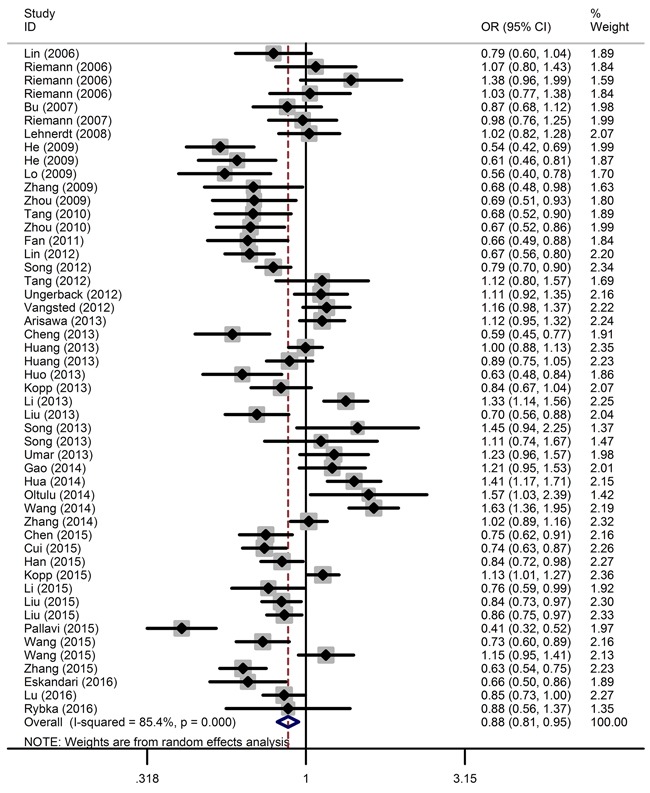
Nuclear factor-kappa B1 (NF-κB1) is a pleiotropic transcription factor and key contributor to tumorigenesis in many types of cancer. Numerous studies have addressed the association of a functional insertion (I)/deletion (D) polymorphism (-94ins/delATTG, rs28362491) in the promoter region of NFKB1 gene with the risk of various types of cancer; however, their conclusions have been inconsistent. We therefore conducted a meta-analysis to reevaluate this association. PubMed, EMBASE, China National Knowledge infrastructure (CNKI), and WANFANG databases were searched through July 2016 to retrieve relevant studies. After careful assessment, 50 case-control studies, comprising 18,299 cases and 23,484 controls were selected. Crude odds ratios (ORs) and 95% confidence intervals (CIs) were used to determine the strength of the association. The NFKB1 -94ins/delATTG polymorphism was associated with a decreased risk of overall cancer in the homozygote model (DD vs. II): OR = 0.75, 95% CI = 0.64-0.87); heterozygote model (ID vs. II): OR = 0.91, 95% CI = 0.83-0.99; recessive model (DD vs. ID/II): OR = 0.81, 95% CI = 0.71-0.91; dominant model (ID/DD vs. II): OR = 0.86, 95% CI = 0.78-0.95; and allele contrast model (D vs. I): OR = 0.88, 95% CI = 0.81-0.95). Subgroup and stratified analyses revealed decreased risks for lung cancer, nasopharyngeal carcinoma, prostate cancer, ovarian cancer, and oral squamous cell carcinoma, and this association held true also for Asians (especially Chinese subjects) in hospital-based studies, and in studies with quality scores less than nine. Well-designed, large-scale case-control studies are needed to confirm these results.
核因子-κB1(NF-κB1)是一种多效性转录因子,也是多种癌症肿瘤发生的关键促成因素。众多研究探讨了NFKB1基因启动子区域功能性插入(I)/缺失(D)多态性(-94ins/delATTG,rs28362491)与各类癌症风险之间的关联;然而,它们的结论并不一致。因此,我们进行了一项荟萃分析以重新评估这种关联。检索了截至2016年7月的PubMed、EMBASE、中国知网(CNKI)和万方数据库,以获取相关研究。经过仔细评估,选取了50项病例对照研究,包括18299例病例和23484例对照。采用粗比值比(OR)和95%置信区间(CI)来确定关联强度。在纯合子模型(DD vs. II)中,NFKB1 -94ins/delATTG多态性与总体癌症风险降低相关:OR = 0.75,95% CI = 0.64 - 0.87);杂合子模型(ID vs. II):OR = 0.91,95% CI = 0.83 - 0.99;隐性模型(DD vs. ID/II):OR = 0.81,95% CI = 0.71 - 0.91;显性模型(ID/DD vs. II):OR = 0.86,95% CI = 0.78 - 0.95;等位基因对比模型(D vs. I):OR = 0.88,95% CI = 0.81 - 0.95)。亚组和分层分析显示,肺癌、鼻咽癌、前列腺癌、卵巢癌和口腔鳞状细胞癌的风险降低,在基于医院的研究以及质量评分低于9分的数据中,亚洲人(尤其是中国受试者)中这种关联也成立。需要设计良好的大规模病例对照研究来证实这些结果。