Reinertsen Erik, Nemati Shamim, Vest Adriana N, Vaccarino Viola, Lampert Rachel, Shah Amit J, Clifford Gari D
Department of Biomedical Engineering, Georgia Institute of Technology, Atlanta, GA, United States of America.
Physiol Meas. 2017 Jun;38(6):1061-1076. doi: 10.1088/1361-6579/aa6e9c. Epub 2017 May 10.
Heart rate variability (HRV) characterizes changes in autonomic nervous system function and varies with posttraumatic stress disorder (PTSD). In this study we developed a classifier based on heart rate (HR) and HRV measures, and improved classifier performance using a novel HR-based window segmentation.
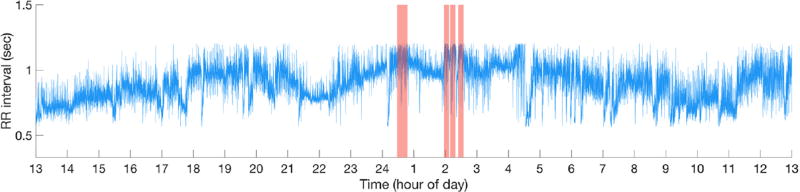
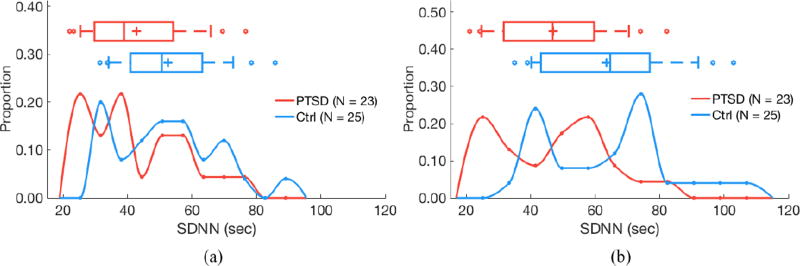
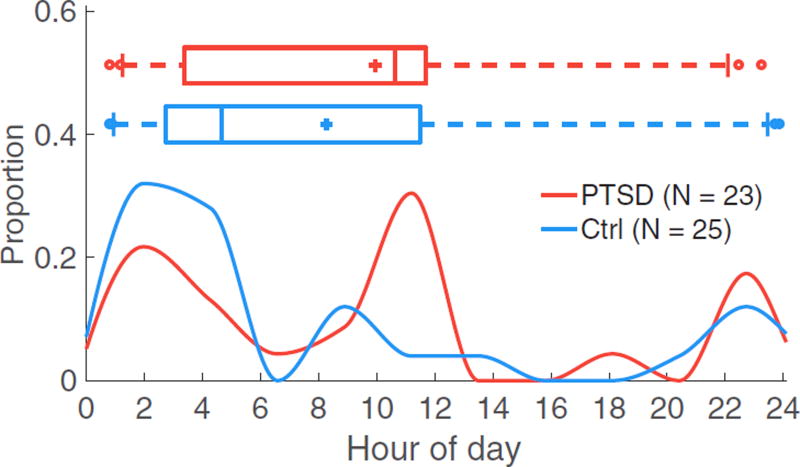
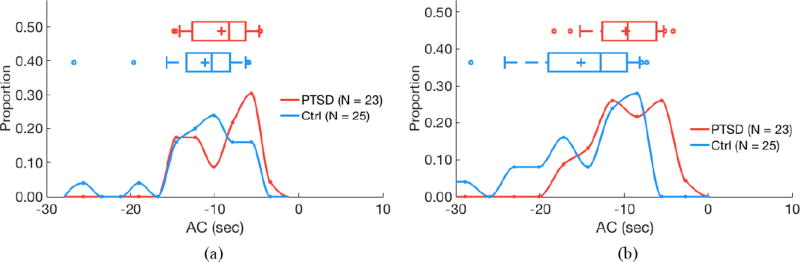
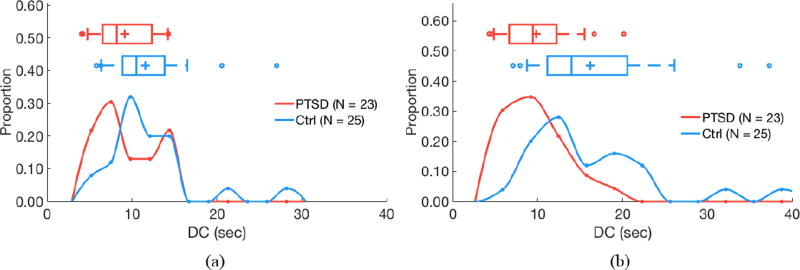
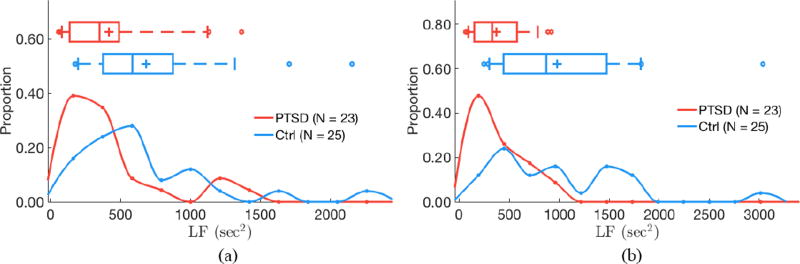
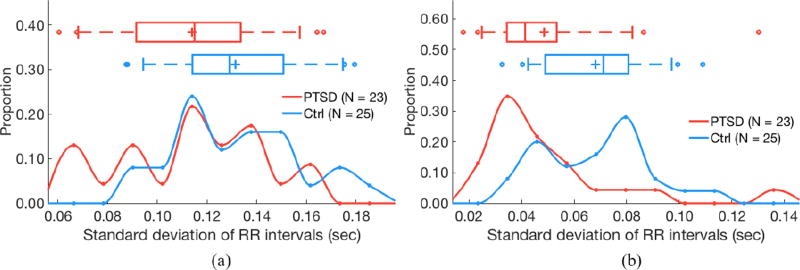
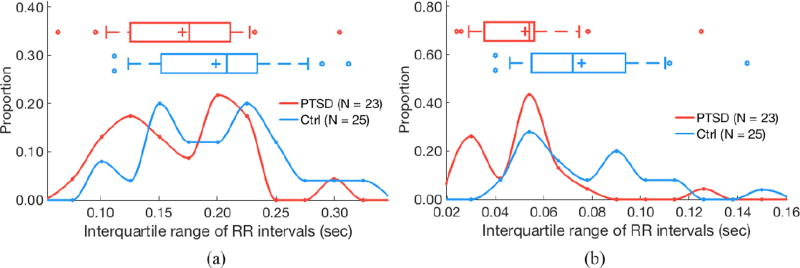
Single-channel ECG data were collected from 23 subjects with current PTSD, and 25 control subjects with no history of PTSD over 24 h. RR intervals were derived from these data, cleaned, and used to calculate HR and HRV metrics. These metrics were used as features in a logistic regression classifier. Performance was assessed via repeated random sub-sampling validation. To reduce noise and activity-related effects, we calculated features from five non-overlapping ten-minute quiescent segments of RR intervals defined by lowest HR, as well as random ten-minute segments as a control.
Using a combination of the four most predictive features derived from quiescent segments we achieved a median area under the receiver operating curve (AUC) of 0.86 on out-of-sample test set data. This was significantly higher than the AUC using 24 h of data (0.72) or random segments (0.67).
These results demonstrate our segmentation approach improves the classification of PTSD from HR and HRV measures, and suggest the potential for tracking PTSD illness severity via objective physiological monitoring. Future studies should prospectively evaluate if classifier output changes significantly with worsening or effective treatment of PTSD.
心率变异性(HRV)可表征自主神经系统功能的变化,且会因创伤后应激障碍(PTSD)而有所不同。在本研究中,我们基于心率(HR)和HRV测量值开发了一种分类器,并通过一种新颖的基于HR的窗口分割方法提高了分类器性能。
从23名患有当前PTSD的受试者以及25名无PTSD病史的对照受试者中收集单通道心电图数据,时长为24小时。从这些数据中得出RR间期,进行清理,并用于计算HR和HRV指标。这些指标被用作逻辑回归分类器中的特征。通过重复随机子采样验证来评估性能。为了减少噪声和与活动相关的影响,我们从由最低心率定义的RR间期的五个不重叠的十分钟静态段以及作为对照的随机十分钟段中计算特征。
使用从静态段得出的四个最具预测性的特征组合,我们在样本外测试集数据上实现了受试者工作特征曲线(AUC)下的中位数面积为0.86。这显著高于使用24小时数据(0.72)或随机段(0.67)的AUC。
这些结果表明我们的分割方法改善了基于HR和HRV测量对PTSD的分类,并表明通过客观生理监测跟踪PTSD疾病严重程度的潜力。未来的研究应前瞻性地评估分类器输出是否会随着PTSD病情恶化或有效治疗而发生显著变化。