Liu Xiaolong, Liang Mingjun, Liu Yuhuan, Fan Xinjiong
School of Basic Medical Sciences, Anhui Medical University, 81 Meishan Rd., Hefei, 230032, Anhui, People's Republic of China.
School of Life Sciences, Sun Yat-sen University, 135 W. Xingang Rd., Guangzhou, 510275, Guangdong, People's Republic of China.
Microb Cell Fact. 2017 May 11;16(1):81. doi: 10.1186/s12934-017-0698-5.
Pyrethroids are potentially harmful to human health and ecosystems. It is necessary to develop some efficient strategies to degrade pyrethroid residues. Biodegradation is generally considered as a safe, efficient, and inexpensive way to eliminate environmental contaminants. To date, although several pyrethroid-hydrolyzing esterases have been cloned, there has been no report about a pyrethroid hydrolase with high hydrolytic activity, good stability, and high productivity, indispensable enzymatic properties in practical biodegradation. Almost all pyrethroid hydrolases are intracellular enzymes, which require complex extraction protocols and present issues in terms of easy inactivation and low production.
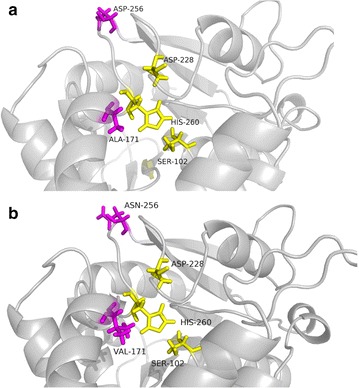
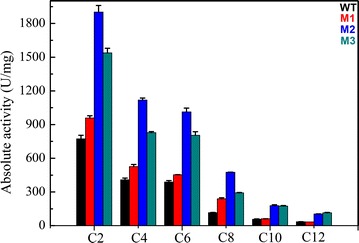
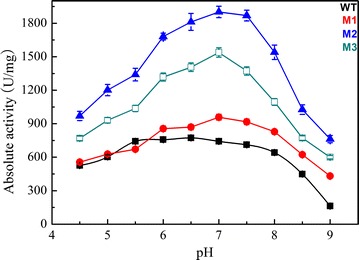
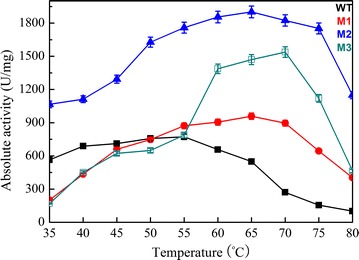
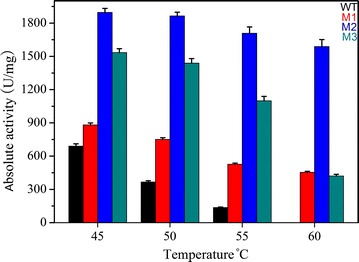
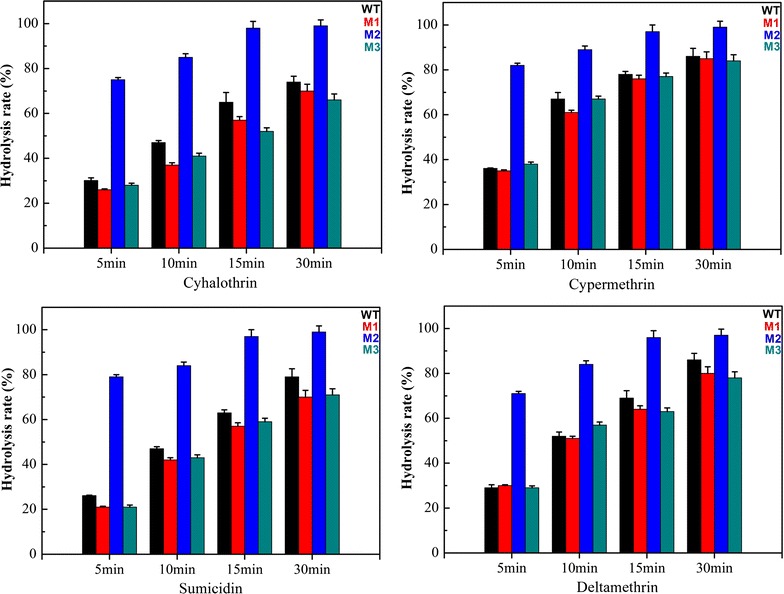
In this study, random mutagenesis was performed on one pyrethroid-hydrolyzing esterase, Sys410, to enhance its activity and thermostability. Two beneficial mutations, A171V and D256N, were obtained by random mutagenesis and gave rise to the mutant M2. The mutant displayed ~1.5-fold improvement in the kcat/Km value and 2.46-fold higher catalytic activity. The optimal temperature was 10 °C higher than that of the wild-type enzyme (55 °C). The half-life at 40-65 °C was 3.3-310 times longer. It was surprising that M2 has a half-life of 12 h at 70 °C while Sys410 was completely inactivated at 70 °C. In addition, the desired gene was extracellularly expressed in a Pichia pastoris host system. The soluble expression level reached up to 689.7 mg/L. Remarkably, the enzyme could efficiently degrade various pyrethroids at moderate temperature for 15 min, exceeding a hydrolysis rate of 98%, which is the highest value ever reported.
This is the first report about random mutagenesis and secretory expression of pyrethroid-hydrolyzing esterase with high-level productivity and purity in P. pastoris. Broad substrate specificity, enhanced activity and thermostability make M2 an ideal candidate for the biodegradation of pyrethroid residues.
拟除虫菊酯对人类健康和生态系统具有潜在危害。有必要制定一些有效的策略来降解拟除虫菊酯残留。生物降解通常被认为是一种安全、高效且廉价的消除环境污染物的方法。迄今为止,尽管已经克隆了几种拟除虫菊酯水解酯酶,但尚未有关于具有高水解活性、良好稳定性和高生产力的拟除虫菊酯水解酶的报道,而这些是实际生物降解中不可或缺的酶学特性。几乎所有的拟除虫菊酯水解酶都是胞内酶,这需要复杂的提取方案,并且在易于失活和低产量方面存在问题。
在本研究中,对一种拟除虫菊酯水解酯酶Sys410进行了随机诱变,以提高其活性和热稳定性。通过随机诱变获得了两个有益突变,A171V和D256N,并产生了突变体M2。该突变体的kcat/Km值提高了约1.5倍,催化活性提高了2.46倍。最佳温度比野生型酶(55℃)高10℃。在40 - 65℃下的半衰期延长了3.3 - 310倍。令人惊讶的是,M2在70℃下的半衰期为12小时,而Sys410在70℃下完全失活。此外,所需基因在毕赤酵母宿主系统中进行了胞外表达。可溶性表达水平达到689.7 mg/L。值得注意的是,该酶能够在中等温度下15分钟内有效降解各种拟除虫菊酯,水解率超过98%,这是迄今报道的最高值。
这是关于在毕赤酵母中对拟除虫菊酯水解酯酶进行随机诱变和分泌表达并具有高水平生产力和纯度的首次报道。广泛的底物特异性、增强的活性和热稳定性使M2成为降解拟除虫菊酯残留的理想候选者。