Romano Alessandra, Giallongo Cesarina, La Cava Piera, Parrinello Nunziatina L, Chiechi Antonella, Vetro Calogero, Tibullo Daniele, Di Raimondo Francesco, Liotta Lance A, Espina Virginia, Palumbo Giuseppe A
Divisione di Ematologia, Azienda Ospedaliera Policlinico UniversitariaCatania, Italy.
Scuola Superiore di CataniaCatania, Italy.
Front Pharmacol. 2017 Apr 26;8:204. doi: 10.3389/fphar.2017.00204. eCollection 2017.
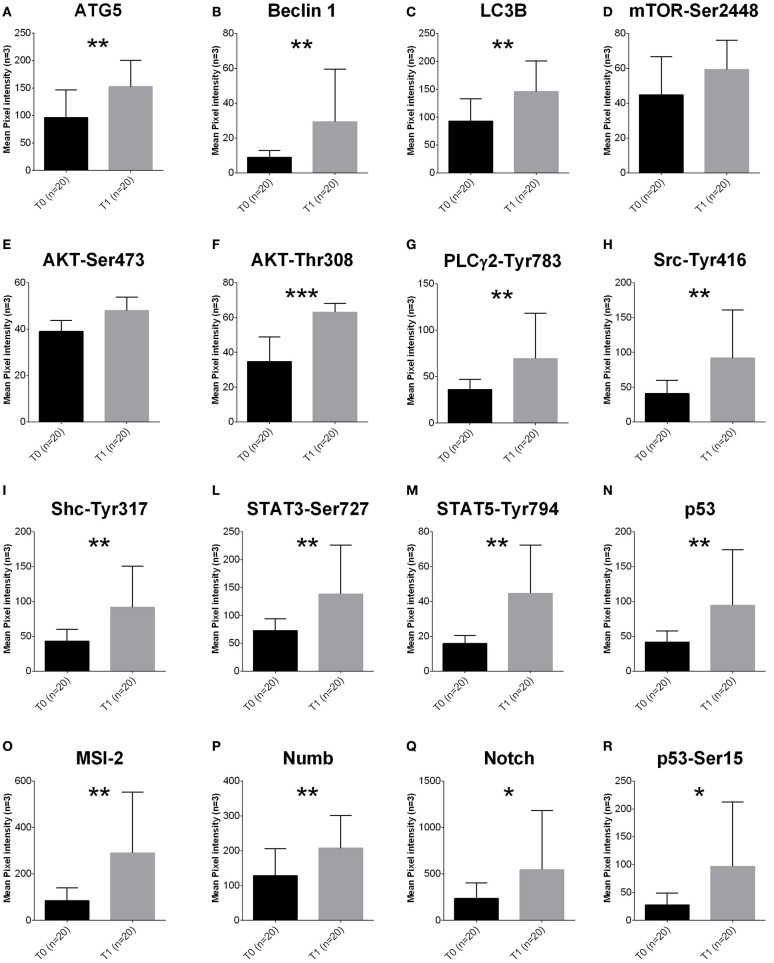
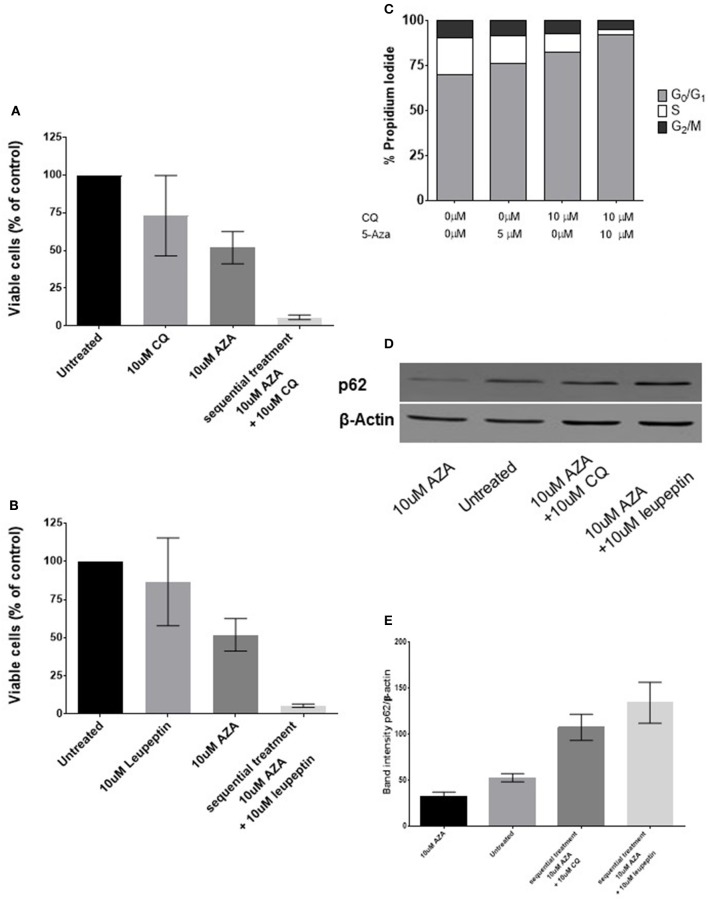
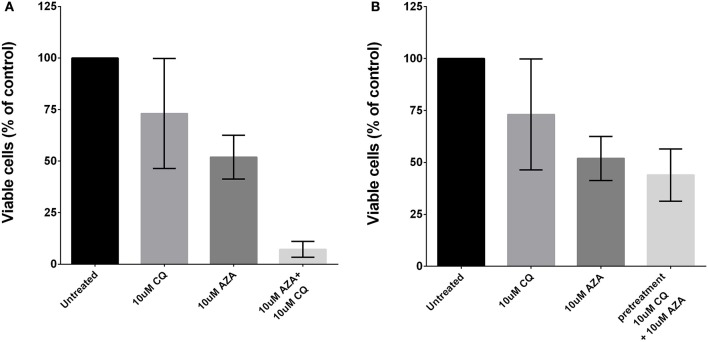
Azacytidine (5-AZA) is the standard first-choice treatment for high-risk myelodysplasia (MDS) patients. However, the clinical outcome for those patients who interrupt treatment or whose disease failed to respond is very poor. In order to identify the cellular pathways that are modified by long-term exposure to 5-AZA, we evaluated key proteins associated with the autophagy pathway by reverse-phase microarray (RPPA). Comparing bone marrow mononucleated cells (BMMCs) obtained from 20 newly-diagnosed patients and after four 5-AZA cycles we found an increased autophagy signaling. We then evaluated the effect of the combination of 5-AZA with autophagy inhibitors chloroquine (CQ) and leupeptin. Since 5-AZA and CQ showed synergism due to an increase of basal autophagy after 5-AZA exposure, we adopted a sequential treatment treating BMMCs with 5 μM 5-AZA for 72 h followed by 10 μM CQ for 24 h and found increased apoptosis, associated to a reduction of G2M phase and increase in G0-G1 phase. Long-term exposure to 5-AZA induced the reduction of the autophagic marker SQSTM1/p62, reversible by CQ or leupeptin exposure. In conclusion, we identified autophagy as a compensatory pathway occurring in MDS-BM after long-term exposure to 5-AZA and we provided evidences that a sequential treatment of 5-AZA followed by CQ could improve 5-AZA efficacy, providing novel insight for tailored therapy in MDS patients progressing after 5-AZA therapy.
阿扎胞苷(5-AZA)是高危骨髓增生异常综合征(MDS)患者的标准首选治疗药物。然而,那些中断治疗或疾病无反应患者的临床结局非常差。为了确定长期暴露于5-AZA后发生改变的细胞途径,我们通过反相微阵列(RPPA)评估了与自噬途径相关的关键蛋白。比较从20例新诊断患者获得的骨髓单个核细胞(BMMCs)以及经过四个5-AZA周期后的细胞,我们发现自噬信号增强。然后,我们评估了5-AZA与自噬抑制剂氯喹(CQ)和亮抑酶肽联合使用的效果。由于5-AZA和CQ因5-AZA暴露后基础自噬增加而显示出协同作用,我们采用序贯治疗,先用5μM 5-AZA处理BMMCs 72小时,然后用10μM CQ处理24小时,发现细胞凋亡增加,这与G2M期减少和G0-G1期增加有关。长期暴露于5-AZA导致自噬标志物SQSTM1/p62减少,CQ或亮抑酶肽暴露可使其逆转。总之,我们确定自噬是长期暴露于5-AZA后MDS骨髓中出现的一种代偿途径,并且我们提供了证据表明5-AZA后序贯使用CQ可提高5-AZA疗效,为5-AZA治疗后病情进展的MDS患者的个体化治疗提供了新的见解。