Kwok Sheldon J J, Kim Moonseok, Lin Harvey H, Seiler Theo G, Beck Eric, Shao Peng, Kochevar Irene E, Seiler Theo, Yun Seok-Hyun
Harvard Medical School and Wellman Center for Photomedicine, Massachusetts General Hospital, Boston, Massachusetts, United States 2Harvard-MIT Health Sciences and Technology, Massachusetts Institute of Technology, Cambridge, Massachusetts, United States.
Harvard Medical School and Wellman Center for Photomedicine, Massachusetts General Hospital, Boston, Massachusetts, United States.
Invest Ophthalmol Vis Sci. 2017 May 1;58(5):2596-2602. doi: 10.1167/iovs.17-21559.
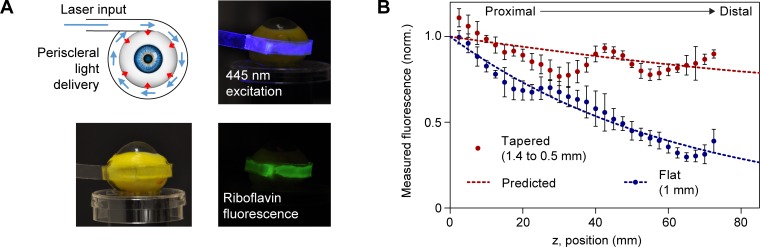
Scleral cross-linking (SXL) with a photosensitizer and light is a potential strategy to mechanically reinforce the sclera and prevent progressive axial elongation responsible for severe myopia. Current approaches for light delivery to the sclera are cumbersome, do not provide uniform illumination, and only treat a limited area of sclera. To overcome these challenges, we developed flexible optical waveguides optimized for efficient, homogeneous light delivery.
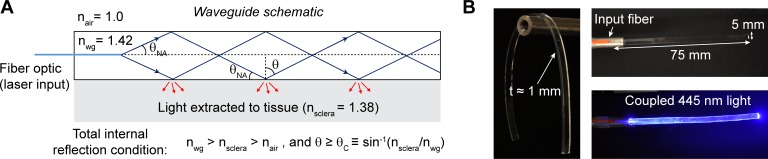
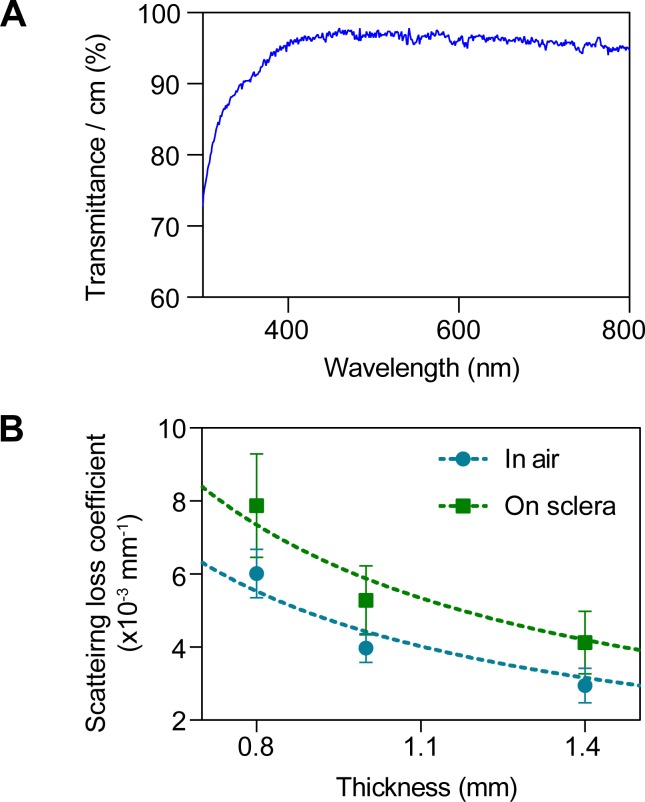
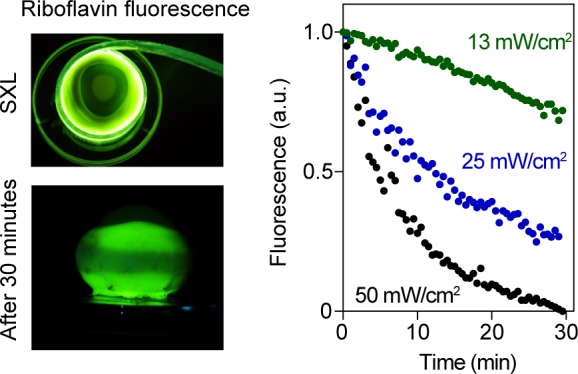
Waveguides were fabricated from polydimethylsiloxane elastomer. Blue light (445 nm) is coupled into the waveguide with an input fiber. Light delivery efficiency from the waveguide to scleral tissue was measured and fit to a theoretical model. SXL was performed on fresh porcine eyes stained with 0.5% riboflavin, using irradiances of 0, 25, and 50 mW/cm2 around the entire equator of the eye. Stiffness of scleral strips was characterized with tensiometry.
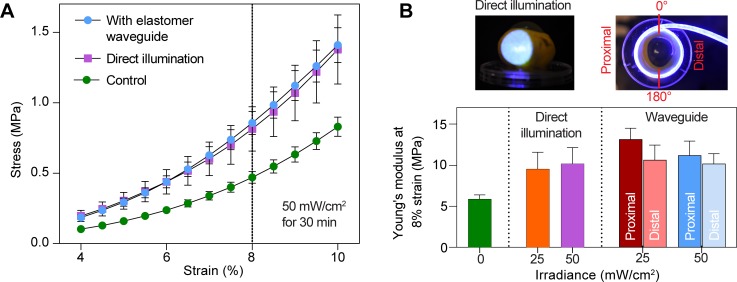
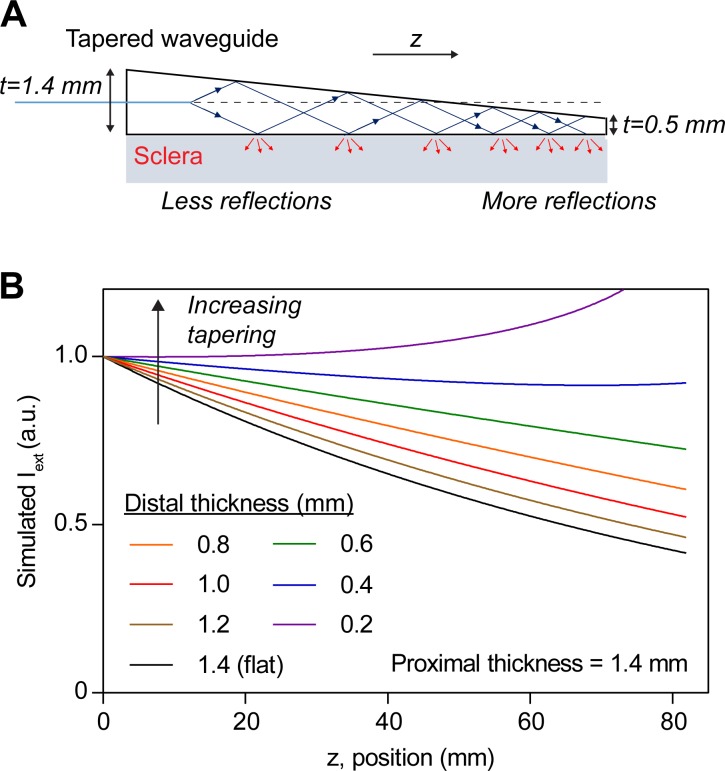
Light delivery with a waveguide of tapered thickness (1.4-0.5 mm) enhanced the uniformity of light delivery, compared to a flat waveguide, achieving a coefficient of variation of less than 10%. At 8% strain, sclera cross-linked with the waveguides at 50 mW/cm2 for 30 minutes had a Young's modulus of 10.7 ± 1.0 MPa, compared to 5.9 ± 0.5 MPa for no irradiation, with no difference in stiffness between proximally and distally treated halves. The stiffness of waveguide-irradiated samples did not differ from direct irradiation at the same irradiance.
We developed flexible waveguides for periscleral cross-linking. We demonstrated efficient and uniform stiffening of a 5-mm-wide equatorial band of scleral tissue.
使用光敏剂和光进行巩膜交联(SXL)是一种潜在的策略,可机械增强巩膜并防止导致严重近视的眼轴渐进性延长。目前将光传递到巩膜的方法很繁琐,不能提供均匀照明,且仅能治疗有限面积的巩膜。为克服这些挑战,我们开发了优化用于高效、均匀光传递的柔性光波导。
光波导由聚二甲基硅氧烷弹性体制成。蓝光(445nm)通过输入光纤耦合到光波导中。测量了从光波导到巩膜组织的光传递效率,并将其拟合到理论模型。在新鲜猪眼上进行SXL,猪眼用0.5%核黄素染色,在眼的整个赤道周围使用0、25和50mW/cm²的辐照度。用张力测定法表征巩膜条的硬度。
与扁平光波导相比,厚度逐渐变细(1.4 - 0.5mm)的光波导进行光传递可提高光传递的均匀性,变异系数小于10%。在8%应变下,用50mW/cm²的光波导交联30分钟的巩膜杨氏模量为10.7±1.0MPa,未照射的为5.9±0.5MPa,近端和远端处理的两半巩膜硬度无差异。光波导照射样品的硬度与相同辐照度下直接照射的无差异。
我们开发了用于巩膜周围交联的柔性光波导。我们证明了巩膜组织5mm宽赤道带能有效且均匀地变硬。