Margulieux Katie R, Liebov Benjamin K, Tirumala Venkata S K K S, Singh Arpita, Bushweller John H, Nakamoto Robert K, Hughes Molly A
Division of Infectious Diseases and International Health, Department of Medicine, School of Medicine, University of Virginia, CharlottesvilleVA, USA.
Department of Chemistry, University of Virginia, CharlottesvilleVA, USA.
Front Microbiol. 2017 Apr 27;8:740. doi: 10.3389/fmicb.2017.00740. eCollection 2017.
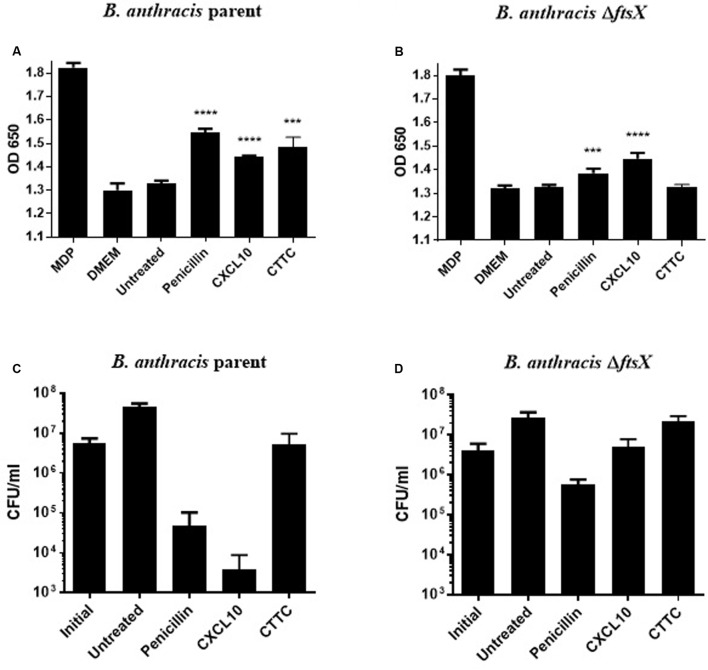
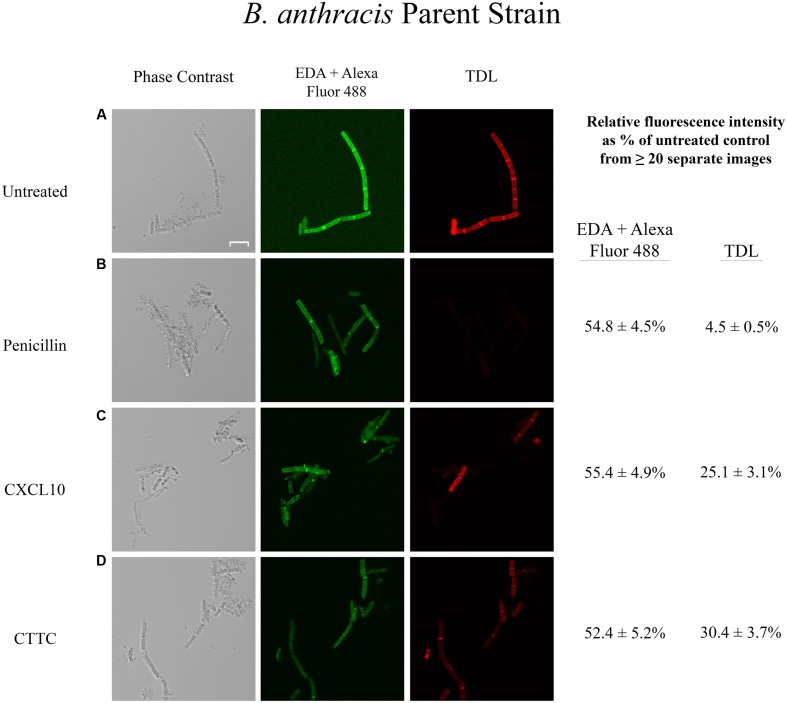
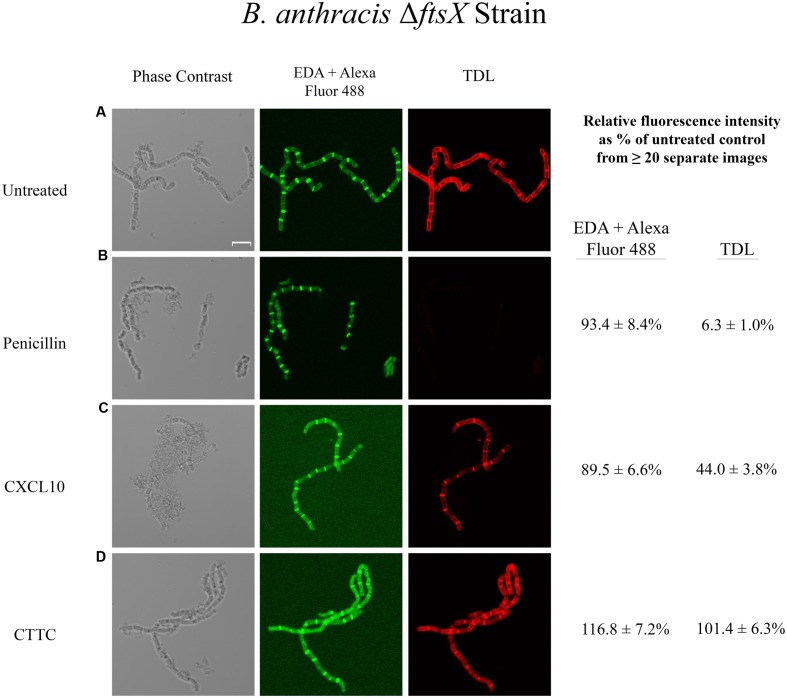
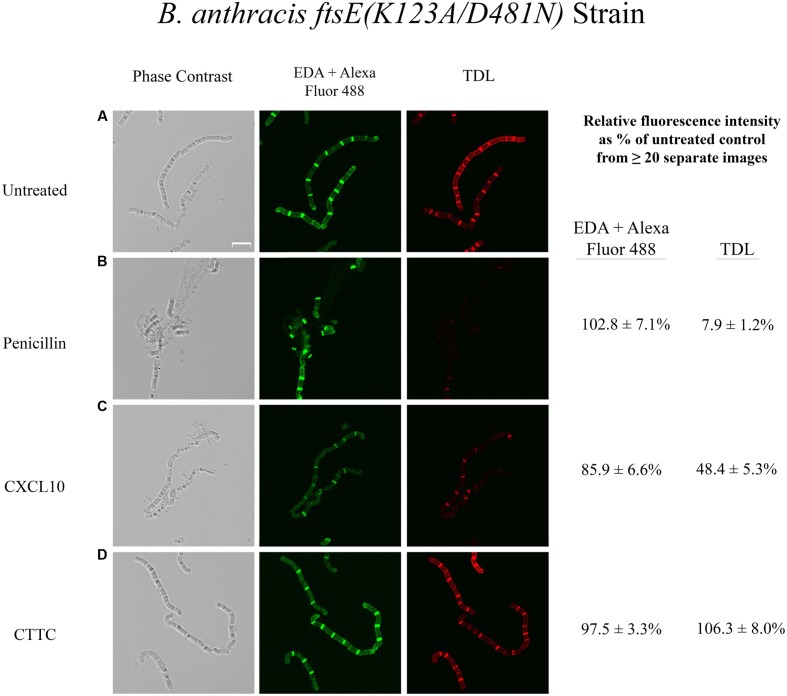
The antimicrobial activity of the chemokine CXCL10 against vegetative cells of occurs via both bacterial FtsE/X-dependent and-independent pathways. Previous studies established that the FtsE/X-dependent pathway was mediated through interaction of the N-terminal region(s) of CXCL10 with a functional FtsE/X complex, while the FtsE/X-independent pathway was mediated through the C-terminal α-helix of CXCL10. Both pathways result in cell lysis and death of . In other bacterial species, it has been shown that FtsE/X is involved in cellular elongation though activation of complex-associated peptidoglycan hydrolases. Thus, we hypothesized that the CXCL10-mediated killing of vegetative cells of through the FtsE/X-dependent pathway resulted from the disruption of peptidoglycan processing. Immunofluorescence microscopy studies using fluorescent peptidoglycan probes revealed that incubation of Sterne (parent) strain with CXCL10 or a C-terminal truncated CXCL10 (CTTC) affected peptidoglycan processing and/or incorporation of precursors into the cell wall. Δ or mutant strains, which lacked a functional FtsE/X complex, exhibited little to no evidence of disruption in peptidoglycan processing by either CXCL10 or CTTC. Additional studies demonstrated that the parent strain exhibited a statistically significant increase in peptidoglycan release in the presence of either CXCL10 or CTTC. While Δ strain showed increased peptidoglycan release in the presence of CXCL10, no increase was observed with CTTC, suggesting that the FtsE/X-independent pathway was responsible for the activity observed with CXCL10. These results indicate that FtsE/X-dependent killing of vegetative cells of results from a loss of cell wall integrity due to disruption of peptidoglycan processing and suggest that FtsE/X may be an important antimicrobial target to study in the search for alternative microbial therapeutics.
趋化因子CXCL10对[细菌名称未给出]营养细胞的抗菌活性通过细菌FtsE/X依赖和非依赖途径实现。先前的研究表明,FtsE/X依赖途径是通过CXCL10的N端区域与功能性FtsE/X复合物的相互作用介导的,而FtsE/X非依赖途径是通过CXCL10的C端α螺旋介导的。这两种途径都会导致[细菌名称未给出]细胞裂解和死亡。在其他细菌物种中,已表明FtsE/X通过激活复合物相关的肽聚糖水解酶参与细胞伸长。因此,我们假设CXCL10通过FtsE/X依赖途径对[细菌名称未给出]营养细胞的杀伤是由于肽聚糖加工的破坏导致细胞壁完整性丧失所致。使用荧光肽聚糖探针的免疫荧光显微镜研究表明,用CXCL10或C端截短的CXCL10(CTTC)孵育[细菌名称未给出]斯特恩(亲本)菌株会影响肽聚糖加工和/或将前体掺入细胞壁。缺乏功能性FtsE/X复合物的Δ[细菌名称未给出]或[细菌名称未给出]突变菌株几乎没有或没有显示出CXCL10或CTTC对肽聚糖加工的破坏迹象。进一步的研究表明,[细菌名称未给出]亲本菌株在存在CXCL10或CTTC的情况下肽聚糖释放有统计学上的显著增加。虽然Δ[细菌名称未给出]菌株在存在CXCL10时肽聚糖释放增加,但在CTTC存在下未观察到增加,这表明FtsE/X非依赖途径负责CXCL10观察到的活性。这些结果表明,FtsE/X依赖的[细菌名称未给出]营养细胞杀伤是由于肽聚糖加工破坏导致细胞壁完整性丧失所致,并表明FtsE/X可能是寻找替代微生物疗法研究中的重要抗菌靶点。