Department of Biology, Indiana University Bloomington, Bloomington, Indiana, USA.
Department of Chemistry, Indiana University Bloomington, Bloomington, Indiana, USA.
mBio. 2019 Jan 29;10(1):e02622-18. doi: 10.1128/mBio.02622-18.
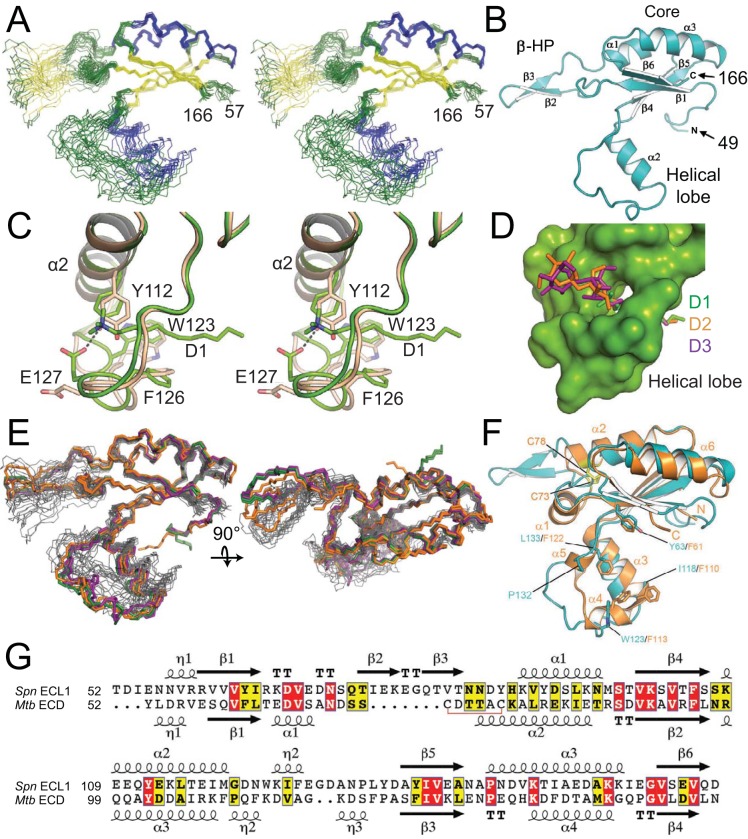
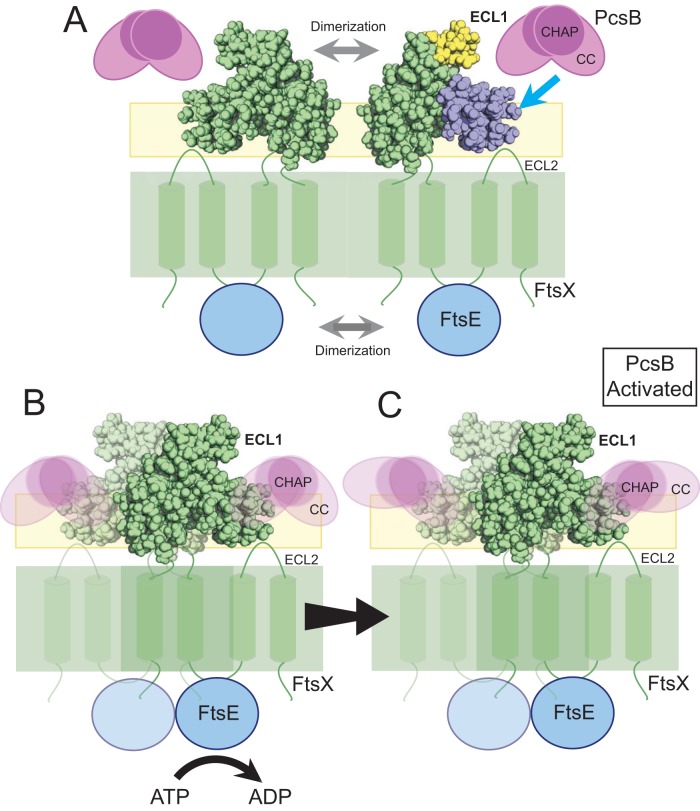
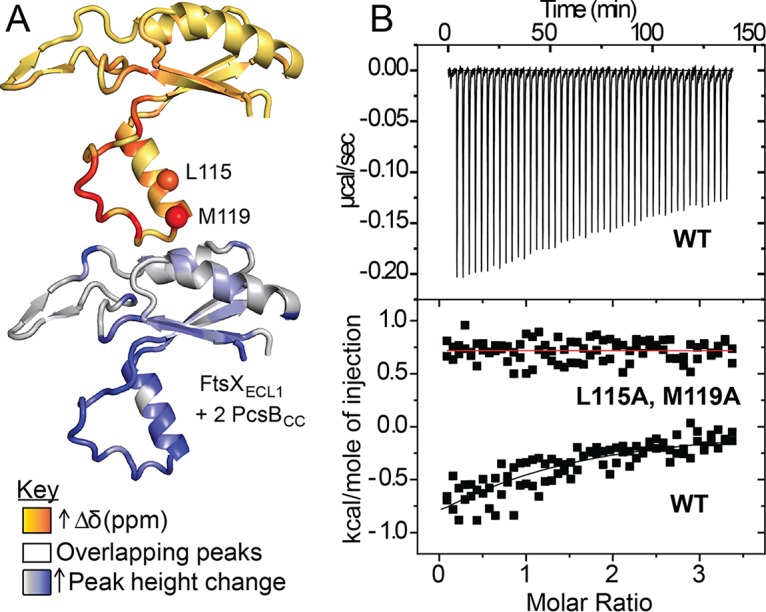
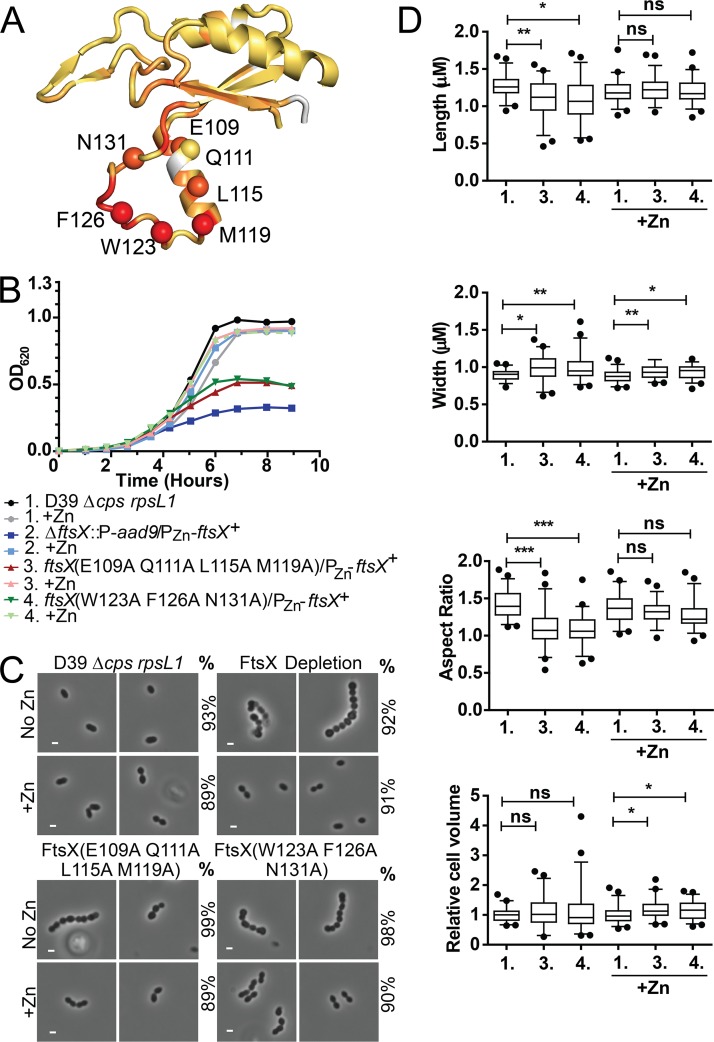
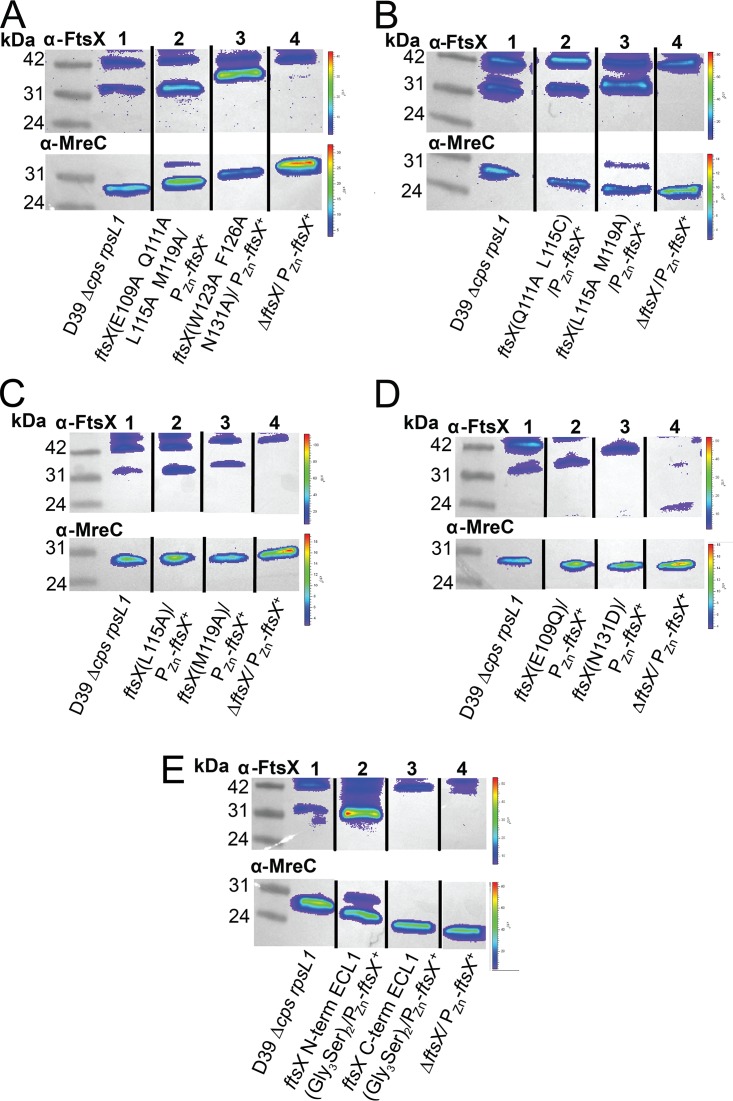
is a leading killer of infants and immunocompromised adults and has become increasingly resistant to major antibiotics. Therefore, the development of new antibiotic strategies is desperately needed. Targeting bacterial cell division is one such strategy, specifically by targeting proteins that are essential for the synthesis and breakdown of peptidoglycan. One complex important to this process is FtsEX. FtsEX comprises a cell division-regulating integral membrane protein (FtsX) and a cytoplasmic ATPase (FtsE) that resembles an ATP-binding cassette (ABC) transporter. Here, we present nuclear magnetic resonance (NMR) solution structural and crystallographic models of the large extracellular domain of FtsX, denoted extracellular loop 1 (ECL1). The structure of ECL1 reveals an upper extended β-hairpin and a lower α-helical lobe, each extending from a mixed α-β core. The helical lobe mediates a physical interaction with the peptidoglycan hydrolase PcsB via the coiled-coil domain of PcsB (PscB). Characterization of strain D39-derived strains harboring mutations in the α-helical lobe shows that this subdomain is essential for cell viability and required for proper cell division of FtsX is a ubiquitous bacterial integral membrane protein involved in cell division that regulates the activity of peptidoglycan (PG) hydrolases. FtsX is representative of a large group of ABC3 superfamily proteins that function as "mechanotransmitters," proteins that relay signals from the inside to the outside of the cell. Here, we present a structural characterization of the large extracellular loop, ECL1, of FtsX from the opportunistic human pathogen We show the molecular nature of the direct interaction between the peptidoglycan hydrolase PcsB and FtsX and demonstrate that this interaction is essential for cell viability. As such, FtsX represents an attractive, conserved target for the development of new classes of antibiotics.
是婴儿和免疫功能低下成年人的主要杀手,并且对主要抗生素的耐药性越来越强。因此,迫切需要开发新的抗生素策略。靶向细菌细胞分裂就是这样一种策略,特别是通过靶向对肽聚糖的合成和分解至关重要的蛋白质。在这个过程中,一个重要的复合物是 FtsEX。FtsEX 由一个细胞分裂调节的整合膜蛋白(FtsX)和一个细胞质 ATP 酶(FtsE)组成,类似于 ATP 结合盒(ABC)转运蛋白。在这里,我们展示了 FtsX 的大细胞外结构域的核磁共振(NMR)溶液结构和晶体结构模型,称为细胞外环 1(ECL1)。ECL1 的结构揭示了一个上延伸的β发夹和一个下α螺旋叶,每个叶从混合的α-β核心延伸。螺旋叶通过 PcsB 的卷曲螺旋结构域(PscB)介导与肽聚糖水解酶 PcsB 的物理相互作用。对源于 D39 株的菌株的特性进行的研究表明,该亚结构域对于细胞活力是必需的,并且对于 FtsX 的正确细胞分裂是必需的。FtsX 是一种普遍存在的细菌整合膜蛋白,参与细胞分裂,调节肽聚糖(PG)水解酶的活性。FtsX 是 ABC3 超家族蛋白的一个代表,作为“机械转导蛋白”,这些蛋白将信号从细胞内传递到细胞外。在这里,我们展示了来自机会性病原体 FtsX 的大细胞外环 1(ECL1)的结构特征。我们展示了肽聚糖水解酶 PcsB 与 FtsX 之间直接相互作用的分子性质,并证明这种相互作用对于细胞活力是必需的。因此,FtsX 代表了开发新型抗生素的有吸引力的保守靶标。