Wang Gang, Gong Yu, Zhu Yi-Xin, Miao Ai-Jun, Yang Liu-Yan, Zhong Huan
State Key Laboratory of Pollution Control and Resource Reuse, School of the Environment, Nanjing University, Nanjing 210023, China.
CQC Intime Testing Technology Co. Ltd., Suzhou 210023, China.
Int J Environ Res Public Health. 2017 May 12;14(5):525. doi: 10.3390/ijerph14050525.
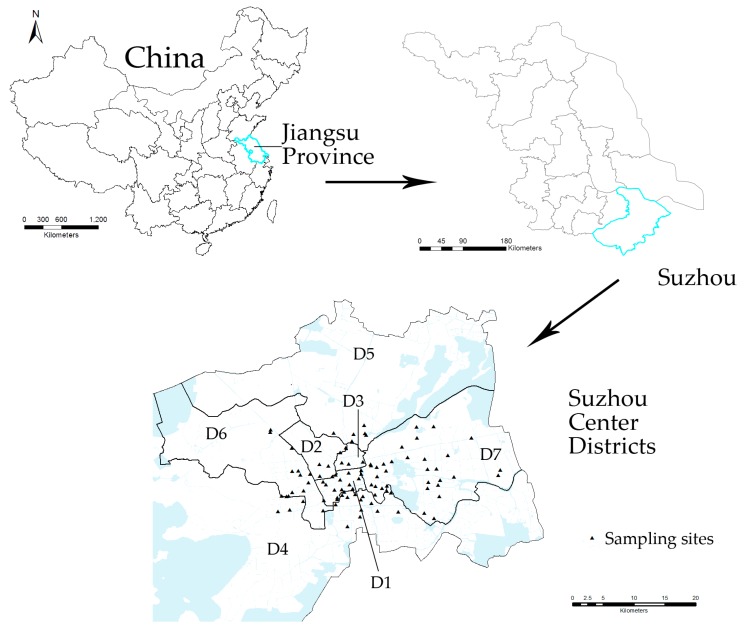
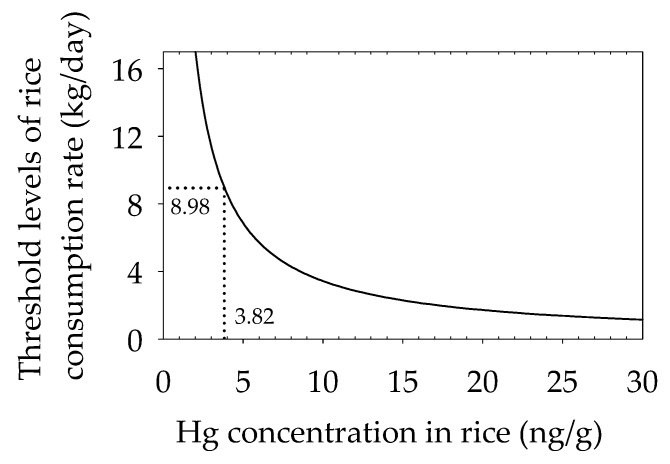
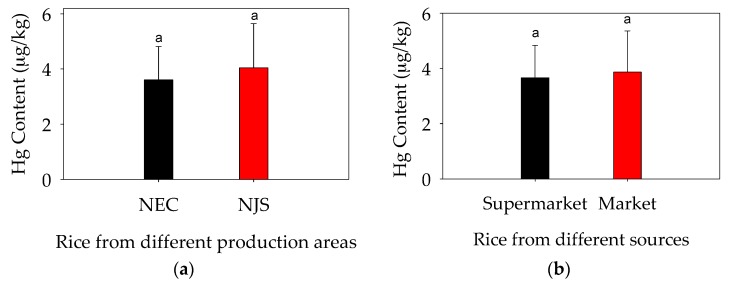
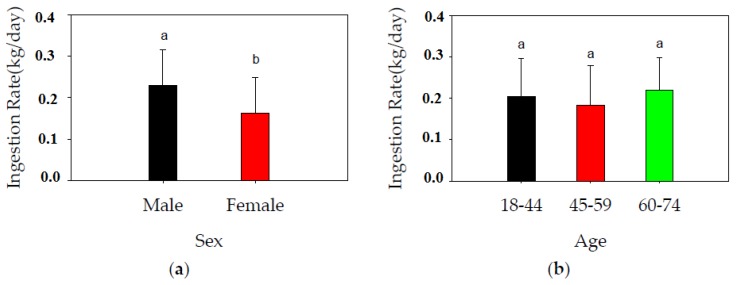
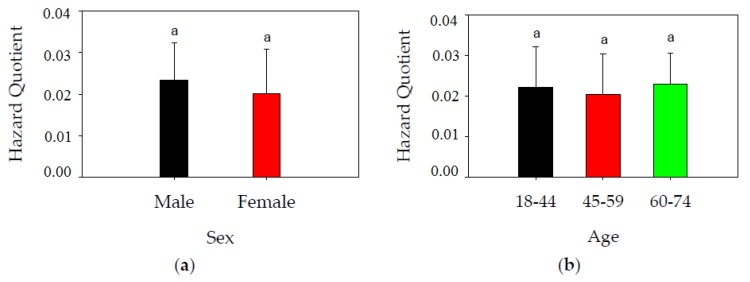
Recent studies have revealed that not only fish but also rice consumption may significantly contribute to human exposure to mercury (Hg) in Asian countries. It is therefore essential to assess dietary exposure to Hg in rice and its associated health risk. However, risk assessments of Hg in rice in non-contaminated areas are generally lacking in Asian countries. In the present study, Hg concentrations were measured in rice samples collected from markets and supermarkets in Suzhou, a typical city in Eastern China. In addition, the rice ingestion rates (IR) were assessed via a questionnaire-based survey of Suzhou residents. The data were then used to assess the risk of Hg exposure associated with rice consumption, by calculating the hazard quotient (HQ). Hg contents in rice samples were well below the national standard (20 μg/kg), ranging from 1.46 to 8.48 ng/g. They were also significantly ( > 0.05) independent of the area of production and place of purchase (markets vs. supermarkets in the different districts). Our results indicate a low risk of Hg exposure from rice in Suzhou (HQ: 0.005-0.05), despite the generally high personal IR (0.05-0.4 kg/day). The risk of Hg associated with rice consumption for Suzhou residents was not significantly affected by the age or sex of the consumer ( > 0.05). Overall, our results provide a study of human exposure to Hg in rice in Chinese cities not known to be contaminated with Hg. Future studies should examine Hg exposure in different areas in China and in potentially vulnerable major food types.
最近的研究表明,在亚洲国家,不仅鱼类,食用大米也可能显著增加人类汞(Hg)的摄入量。因此,评估大米中汞的膳食暴露量及其相关健康风险至关重要。然而,亚洲国家普遍缺乏对未受污染地区大米中汞的风险评估。在本研究中,对从中国东部典型城市苏州的市场和超市采集的大米样本中的汞浓度进行了测量。此外,通过对苏州居民进行问卷调查来评估大米摄入量(IR)。然后,通过计算危害商数(HQ),利用这些数据评估与大米消费相关的汞暴露风险。大米样本中的汞含量远低于国家标准(20μg/kg),范围为1.46至8.48ng/g。它们也与产地和购买地点(不同区的市场与超市)显著无关(P>0.05)。我们的结果表明,苏州大米的汞暴露风险较低(HQ:0.005 - 0.05),尽管个人大米摄入量普遍较高(0.05 - 0.4kg/天)。苏州居民大米消费相关的汞风险不受消费者年龄或性别的显著影响(P>0.05)。总体而言,我们的结果为中国未知汞污染城市人类大米汞暴露情况提供了一项研究。未来的研究应考察中国不同地区以及潜在易受影响的主要食物类型中的汞暴露情况。