Jones Natalia R, Millman Caroline, van der Es Mike, Hukelova Miroslava, Forbes Ken J, Glover Catherine, Haldenby Sam, Hunter Paul R, Jackson Kathryn, O'Brien Sarah J, Rigby Dan, Strachan Norval J C, Williams Nicola, Lake Iain R
School of Environmental Sciences, University of East Anglia, Norwich, United Kingdom
Department of Economics, School of Social Sciences, University of Manchester, Manchester, United Kingdom.
Appl Environ Microbiol. 2017 Jun 30;83(14). doi: 10.1128/AEM.00162-17. Print 2017 Jul 15.
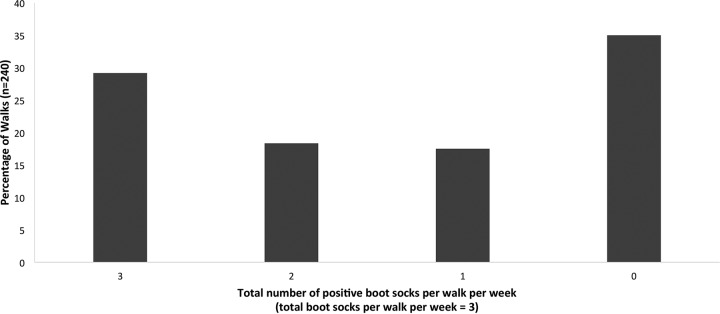
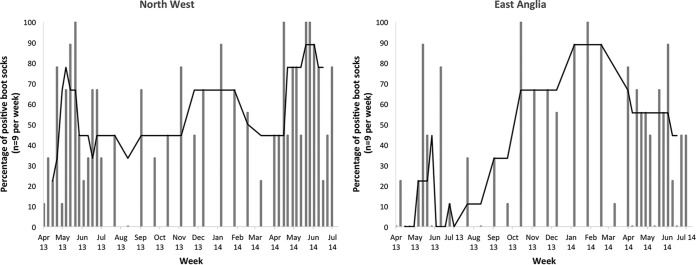
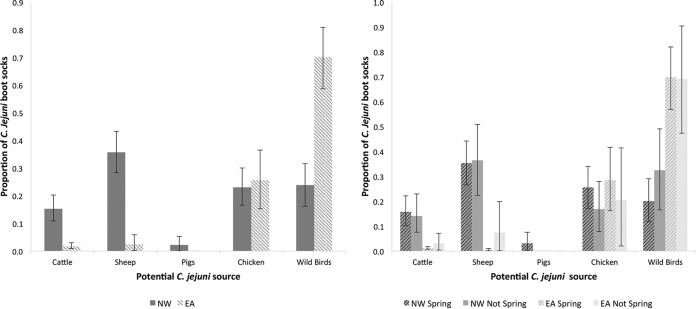
This paper introduces a novel method for sampling pathogens in natural environments. It uses fabric boot socks worn over walkers' shoes to allow the collection of composite samples over large areas. Wide-area sampling is better suited to studies focusing on human exposure to pathogens (e.g., recreational walking). This sampling method is implemented using a citizen science approach: groups of three walkers wearing boot socks undertook one of six routes, 40 times over 16 months in the North West (NW) and East Anglian (EA) regions of England. To validate this methodology, we report the successful implementation of this citizen science approach, the observation that bacteria were detected on 47% of boot socks, and the observation that multiple boot socks from individual walks produced consistent results. The findings indicate higher levels in the livestock-dominated NW than in EA (55.8% versus 38.6%). Seasonal differences in the presence of bacteria were found between the regions, with indications of winter peaks in both regions but a spring peak in the NW. The presence of bacteria on boot socks was negatively associated with ambient temperature ( = 0.011) and positively associated with precipitation ( < 0.001), results consistent with our understanding of survival and the probability of material adhering to boot socks. was the predominant species found; was largely restricted to the livestock-dominated NW. Source attribution analysis indicated that the potential source of was predominantly sheep in the NW and wild birds in EA but did not differ between peak and nonpeak periods of human incidence. There is debate in the literature on the pathways through which pathogens are transferred from the environment to humans. We report on the success of a novel method for sampling human-pathogen interactions using boot socks and citizen science techniques, which enable us to sample human-pathogen interactions that may occur through visits to natural environments. This contrasts with traditional environmental sampling, which is based on spot sampling techniques and does not sample human-pathogen interactions. Our methods are of practical value to scientists trying to understand the transmission of pathogens from the environment to people. Our findings provide insight into the risk of exposure from recreational visits and an understanding of seasonal differences in risk and the factors behind these patterns. We highlight the species predominantly encountered and the potential sources of .
本文介绍了一种在自然环境中对病原体进行采样的新方法。该方法利用套在步行者鞋子上的织物靴套,以便在大面积区域收集复合样本。广域采样更适合于关注人类接触病原体的研究(例如休闲步行)。这种采样方法采用公民科学的方式实施:三组穿着靴套的步行者在英格兰西北部(NW)和东安格利亚(EA)地区,于16个月内40次走完六条路线中的一条。为验证该方法,我们报告了这种公民科学方法的成功实施情况,观察到47%的靴套上检测到了细菌,以及单次步行中多个靴套产生了一致结果。研究结果表明,以畜牧业为主的NW地区的细菌水平高于EA地区(55.8%对38.6%)。两个地区在细菌存在情况上存在季节性差异,两个地区均显示冬季出现峰值,但NW地区在春季出现峰值。靴套上细菌的存在与环境温度呈负相关( = 0.011),与降水量呈正相关( < 0.001),这一结果与我们对细菌生存以及物质附着在靴套上的概率的理解一致。 是发现的主要物种; 主要局限于以畜牧业为主的NW地区。源归因分析表明,NW地区 的潜在来源主要是绵羊,EA地区是野生鸟类,但在人类发病的高峰期和非高峰期之间没有差异。关于病原体从环境转移到人类的途径,文献中存在争议。我们报告了一种使用靴套和公民科学技术对人类与病原体相互作用进行采样的新方法的成功情况,该方法使我们能够对因前往自然环境而可能发生的人类与病原体相互作用进行采样。这与传统环境采样形成对比,传统环境采样基于定点采样技术,不采样人类与病原体的相互作用。我们的方法对试图了解病原体从环境传播到人类的科学家具有实际价值。我们的研究结果为休闲出行导致 暴露的风险提供了见解,并有助于理解风险的季节性差异以及这些模式背后的因素。我们强调了主要遇到的 物种以及 的潜在来源。