Li Qinrui, Han Ying, Dy Angel Belle C, Hagerman Randi J
Department of Pediatrics, Peking University First HospitalBeijing, China.
School of Medicine and Public Health, Ateneo de Manila UniversityQuezon City, Philippines.
Front Cell Neurosci. 2017 Apr 28;11:120. doi: 10.3389/fncel.2017.00120. eCollection 2017.
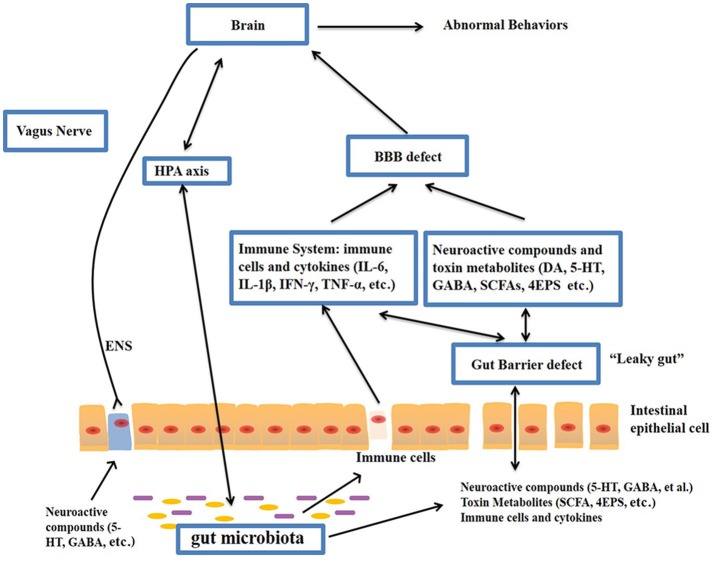
Gastrointestinal (GI) symptoms are a common comorbidity in patients with autism spectrum disorder (ASD), but the underlying mechanisms are unknown. Many studies have shown alterations in the composition of the fecal flora and metabolic products of the gut microbiome in patients with ASD. The gut microbiota influences brain development and behaviors through the neuroendocrine, neuroimmune and autonomic nervous systems. In addition, an abnormal gut microbiota is associated with several diseases, such as inflammatory bowel disease (IBD), ASD and mood disorders. Here, we review the bidirectional interactions between the central nervous system and the gastrointestinal tract (brain-gut axis) and the role of the gut microbiota in the central nervous system (CNS) and ASD. Microbiome-mediated therapies might be a safe and effective treatment for ASD.
胃肠道(GI)症状是自闭症谱系障碍(ASD)患者常见的合并症,但其潜在机制尚不清楚。许多研究表明,ASD患者的粪便菌群组成及肠道微生物群的代谢产物存在改变。肠道微生物群通过神经内分泌、神经免疫和自主神经系统影响大脑发育和行为。此外,肠道微生物群异常与多种疾病有关,如炎症性肠病(IBD)、ASD和情绪障碍。在此,我们综述中枢神经系统与胃肠道之间的双向相互作用(脑-肠轴)以及肠道微生物群在中枢神经系统(CNS)和ASD中的作用。微生物群介导的疗法可能是治疗ASD的一种安全有效的方法。