Department of Experimental and Applied Psychology & Institute for Brain and Behavior Amsterdam (iBBA), Vrije Universiteit, Amsterdam, The Netherlands.
Department of Psychology, Durham University, Durham, UK.
Sci Rep. 2017 May 15;7(1):1886. doi: 10.1038/s41598-017-01911-0.
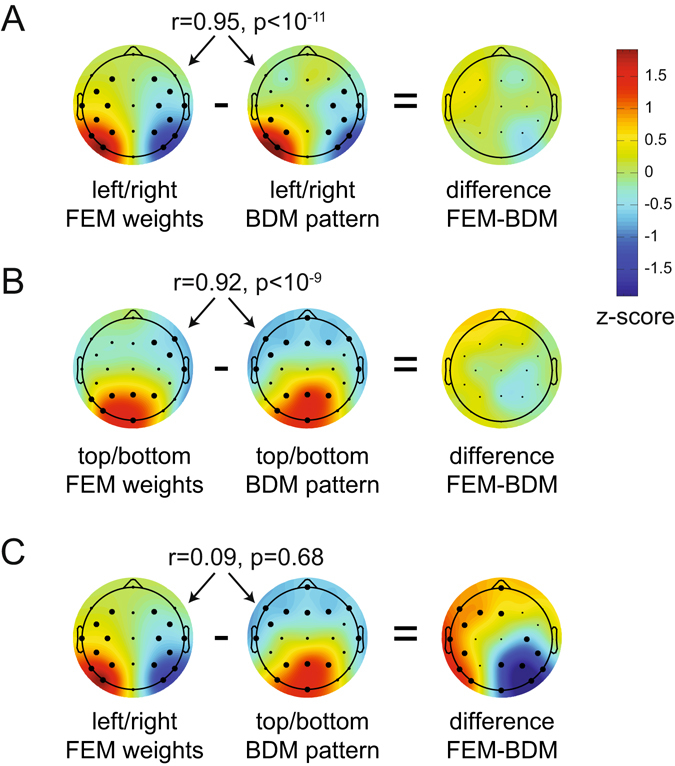
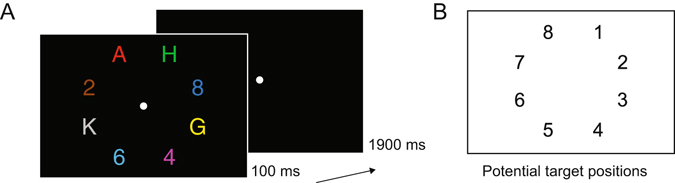
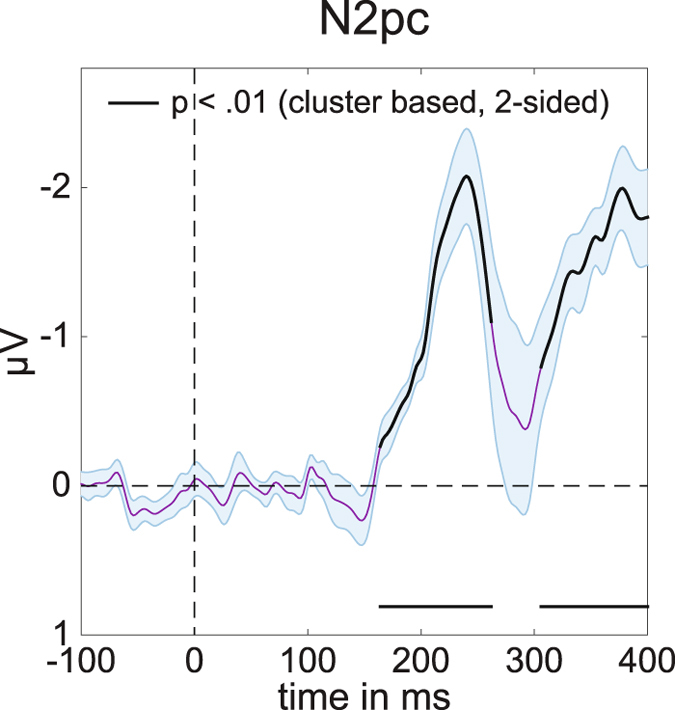
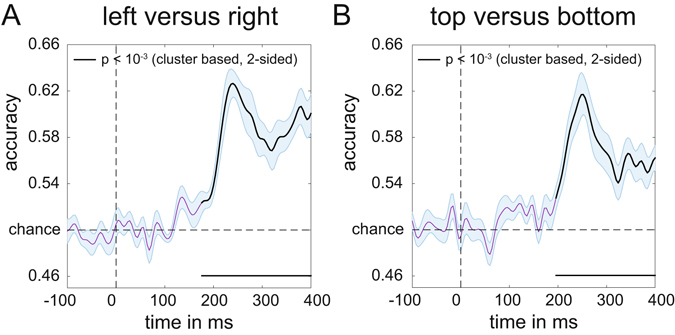
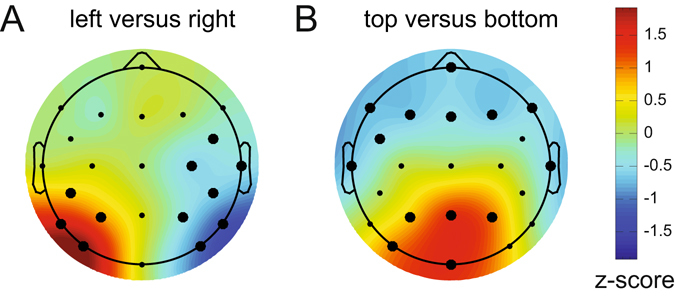
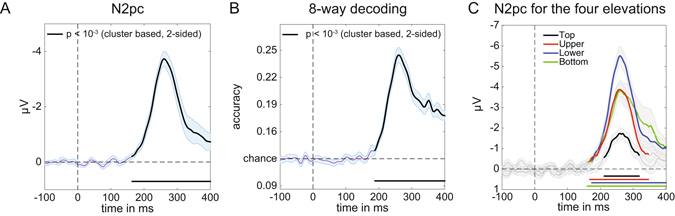
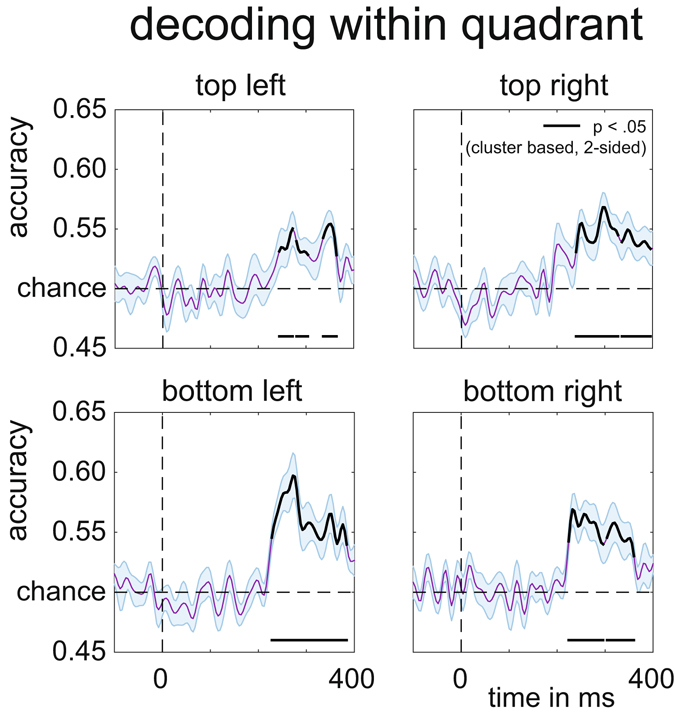
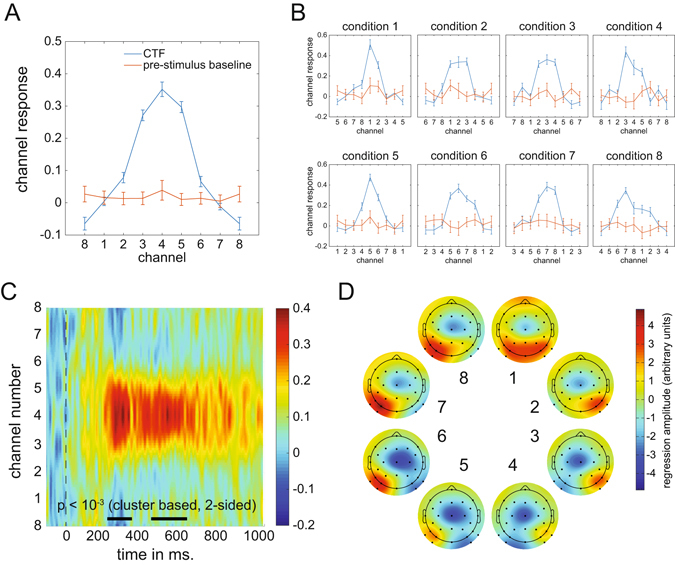
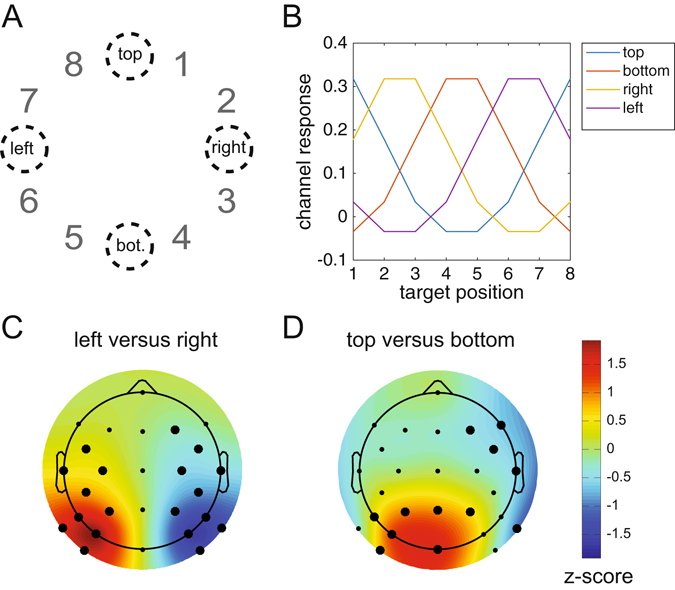
The primary electrophysiological marker of feature-based selection is the N2pc, a lateralized posterior negativity emerging around 180-200 ms. As it relies on hemispheric differences, its ability to discriminate the locus of focal attention is severely limited. Here we demonstrate that multivariate analyses of raw EEG data provide a much more fine-grained spatial profile of feature-based target selection. When training a pattern classifier to determine target position from EEG, we were able to decode target positions on the vertical midline, which cannot be achieved using standard N2pc methodology. Next, we used a forward encoding model to construct a channel tuning function that describes the continuous relationship between target position and multivariate EEG in an eight-position display. This model can spatially discriminate individual target positions in these displays and is fully invertible, enabling us to construct hypothetical topographic activation maps for target positions that were never used. When tested against the real pattern of neural activity obtained from a different group of subjects, the constructed maps from the forward model turned out statistically indistinguishable, thus providing independent validation of our model. Our findings demonstrate the power of multivariate EEG analysis to track feature-based target selection with high spatial and temporal precision.
基于特征的选择的主要电生理标记是 N2pc,这是一种在 180-200ms 左右出现的侧化后负波。由于它依赖于半球差异,因此其区分焦点注意位置的能力受到严重限制。在这里,我们证明了原始 EEG 数据的多元分析可以提供更精细的基于特征的目标选择的空间分布。当我们使用模式分类器从 EEG 中确定目标位置时,我们能够解码垂直中线的目标位置,而这是使用标准 N2pc 方法无法实现的。接下来,我们使用前向编码模型构建了一个通道调谐函数,该函数描述了在八位置显示中目标位置与多元 EEG 之间的连续关系。该模型可以在这些显示中空间区分单个目标位置,并且是完全可逆的,这使我们能够为从未使用过的目标位置构建假设的地形激活图。当我们用来自不同组的被试的实际神经活动模式对其进行测试时,从正向模型构建的地图在统计学上是无法区分的,因此为我们的模型提供了独立的验证。我们的研究结果表明,多元 EEG 分析在跟踪基于特征的目标选择方面具有高度的时空精度。