• 文献检索
  • 文档翻译
  • 深度研究
  • 学术资讯
  • Suppr Zotero 插件Zotero 插件
  • 邀请有礼
  • 套餐&价格
  • 历史记录
应用&插件
Suppr Zotero 插件Zotero 插件浏览器插件Mac 客户端Windows 客户端微信小程序
定价
高级版会员购买积分包购买API积分包
服务
文献检索文档翻译深度研究API 文档MCP 服务
关于我们
关于 Suppr公司介绍联系我们用户协议隐私条款
关注我们

Suppr 超能文献

核心技术专利:CN118964589B侵权必究
粤ICP备2023148730 号-1Suppr @ 2026

文献检索

告别复杂PubMed语法,用中文像聊天一样搜索,搜遍4000万医学文献。AI智能推荐,让科研检索更轻松。

立即免费搜索

文件翻译

保留排版,准确专业,支持PDF/Word/PPT等文件格式,支持 12+语言互译。

免费翻译文档

深度研究

AI帮你快速写综述,25分钟生成高质量综述,智能提取关键信息,辅助科研写作。

立即免费体验

研究短信提醒对提高囊性纤维化儿童和青少年雾化药物治疗依从性的可行性。

Investigating the feasibility of text message reminders to improve adherence to nebulized medication in children and adolescents with cystic fibrosis.

作者信息

Morton Robert W, Elphick Heather E, Edwards Elaine, Daw William J, West Noreen S

机构信息

Cystic Fibrosis Unit, Sheffield Children's Hospital.

Academic Unit of Child Health, University of Sheffield, Sheffield, UK.

出版信息

Patient Prefer Adherence. 2017 May 8;11:861-869. doi: 10.2147/PPA.S123723. eCollection 2017.

DOI:10.2147/PPA.S123723
PMID:28507430
原文链接:https://pmc.ncbi.nlm.nih.gov/articles/PMC5428764/
Abstract

BACKGROUND

Children with cystic fibrosis (CF) often have suboptimal adherence rates to nebulized medication. Adherence barriers cited include forgetting to take the nebulizers, due to busy home and social lives. Text message reminders have been shown to be effective at improving adherence rates in other chronic diseases such as asthma and diabetes.

OBJECTIVE

The objective of this study was to assess the feasibility and efficacy of sending text reminders for a prolonged period of time to children with CF.

MATERIALS AND METHODS

Children with CF aged 5-16 years taking at least one medication via a nebulizer with an electronic adherence monitor were consented for the study. Text message reminders were sent to participants and/or parents via the hospital's automated text service, up to twice a day, for 6 months. The adherence rates for the 6-month text period were compared to the previous 6 months before the study. Rates were calculated for weekdays, weekends, and school holidays.

RESULTS

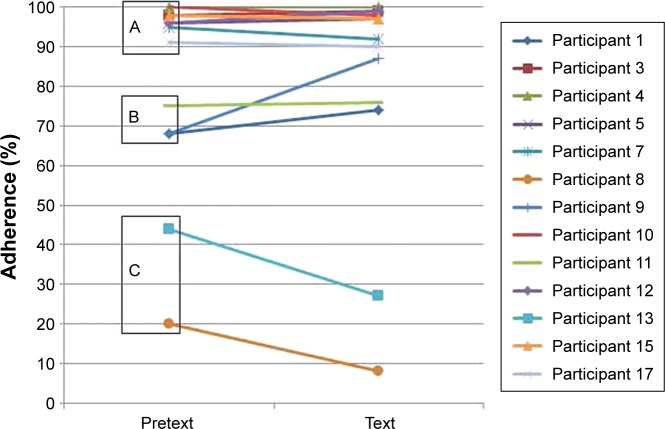
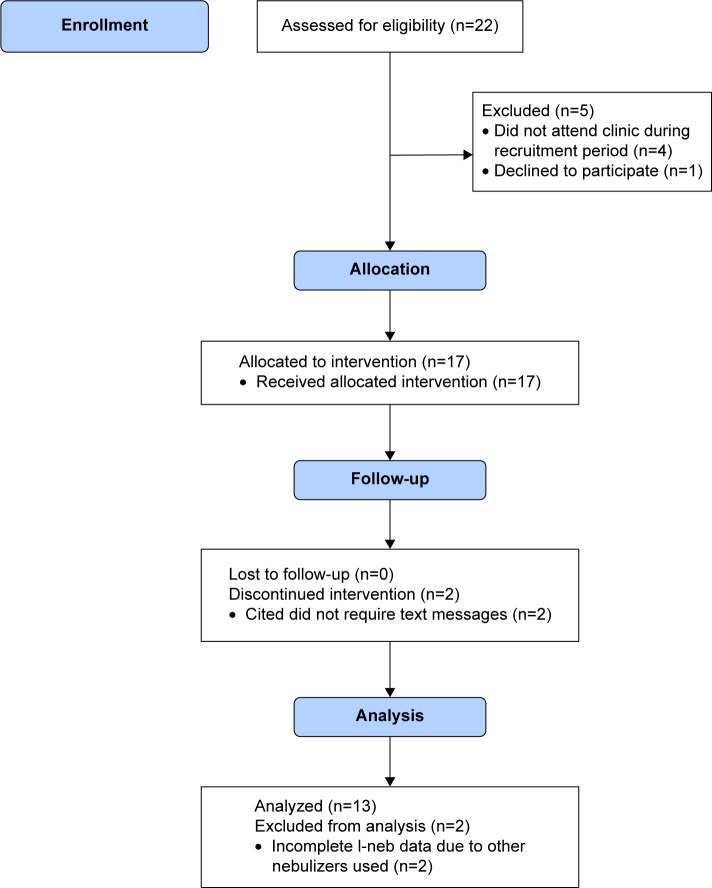
Seventeen participants were recruited to the study, with a mean age of 12 years and a mean forced expiratory volume in 1 second (FEV1) of 81% predicted. Fifteen children completed the 6-month text period, and I-neb data were accurately analyzed for 13 participants. The mean adherence rate in the 6 months receiving texts was 80%, compared to 81% in the prior 6 months. Overall adherence rates on weekdays, weekends, and school holidays were equivalent during the 2 time periods. A subgroup of patients with moderate baseline adherence showed increased adherence during the text period, particularly at weekends.

CONCLUSION

It is feasible to send text message reminders to children with CF, and they are amenable to this approach. Although text reminders do not increase rates in patients with existing optimal adherence, they may be of value in patients with more moderate baseline rates.

摘要

背景

囊性纤维化(CF)患儿对雾化药物的依从率往往不理想。所提及的依从障碍包括因家庭和社交生活繁忙而忘记使用雾化器。短信提醒已被证明在提高哮喘和糖尿病等其他慢性病的依从率方面有效。

目的

本研究的目的是评估向CF患儿长期发送短信提醒的可行性和有效性。

材料与方法

年龄在5至16岁、通过雾化器服用至少一种药物且配备电子依从性监测器的CF患儿同意参与本研究。通过医院的自动短信服务向参与者和/或家长发送短信提醒,每天最多两次,持续6个月。将6个月短信期的依从率与研究前的前6个月进行比较。计算工作日、周末和学校假期的依从率。

结果

17名参与者被纳入研究,平均年龄为12岁,1秒用力呼气容积(FEV1)平均为预测值的81%。15名儿童完成了6个月的短信期,对13名参与者的I-neb数据进行了准确分析。接受短信的6个月内平均依从率为80%,而前6个月为81%。两个时间段内工作日、周末和学校假期的总体依从率相当。一组基线依从性中等的患者在短信期内依从性增加,尤其是在周末。

结论

向CF患儿发送短信提醒是可行的,他们也适合这种方法。虽然短信提醒不会提高现有依从性最佳的患者的依从率,但可能对基线依从率较为中等的患者有价值。
https://cdn.ncbi.nlm.nih.gov/pmc/blobs/36a9/5428764/93b3c19fc2ce/ppa-11-861Fig2.jpg
https://cdn.ncbi.nlm.nih.gov/pmc/blobs/36a9/5428764/ef2066b8d8fa/ppa-11-861Fig1.jpg
https://cdn.ncbi.nlm.nih.gov/pmc/blobs/36a9/5428764/93b3c19fc2ce/ppa-11-861Fig2.jpg
https://cdn.ncbi.nlm.nih.gov/pmc/blobs/36a9/5428764/ef2066b8d8fa/ppa-11-861Fig1.jpg
https://cdn.ncbi.nlm.nih.gov/pmc/blobs/36a9/5428764/93b3c19fc2ce/ppa-11-861Fig2.jpg

相似文献

1
Investigating the feasibility of text message reminders to improve adherence to nebulized medication in children and adolescents with cystic fibrosis.研究短信提醒对提高囊性纤维化儿童和青少年雾化药物治疗依从性的可行性。
Patient Prefer Adherence. 2017 May 8;11:861-869. doi: 10.2147/PPA.S123723. eCollection 2017.
2
Text-message reminders to improve sunscreen use: a randomized, controlled trial using electronic monitoring.通过短信提醒提高防晒霜使用率:一项使用电子监测的随机对照试验
Arch Dermatol. 2009 Nov;145(11):1230-6. doi: 10.1001/archdermatol.2009.269.
3
Controller adherence following hospital discharge in high risk children: A pilot randomized trial of text message reminders.高危儿童出院后的医嘱依从性:短信提醒的一项初步随机试验
J Asthma. 2019 Jan;56(1):95-103. doi: 10.1080/02770903.2018.1424195. Epub 2018 Feb 13.
4
Feasibility of interactive text message response (ITR) as a novel, real-time measure of adherence to antiretroviral therapy for HIV+ youth.互动式短信回复(ITR)作为一种新颖的、实时的抗 HIV 青少年抗逆转录病毒治疗依从性测量方法的可行性。
AIDS Behav. 2013 Jul;17(6):2237-43. doi: 10.1007/s10461-013-0464-6.
5
Impact of text message reminders on immunosuppressive medication adherence among kidney transplant recipients: A randomized controlled study.短信提醒对肾移植受者免疫抑制药物依从性的影响:一项随机对照研究。
J Eval Clin Pract. 2025 Feb;31(1):e14178. doi: 10.1111/jep.14178. Epub 2024 Oct 16.
6
Automated Adherence Reminders for High Risk Children With Asthma: A Research Protocol.针对高危哮喘儿童的自动依从性提醒:一项研究方案。
JMIR Res Protoc. 2017 Mar 27;6(3):e48. doi: 10.2196/resprot.6674.
7
A Systematic Review of the Effectiveness of Text Message Reminders on Asthma Medication Adherence.短信提醒对哮喘药物依从性有效性的系统评价
Innov Pharm. 2018 Oct 16;9(3):1-7. doi: 10.24926/iip.v9i3.1370. eCollection 2018.
8
The Impact of Text Messaging on Medication Adherence and Exercise Among Postmyocardial Infarction Patients: Randomized Controlled Pilot Trial.短信对心肌梗死后患者药物依从性和运动的影响:随机对照试验。
JMIR Mhealth Uhealth. 2017 Aug 3;5(8):e110. doi: 10.2196/mhealth.7144.
9
Therapeutic effects of mobile-based text message reminders for medication adherence in bipolar I disorder: Are they maintained after intervention cessation?基于移动设备的短信提醒对双相情感障碍 I 型患者药物依从性的治疗效果:干预停止后是否仍能维持?
J Psychiatr Res. 2018 Sep;104:163-168. doi: 10.1016/j.jpsychires.2018.07.013. Epub 2018 Jul 26.
10
A response to COVID-19 school closures: The feasibility of a school-linked text message intervention as an adaptation to school-supervised asthma therapy.应对 COVID-19 学校关闭的措施:将学校短信干预作为一种适应学校监督哮喘治疗方法的可行性。
Pediatr Pulmonol. 2022 May;57(5):1214-1222. doi: 10.1002/ppul.25851. Epub 2022 Feb 16.

引用本文的文献

1
Children and young people's preferences and needs when using health technology to self-manage a long-term condition: a scoping review.儿童和青少年在使用健康技术自我管理长期疾病时的偏好和需求:范围综述。
Arch Dis Child. 2024 Sep 25;109(10):826-835. doi: 10.1136/archdischild-2023-326044.
2
Cross-Cutting mHealth Behavior Change Techniques to Support Treatment Adherence and Self-Management of Complex Medical Conditions: Systematic Review.交叉切割移动健康行为改变技术以支持复杂医疗状况的治疗依从性和自我管理:系统评价。
JMIR Mhealth Uhealth. 2024 May 1;12:e49024. doi: 10.2196/49024.
3
A Participatory Approach Involving Patients with Cystic Fibrosis and Healthcare Professionals for the Co-Design of an Adherence-Enhancing Intervention Toolkit.

本文引用的文献

1
e-Monitoring of Asthma Therapy to Improve Compliance in children (e-MATIC): a randomised controlled trial.电子哮喘治疗监测以提高儿童依从性(e-MATIC):一项随机对照试验。
Eur Respir J. 2016 Sep;48(3):758-67. doi: 10.1183/13993003.01698-2015. Epub 2016 May 26.
2
Moving cystic fibrosis care from rescue to prevention by embedding adherence measurement in routine care.通过在常规护理中嵌入依从性测量,将囊性纤维化护理从抢救转向预防。
Paediatr Respir Rev. 2014 Jun;15 Suppl 1:16-8. doi: 10.1016/j.prrv.2014.04.007. Epub 2014 Apr 13.
3
Patient reminder systems and asthma medication adherence: a systematic review.
一种让囊性纤维化患者和医疗保健专业人员共同参与的方法,用于共同设计一个增强依从性的干预工具包。
Patient Prefer Adherence. 2023 Apr 10;17:995-1004. doi: 10.2147/PPA.S389792. eCollection 2023.
4
Is mHealth a useful therapy for improving physical or emotional health in adolescents with cystic fibrosis? A systematic review.移动健康对改善囊性纤维化青少年的身体或情绪健康是否是一种有效的疗法?一项系统综述。
Curr Psychol. 2021 Nov 24:1-14. doi: 10.1007/s12144-021-02452-6.
5
Telemedicine in cystic fibrosis.囊性纤维化中的远程医疗
J Clin Transl Endocrinol. 2021 Oct 26;26:100270. doi: 10.1016/j.jcte.2021.100270. eCollection 2021 Dec.
6
Aerosol Therapy in Asthma-Why We Are Failing Our Patients and How We Can Do Better.哮喘的雾化治疗——为何我们辜负了患者以及如何做得更好
Front Pediatr. 2020 Jun 11;8:305. doi: 10.3389/fped.2020.00305. eCollection 2020.
7
Digital technologies and adherence in respiratory diseases: the road ahead.数字技术与呼吸系统疾病的依从性:未来之路。
Eur Respir J. 2018 Nov 22;52(5). doi: 10.1183/13993003.01147-2018. Print 2018 Nov.
患者提醒系统与哮喘药物依从性:一项系统综述
J Asthma. 2014 Jun;51(5):536-43. doi: 10.3109/02770903.2014.888572. Epub 2014 Feb 13.
4
Pulmonary medication adherence and health-care use in cystic fibrosis.囊性纤维化患者的肺部药物治疗依从性和医疗保健使用情况。
Chest. 2014 Jul;146(1):142-151. doi: 10.1378/chest.13-1926.
5
Mobile phone text messages for improving adherence to antiretroviral therapy (ART): an individual patient data meta-analysis of randomised trials.手机短信提高抗逆转录病毒治疗(ART)依从性:一项随机试验的个体患者数据荟萃分析。
BMJ Open. 2013 Dec 17;3(12):e003950. doi: 10.1136/bmjopen-2013-003950.
6
Adherence to nebulised therapies in adolescents with cystic fibrosis is best on week-days during school term-time.青少年囊性纤维化患者在上学期间的工作日对雾化治疗的依从性最佳。
J Cyst Fibros. 2013 Sep;12(5):440-4. doi: 10.1016/j.jcf.2012.12.012. Epub 2013 Jan 29.
7
New nebulizer technology to monitor adherence and nebulizer performance in cystic fibrosis.新型雾化器技术可监测囊性纤维化患者的用药依从性和雾化器性能。
J Aerosol Med Pulm Drug Deliv. 2012 Dec;25(6):307-9. doi: 10.1089/jamp.2011.0934. Epub 2012 Aug 2.
8
Multi-ethnic reference values for spirometry for the 3-95-yr age range: the global lung function 2012 equations.用于 3-95 岁年龄范围的肺量测定的多民族参考值:全球肺功能 2012 方程。
Eur Respir J. 2012 Dec;40(6):1324-43. doi: 10.1183/09031936.00080312. Epub 2012 Jun 27.
9
SMS reminders improve adherence to oral medication in type 2 diabetes patients who are real time electronically monitored.短信提醒可提高实时电子监测的 2 型糖尿病患者对口服药物的依从性。
Int J Med Inform. 2012 Sep;81(9):594-604. doi: 10.1016/j.ijmedinf.2012.05.005. Epub 2012 May 30.
10
Barriers to adherence in adolescents and young adults with cystic fibrosis: a questionnaire study in young patients and their parents.青少年和青年囊性纤维化患者的依从性障碍:一项针对年轻患者及其父母的问卷调查研究
Patient Prefer Adherence. 2011;5:507-15. doi: 10.2147/PPA.S25308. Epub 2011 Oct 11.