Deganutti Giuseppe, Moro Stefano
Molecular Modeling Section (MMS), Department of Pharmaceutical and Pharmacological Sciences, University of Padova, Via Marzolo 5, 35131 Padua, Italy.
Molecules. 2017 May 16;22(5):818. doi: 10.3390/molecules22050818.
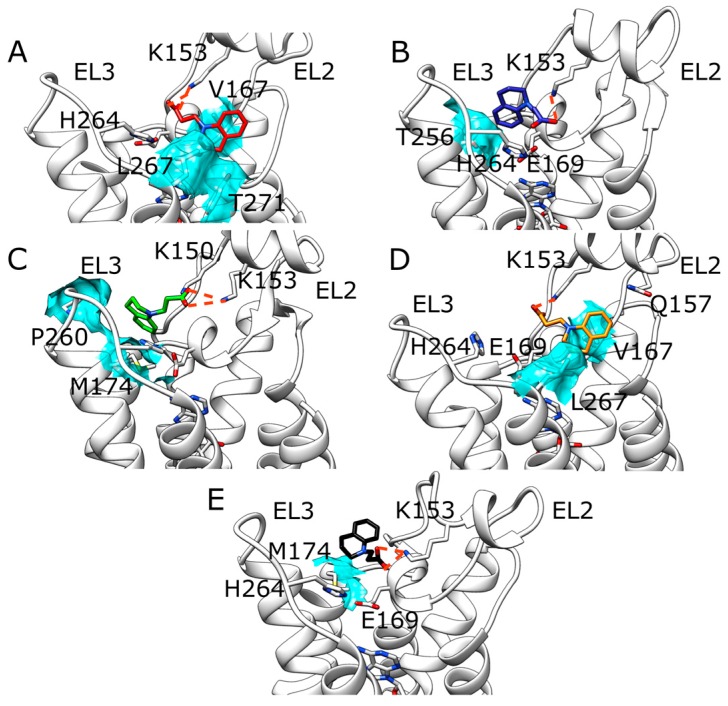
Structure-driven fragment-based (SDFB) approaches have provided efficient methods for the identification of novel drug candidates. This strategy has been largely applied in discovering several pharmacological ligand classes, including enzyme inhibitors, receptor antagonists and, more recently, also allosteric (positive and negative) modulators. Recently, Siegal and collaborators reported an interesting study, performed on a detergent-solubilized StaR adenosine A receptor, describing the existence of both fragment-like negative allosteric modulators (NAMs), and fragment-like positive allosteric modulators (PAMs). From this retrospective study, our results suggest that Supervised Molecular Dynamics (SuMD) simulations can support, on a reasonable time scale, the identification of fragment-like PAMs following their receptor recognition pathways and characterizing the possible allosteric binding sites.
基于结构的片段(SDFB)方法为新型药物候选物的鉴定提供了有效方法。该策略已广泛应用于发现多种药理配体类别,包括酶抑制剂、受体拮抗剂,以及最近的变构(正性和负性)调节剂。最近,西格尔及其合作者报道了一项有趣的研究,该研究在去污剂增溶的StaR腺苷A受体上进行,描述了片段样负性变构调节剂(NAMs)和片段样正性变构调节剂(PAMs)的存在。从这项回顾性研究来看,我们的结果表明,监督分子动力学(SuMD)模拟可以在合理的时间尺度上,支持通过受体识别途径鉴定片段样PAMs,并表征可能的变构结合位点。