Department of Pharmaceutical and Pharmacological Sciences, Molecular Modeling Section (MMS), University of Padova, via Marzolo 5, 35131 Padova, Italy.
School of Biological Sciences, University of Essex, Wivenhoe Park, Colchester CO4 3SQ, UK.
Molecules. 2019 Jul 29;24(15):2752. doi: 10.3390/molecules24152752.
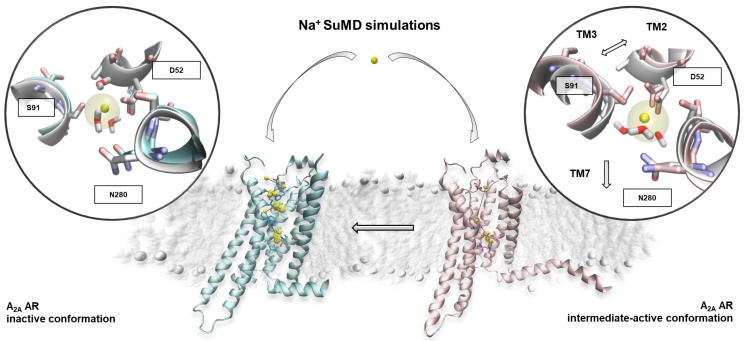
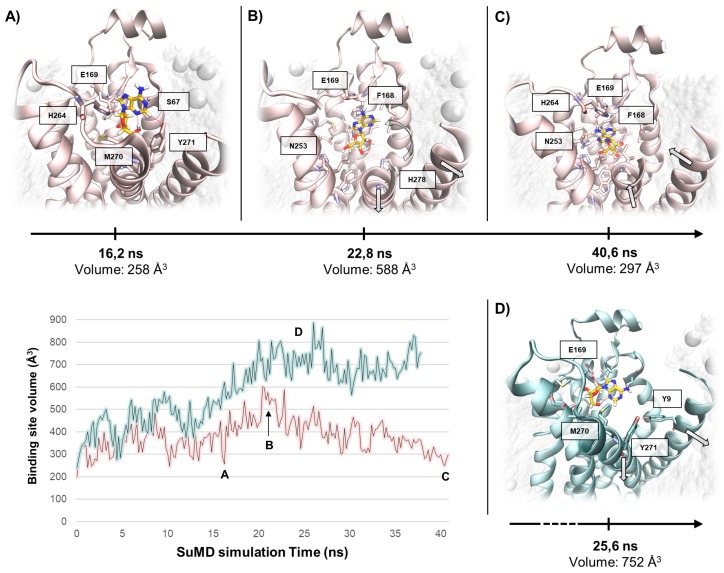
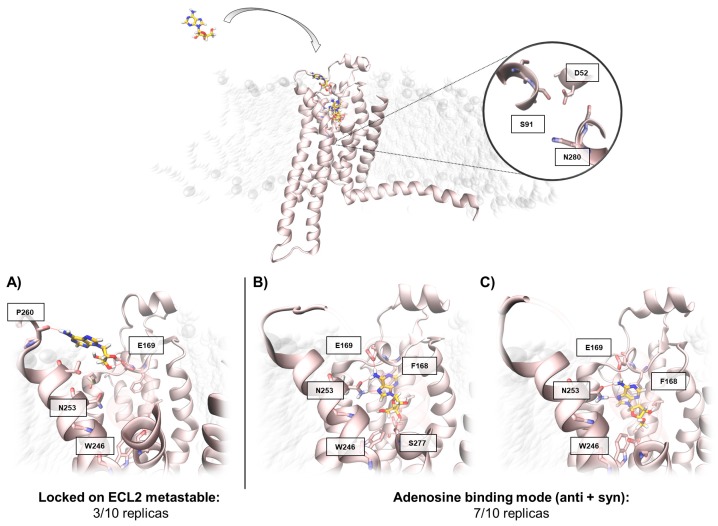
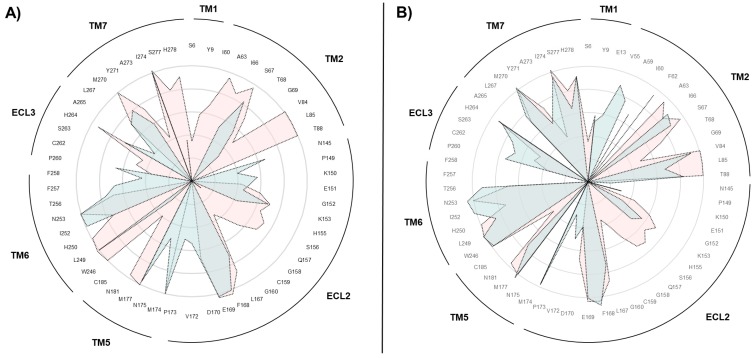
One of the most intriguing findings highlighted from G protein-coupled receptor (GPCR) crystallography is the presence, in many members of class A, of a partially hydrated sodium ion in the middle of the seven transmembrane helices (7TM) bundle. In particular, the human adenosine A receptor (A AR) is the first GPCR in which a monovalent sodium ion was crystallized in a distal site from the canonical orthosteric one, corroborating, from a structural point of view, its role as a negative allosteric modulator. However, the molecular mechanism by which the sodium ion influences the recognition of the A AR agonists is not yet fully understood. In this study, the supervised molecular dynamics (SuMD) technique was exploited to analyse the sodium ion recognition mechanism and how its presence influences the binding of the endogenous agonist adenosine. Due to a higher degree of flexibility of the receptor extracellular (EC) vestibule, we propose the sodium-bound A AR as less efficient in stabilizing the adenosine during the different steps of binding.
从 G 蛋白偶联受体 (GPCR) 晶体学中得到的最有趣的发现之一是,在许多 A 类成员中,在跨膜 7 螺旋束 (7TM) 的中间存在部分水合钠离子。特别是,人腺苷 A 受体 (AAR) 是第一个在与经典正位构象不同的远端位置结晶出单价钠离子的 GPCR,从结构角度证实了它作为负变构调节剂的作用。然而,钠离子影响 AAR 激动剂识别的分子机制尚不完全清楚。在这项研究中,利用监督分子动力学 (SuMD) 技术分析了钠离子识别机制,以及其存在如何影响内源性激动剂腺苷的结合。由于受体细胞外 (EC) 前庭的柔韧性更高,我们提出与钠离子结合的 AAR 在结合的不同步骤中对稳定腺苷的效率较低。