Levich Institute and Department of Physics, City College of New York, New York, New York 10031, USA.
Grandata Labs, 550 15th Street, San Francisco, California 94103, USA.
Nat Commun. 2017 May 16;8:15227. doi: 10.1038/ncomms15227.
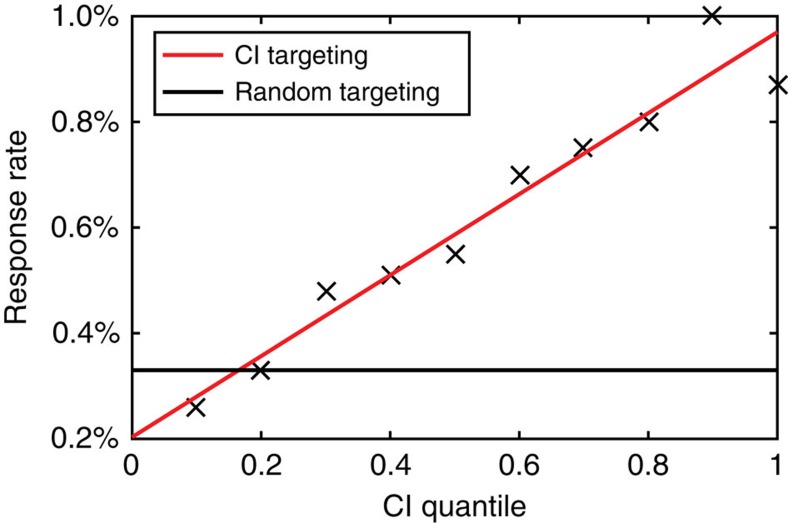
It is commonly believed that patterns of social ties affect individuals' economic status. Here we translate this concept into an operational definition at the network level, which allows us to infer the economic well-being of individuals through a measure of their location and influence in the social network. We analyse two large-scale sources: telecommunications and financial data of a whole country's population. Our results show that an individual's location, measured as the optimal collective influence to the structural integrity of the social network, is highly correlated with personal economic status. The observed social network patterns of influence mimic the patterns of economic inequality. For pragmatic use and validation, we carry out a marketing campaign that shows a threefold increase in response rate by targeting individuals identified by our social network metrics as compared to random targeting. Our strategy can also be useful in maximizing the effects of large-scale economic stimulus policies.
人们普遍认为,社会关系模式会影响个人的经济地位。在这里,我们将这一概念转化为网络层面的操作定义,通过衡量个人在社交网络中的位置和影响力,来推断其经济福利。我们分析了两个大规模的数据源:一个国家的人口的电信和金融数据。我们的结果表明,个人的位置(衡量方式是对社交网络结构完整性的最优集体影响)与个人的经济地位高度相关。所观察到的影响社会网络模式与经济不平等模式相似。为了实际应用和验证,我们开展了一项营销活动,与随机定位相比,通过针对我们的社交网络指标确定的个人进行定位,将响应率提高了两倍。我们的策略对于最大化大规模经济刺激政策的效果也很有用。