Geyer Kathrin K, Niazi Umar H, Duval David, Cosseau Céline, Tomlinson Chad, Chalmers Iain W, Swain Martin T, Cutress David J, Bickham-Wright Utibe, Munshi Sabrina E, Grunau Christoph, Yoshino Timothy P, Hoffmann Karl F
Institute of Biological, Environmental and Rural Sciences, Aberystwyth University, Penglais Campus, Aberystwyth, United Kingodm.
Université Perpignan Via Domitia, CNRS, IFREMER, Perpignan, France.
PLoS Negl Trop Dis. 2017 May 16;11(5):e0005246. doi: 10.1371/journal.pntd.0005246. eCollection 2017 May.
The debilitating human disease schistosomiasis is caused by infection with schistosome parasites that maintain a complex lifecycle alternating between definitive (human) and intermediate (snail) hosts. While much is known about how the definitive host responds to schistosome infection, there is comparably less information available describing the snail's response to infection.
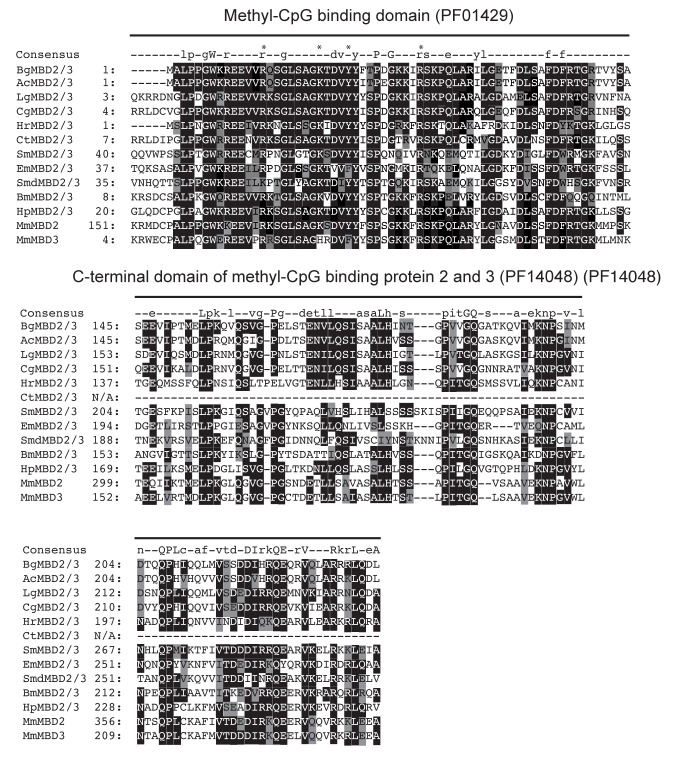
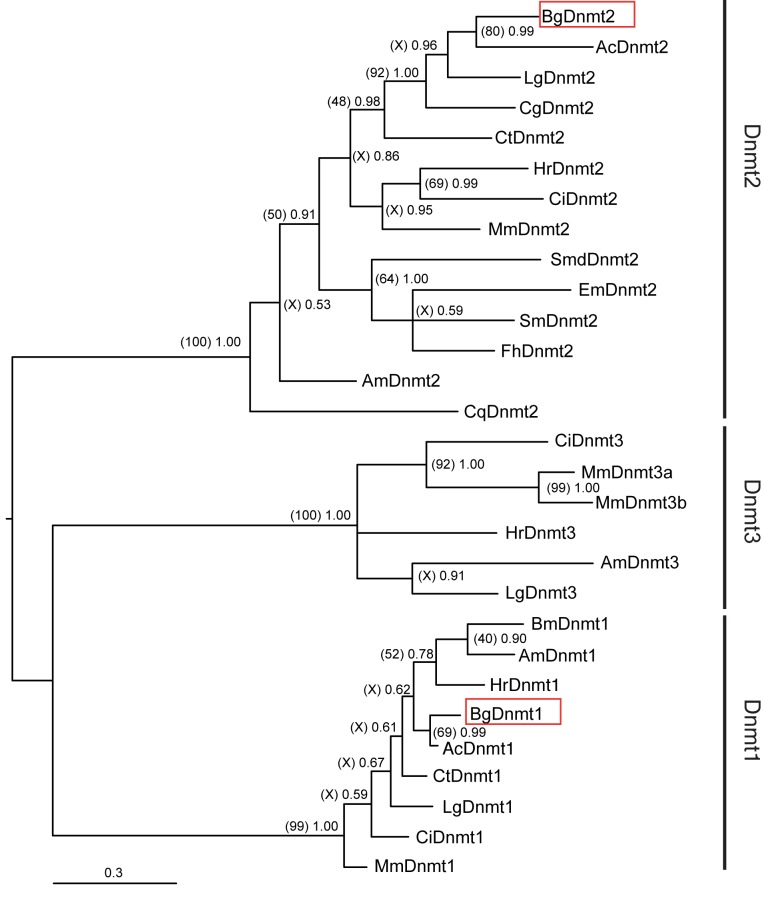
METHODOLOGY/PRINCIPLE FINDINGS: Here, using information recently revealed by sequencing of the Biomphalaria glabrata intermediate host genome, we provide evidence that the predicted core snail DNA methylation machinery components are associated with both intra-species reproduction processes and inter-species interactions. Firstly, methyl-CpG binding domain protein (Bgmbd2/3) and DNA methyltransferase 1 (Bgdnmt1) genes are transcriptionally enriched in gonadal compared to somatic tissues with 5-azacytidine (5-AzaC) treatment significantly inhibiting oviposition. Secondly, elevated levels of 5-methyl cytosine (5mC), DNA methyltransferase activity and 5mC binding in pigmented hybrid- compared to inbred (NMRI)- B. glabrata populations indicate a role for the snail's DNA methylation machinery in maintaining hybrid vigour or heterosis. Thirdly, locus-specific detection of 5mC by bisulfite (BS)-PCR revealed 5mC within an exonic region of a housekeeping protein-coding gene (Bg14-3-3), supporting previous in silico predictions and whole genome BS-Seq analysis of this species' genome. Finally, we provide preliminary evidence for parasite-mediated host epigenetic reprogramming in the schistosome/snail system, as demonstrated by the increase in Bgdnmt1 and Bgmbd2/3 transcript abundance following Bge (B. glabrata embryonic cell line) exposure to parasite larval transformation products (LTP).
CONCLUSIONS/SIGNIFICANCE: The presence of a functional DNA methylation machinery in B. glabrata as well as the modulation of these gene products in response to schistosome products, suggests a vital role for DNA methylation during snail development/oviposition and parasite interactions. Further deciphering the role of this epigenetic process during Biomphalaria/Schistosoma co-evolutionary biology may reveal key factors associated with disease transmission and, moreover, enable the discovery of novel lifecycle intervention strategies.
使人衰弱的人类疾病血吸虫病是由感染血吸虫寄生虫引起的,这些寄生虫维持着在终末宿主(人类)和中间宿主(蜗牛)之间交替的复杂生命周期。虽然人们对终末宿主如何应对血吸虫感染了解很多,但关于蜗牛对感染的反应的信息相对较少。
方法/主要发现:在这里,利用最近通过对光滑双脐螺中间宿主基因组测序揭示的信息,我们提供证据表明,预测的蜗牛核心DNA甲基化机制成分与物种内繁殖过程和物种间相互作用都有关联。首先,与体细胞组织相比,甲基化CpG结合域蛋白(Bgmbd2/3)和DNA甲基转移酶1(Bgdnmt1)基因在性腺中转录富集,用5-氮杂胞苷(5-AzaC)处理可显著抑制产卵。其次,与近交(NMRI)光滑双脐螺种群相比,有色杂交光滑双脐螺种群中5-甲基胞嘧啶(5mC)、DNA甲基转移酶活性和5mC结合水平升高,表明蜗牛的DNA甲基化机制在维持杂种优势中起作用。第三,通过亚硫酸氢盐(BS)-PCR对5mC进行位点特异性检测,发现在一个管家蛋白编码基因(Bg14-3-3)的外显子区域内有5mC,支持了之前对该物种基因组的计算机预测和全基因组BS-Seq分析。最后,我们提供了血吸虫/蜗牛系统中寄生虫介导的宿主表观遗传重编程的初步证据,如光滑双脐螺胚胎细胞系(Bge)暴露于寄生虫幼虫转化产物(LTP)后Bgdnmt1和Bgmbd2/3转录本丰度增加所示。
结论/意义:光滑双脐螺中存在功能性DNA甲基化机制,以及这些基因产物对血吸虫产物的调节,表明DNA甲基化在蜗牛发育/产卵和寄生虫相互作用中起着至关重要的作用。进一步解读这一表观遗传过程在光滑双脐螺/血吸虫共同进化生物学中的作用,可能会揭示与疾病传播相关的关键因素,此外,还能发现新的生命周期干预策略。