Chung Kuo-Fang, Leong Wai-Chao, Rubite Rosario Rivera, Repin Rimi, Kiew Ruth, Liu Yan, Peng Ching-I
School of Forestry and Resource Conservation, National Taiwan University, Daan, Taipei, 106, Taiwan.
Herbarium (HAST), Biodiversity Research Center, Academia Sinica, Nangang, Taipei, 115, Taiwan.
Bot Stud. 2014 Dec;55(1):1. doi: 10.1186/1999-3110-55-1. Epub 2014 Jan 7.
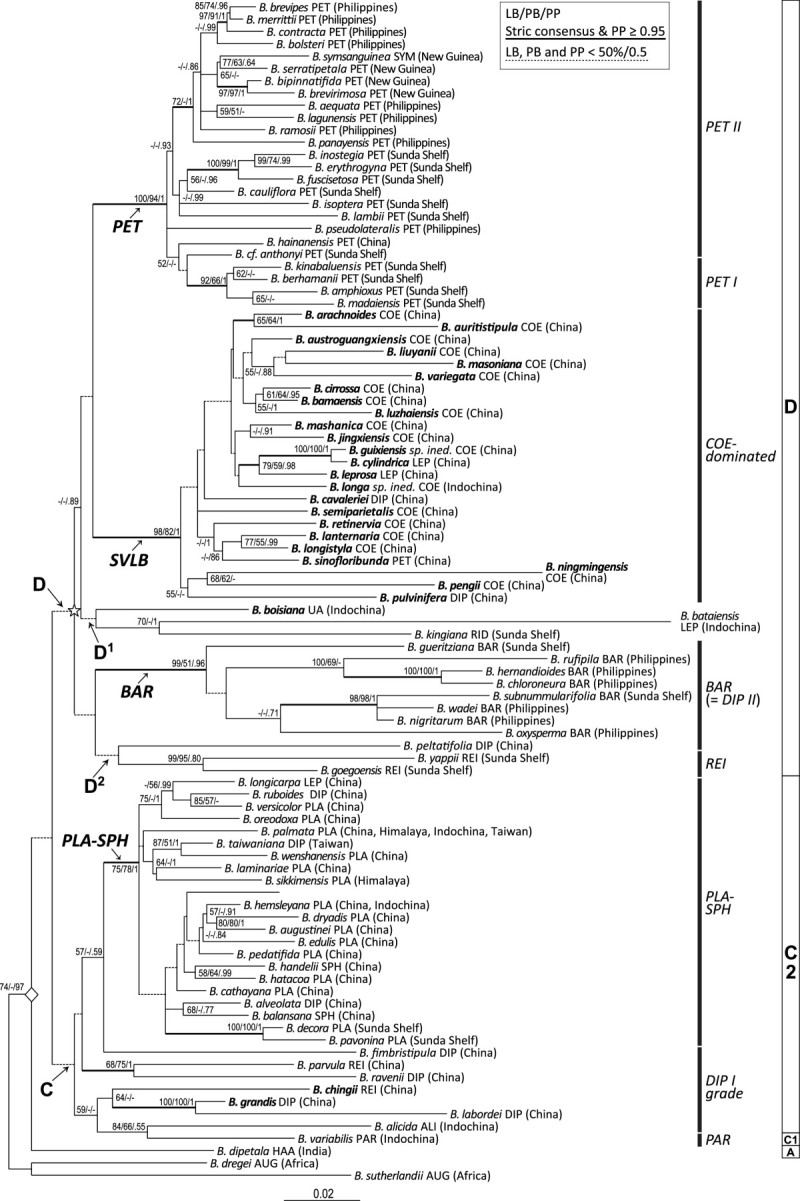
The picturesque limestone karsts across the Sino-Vietnamese border are renowned biodiversity hotspot, distinguished for extremely high endemism of calciphilous plants restricted to caves and cave-like microhabitats that have functioned as biological refugia on the otherwise harsh habitats. To understand evolutionary mechanisms underlying the splendid limestone flora, dated phylogeny is reconstructed for Asian Begonia, a species-rich genus on limestone substrates represented by no less than 60 species in southern China, using DNA sequences of nrITS and chloroplast rpL16 intron. The sampling includes 94 Begonia species encompassing most major Asian clades with a special emphasized on Chinese species.
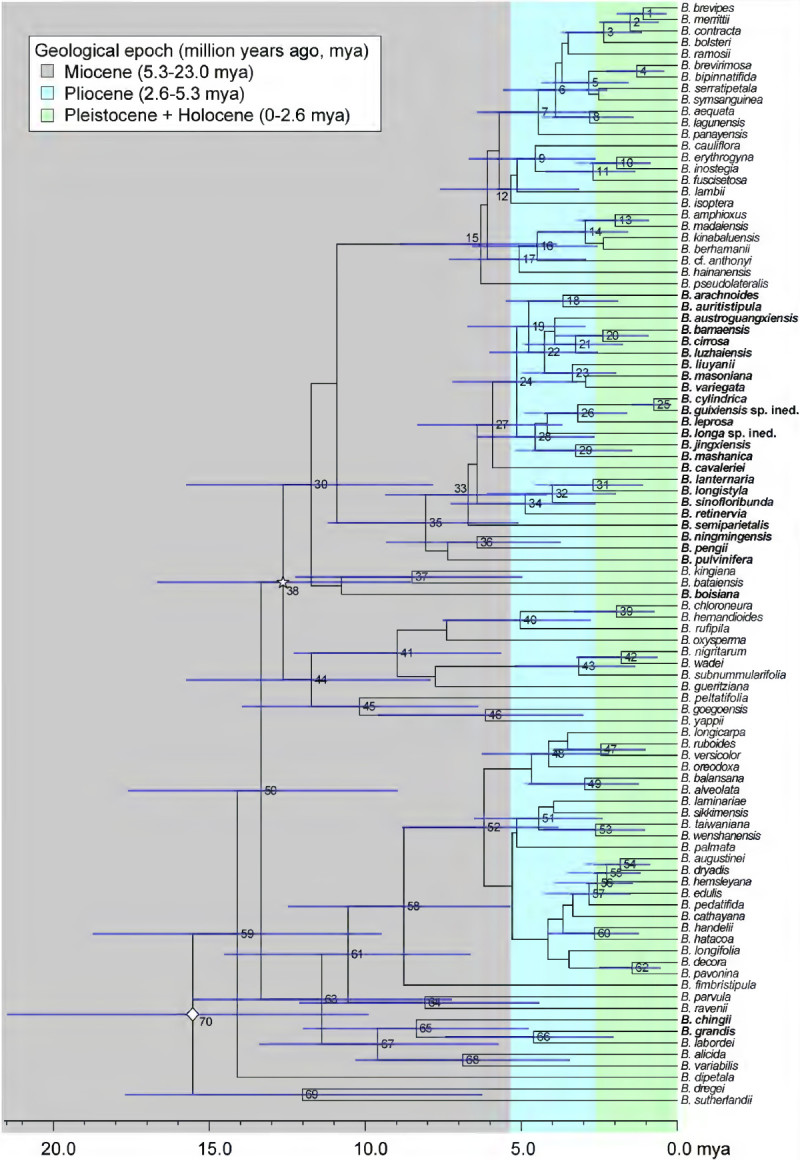
Except for two tuberous deciduous species and a species with upright stems, a majority of Sino-Vietnamese limestone Begonia (SVLB), including sect. Coelocentrum (19 species sampled) and five species of sect. Diploclinium, Leprosae, and Petermannia, are rhizomatous and grouped in a strongly supported and yet internally poorly resolved clade (Clade SVLB), suggesting a single evolutionary origin of the adaptation to limestone substrates by rhizomatous species, subsequent species radiation, and a strong tendency to retain their ancestral niche. Divergence-time estimates indicate a late Miocene diversification of Clade SVLB, coinciding with the onset of the East Asian monsoon and the period of extensive karstification in the area.
Based on our phylogenetic study, Begonia sect. Coelocentrum is recircumscribed and expanded to include other members of the Clade SVLB (sect. Diploclinium: B. cavaleriei, B. pulvinifera, and B. wangii; sect. Leprosae: B. cylindrica and B. leprosa; sect. Petermannia: B. sinofloribunda). Because species of Clade SVLB have strong niche conservatism to retain in their ancestral habitats in cave-like microhabitats and Begonia are generally poor dispersers prone to diversify allopatrically, we propose that extensive and continuous karstification of the Sino-Vietnamese limestone region facilitated by the onset of East Asian monsoon since the late Miocene has been the major driving force for species accumulation via geographic isolation in Clade SVLB. Morphologically species of Clade SVLB differ mainly in vegetative traits without apparent adaptive value, suggesting that limestone Begonia radiation is better characterized as non-adaptive, an underappreciated speciation mode crucial for rapid species accumulations in organisms of low vagility and strong niche conservatism.
中越边境风景如画的石灰岩喀斯特地区是著名的生物多样性热点地区,以喜钙植物的极高特有性而闻名,这些植物局限于洞穴和类似洞穴的微生境,在原本恶劣的栖息地中起到了生物避难所的作用。为了了解这片壮丽的石灰岩植物群背后的进化机制,利用nrITS和叶绿体rpL16内含子的DNA序列,对亚洲秋海棠属进行了定年系统发育重建。亚洲秋海棠属是一个物种丰富的石灰岩基质属,在中国南方有不少于60个物种。采样包括94种秋海棠属植物,涵盖了亚洲的大多数主要分支,特别强调了中国的物种。
除了两种块茎落叶物种和一种直立茎物种外,大多数中越石灰岩秋海棠(SVLB),包括腔心组(采样19种)以及双萼组、麻叶组和小叶组的5个物种,都是根茎状的,并聚集成一个得到有力支持但内部解析度较差的分支(SVLB分支),这表明根茎状物种对石灰岩基质的适应性具有单一的进化起源、随后的物种辐射以及强烈的保留其祖先生态位的趋势。分歧时间估计表明,SVLB分支在中新世晚期发生了多样化,这与东亚季风的开始以及该地区广泛的岩溶作用时期相吻合。
基于我们的系统发育研究,腔心组秋海棠属被重新界定并扩大,以包括SVLB分支的其他成员(双萼组:贵州秋海棠、垫状秋海棠和汪氏秋海棠;麻叶组:圆柱秋海棠和麻叶秋海棠;小叶组:中华多花秋海棠)。由于SVLB分支的物种对保留在其祖先栖息地的类似洞穴的微生境中具有很强的生态位保守性,并且秋海棠通常是扩散能力较差的物种,容易在异域发生分化,我们提出,自中新世晚期以来东亚季风引发的中越石灰岩地区广泛而持续的岩溶作用,是通过地理隔离在SVLB分支中促进物种积累的主要驱动力。SVLB分支的物种在形态上主要在营养性状上有所不同,没有明显的适应性价值,这表明石灰岩秋海棠的辐射更好地被描述为非适应性的,这是一种未被充分认识的物种形成模式,对于低扩散性和强生态位保守性的生物体中的快速物种积累至关重要。