Yamada Shutaro, Imura Yoshinori, Nakai Takaaki, Nakai Sho, Yasuda Naohiro, Kaneko Keiko, Outani Hidetatsu, Takenaka Satoshi, Hamada Kenichiro, Myoui Akira, Araki Nobuhito, Ueda Takafumi, Itoh Kazuyuki, Yoshikawa Hideki, Naka Norifumi
Department of Orthopaedic Surgery, Osaka University Graduate School of Medicine, 2-2 Yamadaoka, Suita, Osaka, 565-0871, Japan.
Musculoskeletal Oncology Service, Osaka International Cancer Institute, 3-1-69 Otemae, Chuo-ku, Osaka, 541-8567, Japan.
BMC Cancer. 2017 May 16;17(1):334. doi: 10.1186/s12885-017-3324-3.
The prognosis of synovial sarcoma (SS), an aggressive soft tissue sarcoma, remains poor. We previously reported that c-MET or platelet-derived growth factor receptor α (PDGFRα) signalling pathway is related to SS progression based upon the findings of phospho-receptor tyrosine kinase (RTK) arrays. TAS-115 is a novel c-MET/ vascular endothelial growth factor receptor-targeting tyrosine kinase inhibitor that has been shown to inhibit multiple RTKs. Here we aimed to investigate the therapeutic potential of TAS-115 against SS.
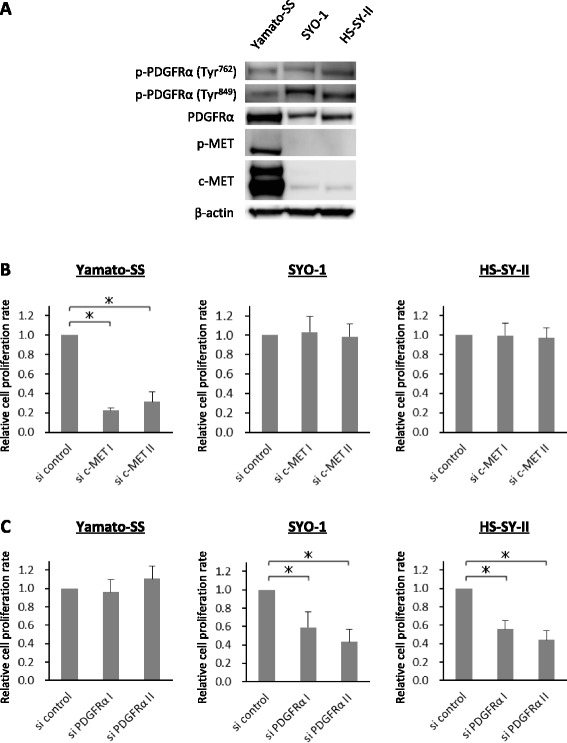
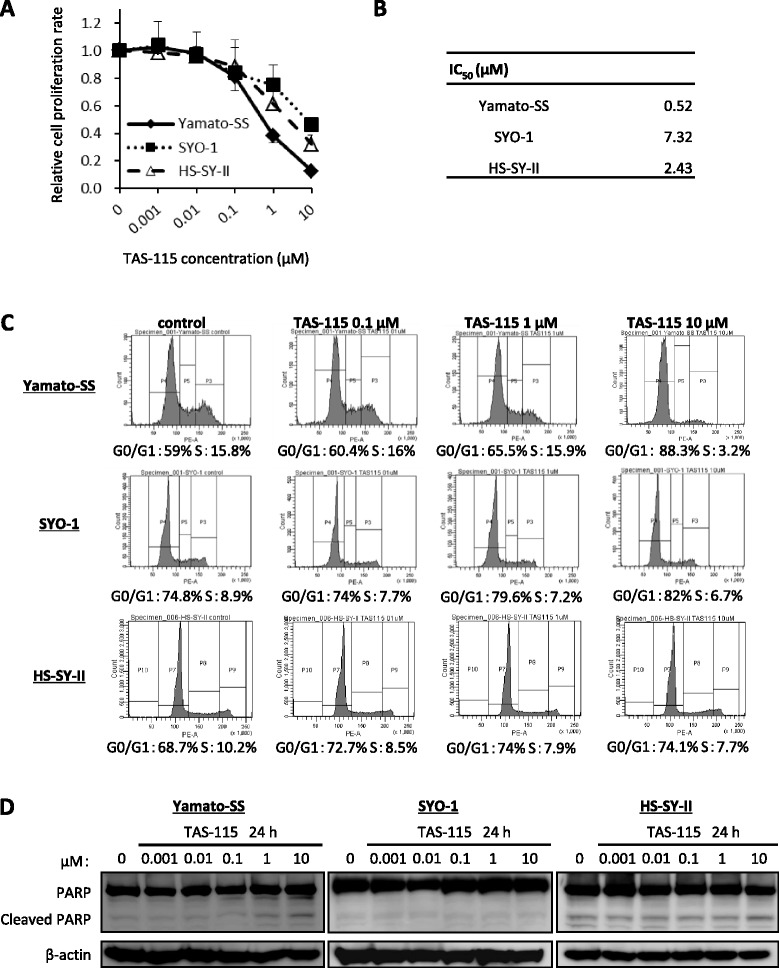
We first evaluated which signalling pathway was relevant to the viability of three human SS cell lines: Yamato-SS, SYO-1 and HS-SY-II. Next, we assessed the anticancer activity and mechanism of action of TAS-115 in these SS cell lines. Finally, we compared the ability of TAS-115 to inhibit c-MET and PDGFRα phosphorylation with that of pazopanib.
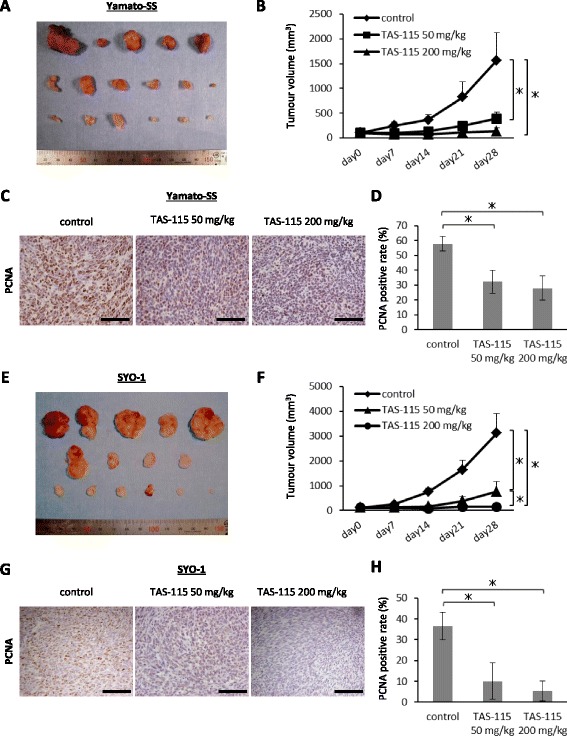
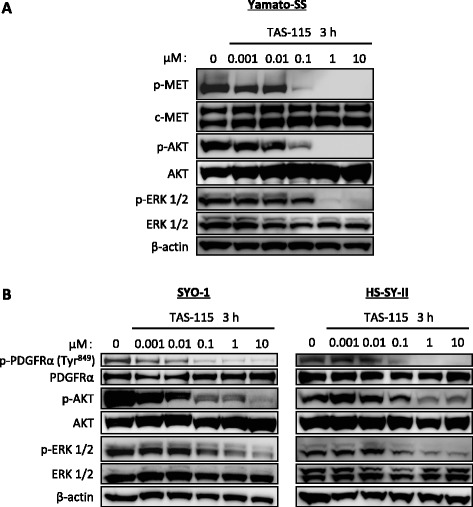
We classified the SS cell lines as c-MET-dependent or PDGFRα-dependent based upon the differences in the signalling pathway relevant for growth and/or survival. We also found that c-MET and PDGFRα were the primary activators of both phosphatidylinositol 3-kinase/AKT and mitogen-activated protein kinase pathways in c-MET-dependent and PDGFRα-dependent SS cells, respectively. TAS-115 treatment blocked the phosphorylation of PDGFRα as well as that of c-MET and their downstream effectors, leading to marked growth inhibition in both types of SS cell lines in in vitro and in vivo studies. Furthermore, PDGFRα phosphorylation, on at least four representative autophosphorylation sites, was impeded by TAS-115 equivalently to pazopanib.
These experimental results have demonstrated the significance of c-MET and PDGFRα signalling for growth and/or survival of SS tumours. TAS-115 monotherapy may benefit SS patients whose tumours are dependent upon either c-MET or PDGFRα signalling by functioning as a multiple tyrosine kinase inhibitor to suppress c-MET as well as PDGFRα pathways.
滑膜肉瘤(SS)是一种侵袭性软组织肉瘤,其预后仍然很差。基于磷酸化受体酪氨酸激酶(RTK)阵列的研究结果,我们之前报道过c-MET或血小板衍生生长因子受体α(PDGFRα)信号通路与SS进展相关。TAS-115是一种新型的靶向c-MET/血管内皮生长因子受体的酪氨酸激酶抑制剂,已被证明可抑制多种RTK。在此,我们旨在研究TAS-115对SS的治疗潜力。
我们首先评估了哪种信号通路与三种人类SS细胞系(Yamato-SS、SYO-1和HS-SY-II)的活力相关。接下来,我们评估了TAS-115在这些SS细胞系中的抗癌活性和作用机制。最后,我们比较了TAS-115与帕唑帕尼抑制c-MET和PDGFRα磷酸化的能力。
根据与生长和/或存活相关的信号通路差异,我们将SS细胞系分为c-MET依赖性或PDGFRα依赖性。我们还发现,在c-MET依赖性和PDGFRα依赖性SS细胞中,c-MET和PDGFRα分别是磷脂酰肌醇3激酶/AKT和丝裂原活化蛋白激酶途径的主要激活剂。在体外和体内研究中,TAS-115处理可阻断PDGFRα以及c-MET及其下游效应器的磷酸化,导致两种类型的SS细胞系均出现明显的生长抑制。此外,TAS-115对至少四个代表性自磷酸化位点的PDGFRα磷酸化的抑制作用与帕唑帕尼相当。
这些实验结果证明了c-MET和PDGFRα信号通路对SS肿瘤生长和/或存活的重要性。TAS-115单药治疗可能使肿瘤依赖c-MET或PDGFRα信号通路的SS患者受益,因为它可作为一种多酪氨酸激酶抑制剂来抑制c-MET以及PDGFRα途径。