Boyd Andrew T, Hulland Erin N, Grand'Pierre Reynold, Nesi Floris, Honoré Patrice, Jean-Louis Reginald, Handzel Endang
Epidemic Intelligence Service, Centers for Disease Control and Prevention, Atlanta, GA, USA.
Division of Global Health Protection, Centers for Disease Control and Prevention, Atlanta, GA, USA.
BMC Pregnancy Childbirth. 2017 May 16;17(1):145. doi: 10.1186/s12884-017-1329-1.
Accurate assessment of maternal deaths is difficult in countries lacking standardized data sources for their review. As a first step to investigate suspected maternal deaths, WHO suggests surveillance of "pregnancy-related deaths", defined as deaths of women while pregnant or within 42 days of termination of pregnancy, irrespective of cause. Rapid Ascertainment Process for Institutional Deaths (RAPID), a surveillance tool, retrospectively identifies pregnancy-related deaths occurring in health facilities that may be missed by routine surveillance to assess gaps in reporting these deaths.
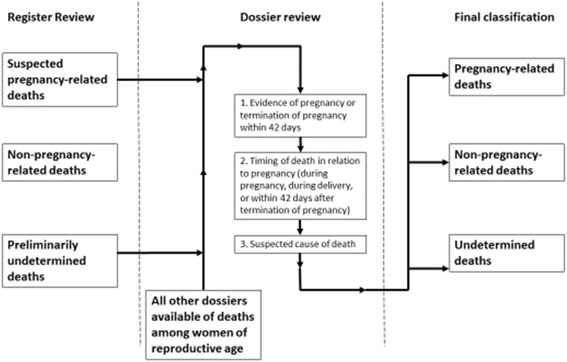
We used RAPID to review pregnancy-related deaths in six tertiary obstetric care facilities in three departments in Haiti. We reviewed registers and medical dossiers of deaths among women of reproductive age occurring in 2014 and 2015 from all wards, along with any additional available dossiers of deaths not appearing in registers, to capture pregnancy status, suspected cause of death, and timing of death in relation to the pregnancy. We used capture-recapture analyses to estimate the true number of in-hospital pregnancy-related deaths in these facilities.
Among 373 deaths of women of reproductive age, we found 111 pregnancy-related deaths, 25.2% more than were reported through routine surveillance, and 22.5% of which were misclassified as non-pregnancy-related. Hemorrhage (27.0%) and hypertensive disorders (18.0%) were the most common categories of suspected causes of death, and deaths after termination of pregnancy were statistically significantly more common than deaths during pregnancy or delivery. Data were missing at multiple levels: 210 deaths had an undetermined pregnancy status, 48.7% of pregnancy-related deaths lacked specific information about timing of death in relation to the pregnancy, and capture-recapture analyses in three hospitals suggested that approximately one-quarter of pregnancy-related deaths were not captured by RAPID or routine surveillance.
Across six tertiary obstetric care facilities in Haiti, RAPID identified unreported pregnancy-related deaths, and showed that missing data was a widespread problem. RAPID is a useful tool to more completely identify facility-based pregnancy-related deaths, but its repeated use would require a concomitant effort to systematically improve documentation of clinical findings in medical records. Limitations of RAPID demonstrate the need to use it alongside other tools to more accurately measure and address maternal mortality.
在缺乏标准化数据来源以供审查的国家,准确评估孕产妇死亡情况存在困难。作为调查疑似孕产妇死亡的第一步,世界卫生组织建议对“与妊娠相关的死亡”进行监测,即定义为女性在怀孕期间或终止妊娠后42天内死亡,无论其死因如何。机构死亡快速确定程序(RAPID)是一种监测工具,可追溯性地识别卫生设施中可能被常规监测遗漏的与妊娠相关的死亡,以评估报告这些死亡情况时存在的差距。
我们使用RAPID对海地三个部门的六家三级产科护理机构中与妊娠相关的死亡情况进行审查。我们查阅了2014年和2015年所有病房中育龄妇女死亡的登记册和医疗档案,以及登记册中未出现的任何其他可用死亡档案,以获取妊娠状态、疑似死因以及死亡时间与妊娠的关系。我们使用捕获-再捕获分析来估计这些机构中院内与妊娠相关死亡的真实数量。
在373例育龄妇女死亡中,我们发现111例与妊娠相关的死亡,比常规监测报告的多25.2%,其中22.5%被错误分类为与妊娠无关。出血(27.0%)和高血压疾病(18.0%)是最常见的疑似死因类别,终止妊娠后的死亡在统计学上比妊娠期间或分娩期间的死亡更为常见。在多个层面存在数据缺失:210例死亡的妊娠状态未确定,48.7%的与妊娠相关的死亡缺乏死亡时间与妊娠关系的具体信息,三家医院的捕获-再捕获分析表明,约四分之一的与妊娠相关的死亡未被RAPID或常规监测捕获。
在海地的六家三级产科护理机构中,RAPID识别出了未报告的与妊娠相关的死亡,并表明数据缺失是一个普遍存在的问题。RAPID是更全面识别基于机构的与妊娠相关死亡的有用工具,但其重复使用需要同时努力系统地改善病历中临床发现的记录。RAPID的局限性表明需要将其与其他工具一起使用,以更准确地衡量和解决孕产妇死亡率问题。