Gerván Patrícia, Soltész Péter, Filep Orsolya, Berencsi Andrea, Kovács Ilona
Department of General Psychology, Institute of Psychology, Pázmány Péter Catholic UniversityBudapest, Hungary.
Laboratory for Psychological Research, Pázmány Péter Catholic UniversityBudapest, Hungary.
Front Psychol. 2017 May 2;8:674. doi: 10.3389/fpsyg.2017.00674. eCollection 2017.
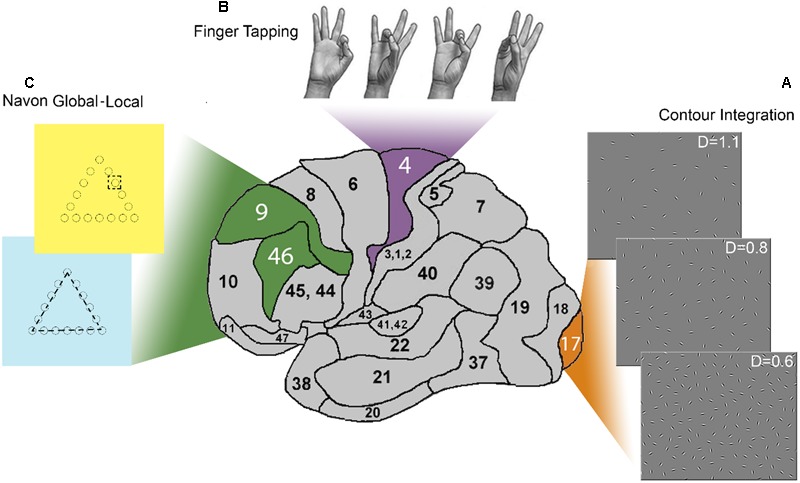
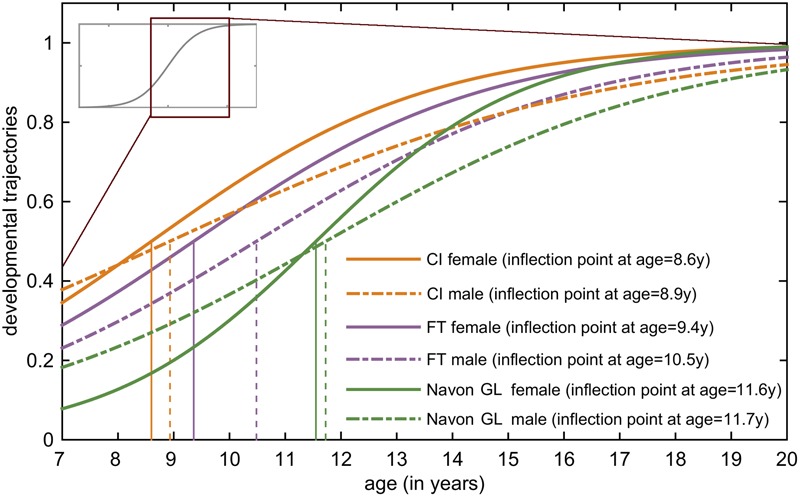
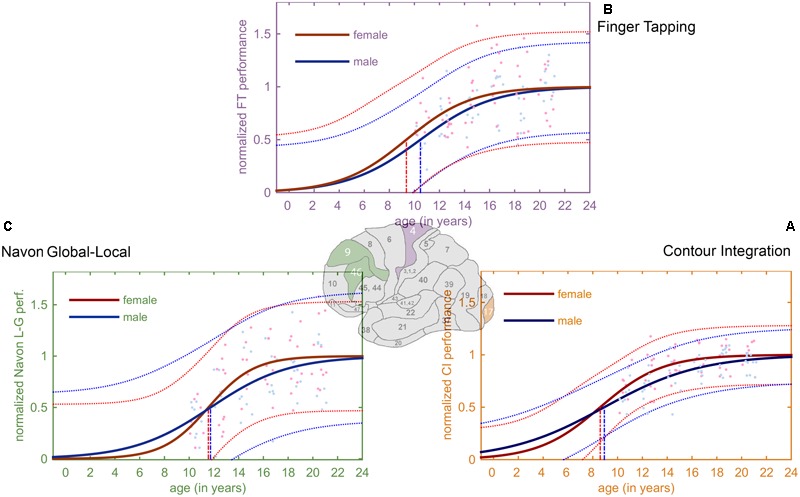
Based on several postmortem morphometric and imaging studies it has been postulated that brain maturation roughly follows a caudal to rostral direction. In this study, we linked this maturational pattern to psychological function employing a series of well-established behavioral tasks. We addressed three distinct functions and brain regions with a perceptual (contour integration, CI), motor (finger tapping, FT), and executive control (Navon global-local) task. Our purpose was to investigate basic visual integration functions relying on primary visual cortex (V1) in CI; motor coordination function related to primary motor cortex (M1) in FT, and the executive control component, switching, related to the dorsolateral prefrontal region of the brain in the Navon task. 122 volunteer subjects were recruited to participate in this study between the ages of 10 and 20 (females = 63, males = 59). Employing conventional statistical methods, we found that 10 and 12 year olds are performing significantly weaker than 20 year olds in all three tasks. In the CI and Navon global-local tasks, even 14 years old perform poorer than adults. We have also investigated the developmental trajectories by fitting sigmoid curves on our data streams. The analysis of the developmental trajectories of the three tasks showed a posterior to anterior pattern in the emergence of the developmental functions with the earliest development in the visual CI task (V1), followed by motor development in the FT task (M1), and cognitive development as measured in the Navon global-local task (DLPC) being the slowest. Gender difference was also present in FT task showing an earlier maturation for girls in the motor domain.
基于多项尸检形态测量和影像学研究,有人推测大脑成熟大致遵循从尾端到头端的方向。在本研究中,我们通过一系列成熟的行为任务,将这种成熟模式与心理功能联系起来。我们用一个知觉任务(轮廓整合,CI)、一个运动任务(手指敲击,FT)和一个执行控制任务(纳冯全局-局部任务)来研究三种不同的功能和脑区。我们的目的是在CI任务中研究依赖初级视觉皮层(V1)的基本视觉整合功能;在FT任务中研究与初级运动皮层(M1)相关的运动协调功能;以及在纳冯任务中研究与大脑背外侧前额叶区域相关的执行控制成分——转换功能。122名志愿者参与了本研究,年龄在10岁至20岁之间(女性 = 63人,男性 = 59人)。采用传统统计方法,我们发现10岁和12岁的儿童在所有三项任务中的表现明显比20岁的成年人差。在CI任务和纳冯全局-局部任务中,甚至14岁的儿童表现也比成年人差。我们还通过对我们的数据流拟合S形曲线来研究发育轨迹。对三项任务发育轨迹的分析显示,发育功能的出现呈现从后到前的模式,最早发育的是视觉CI任务(V1),其次是FT任务中的运动发育(M1),而纳冯全局-局部任务(DLPC)中测量的认知发育最慢。FT任务中也存在性别差异,表明女孩在运动领域成熟较早。