Johnston Laura K, Bryce Paul J
Department of Medicine, Division of Allergy-Immunology, Northwestern University Feinberg School of Medicine, Chicago, IL, USA.
Front Med (Lausanne). 2017 May 2;4:51. doi: 10.3389/fmed.2017.00051. eCollection 2017.
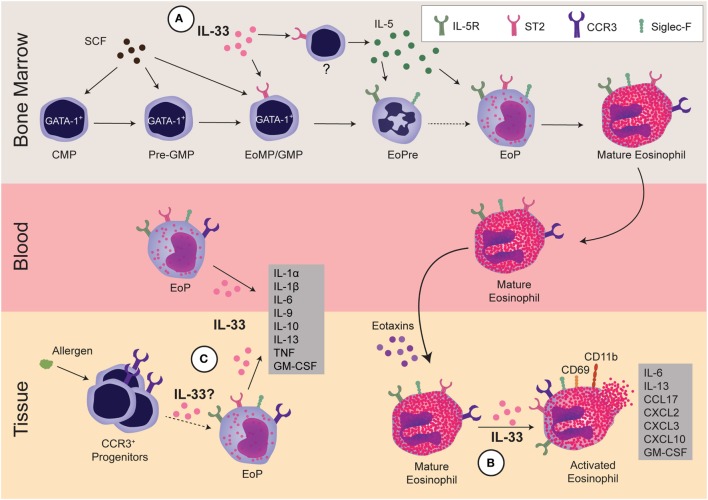
Over the last decade, significant interest in the contribution of three "epithelial-derived cytokines," such as thymic stromal lymphopoietin, interleukin 25, and interleukin 33 (IL-33), has developed. These cytokines have been strongly linked to the early events that occur during allergen exposures and how they contribute to the subsequent type 2 immune response. Of these three cytokines, IL-33 has proven particularly interesting because of the strong associations found between both it and its receptor, ST2, in several genome-wide association studies of allergic diseases. Further work has demonstrated clear mechanisms through which this cytokine might orchestrate allergic inflammation, including activation of several key effector cells that possess high ST2 levels, including mast cells, basophils, innate lymphoid cells, and eosinophils. Despite this, controversies surrounding IL-33 seem to suggest the biology of this cytokine might not be as simple as current dogmas suggest including: the relevant cellular sources of IL-33, with significant evidence for inducible expression in some hematopoietic cells; the mechanistic contributions of nuclear localization vs secretion; secretion and processing mechanisms; and the biological consequences of IL-33 exposure on different cell types. In this review, we will address the evidence for IL-33 and ST2 regulation over eosinophils and how this may contribute to allergic diseases. In particular, we focus on the accumulating evidence for a role of IL-33 in regulating hematopoiesis and how this relates to eosinophils as well as how this may provide new concepts for how the progression of allergy is regulated.
在过去十年中,人们对三种“上皮来源的细胞因子”,如胸腺基质淋巴细胞生成素、白细胞介素25和白细胞介素33(IL-33)的作用产生了浓厚兴趣。这些细胞因子与过敏原暴露期间发生的早期事件以及它们如何促成随后的2型免疫反应密切相关。在这三种细胞因子中,IL-33已被证明特别有趣,因为在多项过敏性疾病的全基因组关联研究中发现它与其受体ST2之间存在很强的关联。进一步的研究已经证明了这种细胞因子可能协调过敏性炎症的明确机制,包括激活几种ST2水平高的关键效应细胞,如肥大细胞、嗜碱性粒细胞、固有淋巴细胞和嗜酸性粒细胞。尽管如此,围绕IL-33的争议似乎表明这种细胞因子的生物学特性可能不像当前的理论所认为的那么简单,包括:IL-33的相关细胞来源,有大量证据表明其在一些造血细胞中可诱导表达;核定位与分泌的机制贡献;分泌和加工机制;以及IL-33暴露对不同细胞类型的生物学后果。在这篇综述中,我们将阐述IL-33和ST2对嗜酸性粒细胞调节的证据,以及这可能如何促成过敏性疾病。特别是,我们关注关于IL-33在调节造血过程中的作用的越来越多的证据,以及这与嗜酸性粒细胞的关系,以及这可能如何为过敏进展的调节提供新的概念。