Department of Bioengineering, University of Illinois at Urbana-Champaign, 1270 Digital Computer Laboratory MC-278, Urbana, Illinois 61801, USA.
Micro and Nanotechnology Laboratory, University of Illinois at Urbana-Champaign, 208 North Wright Street MC-249, Urbana, Illinois 61801, USA.
Nat Commun. 2017 May 17;8:14849. doi: 10.1038/ncomms14849.
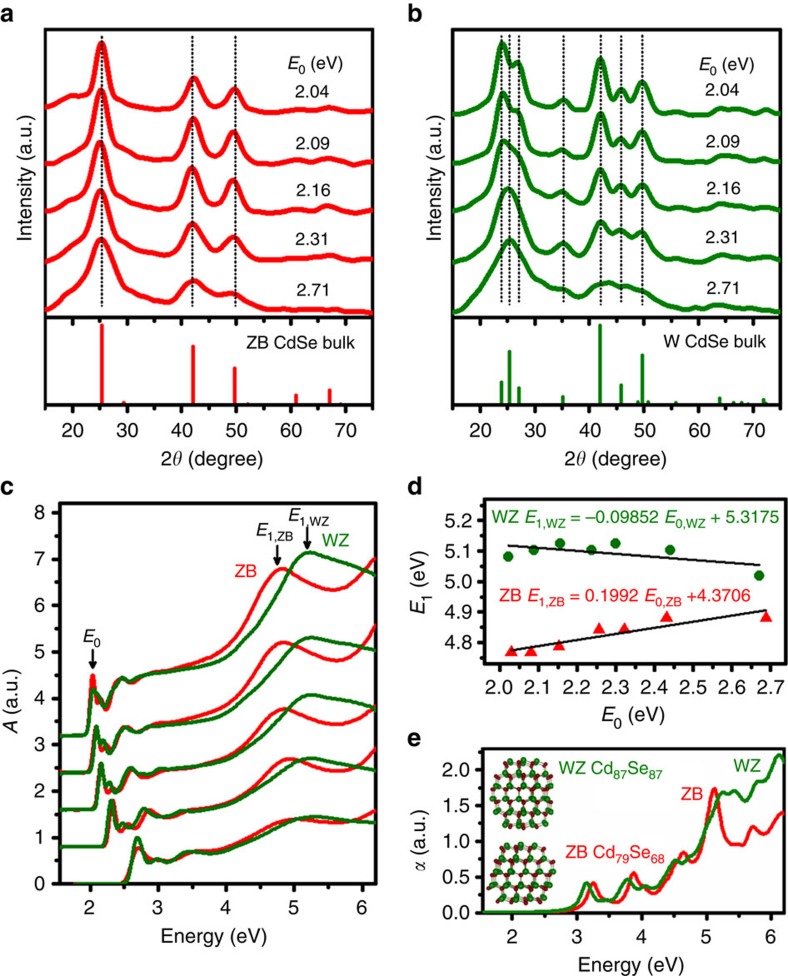
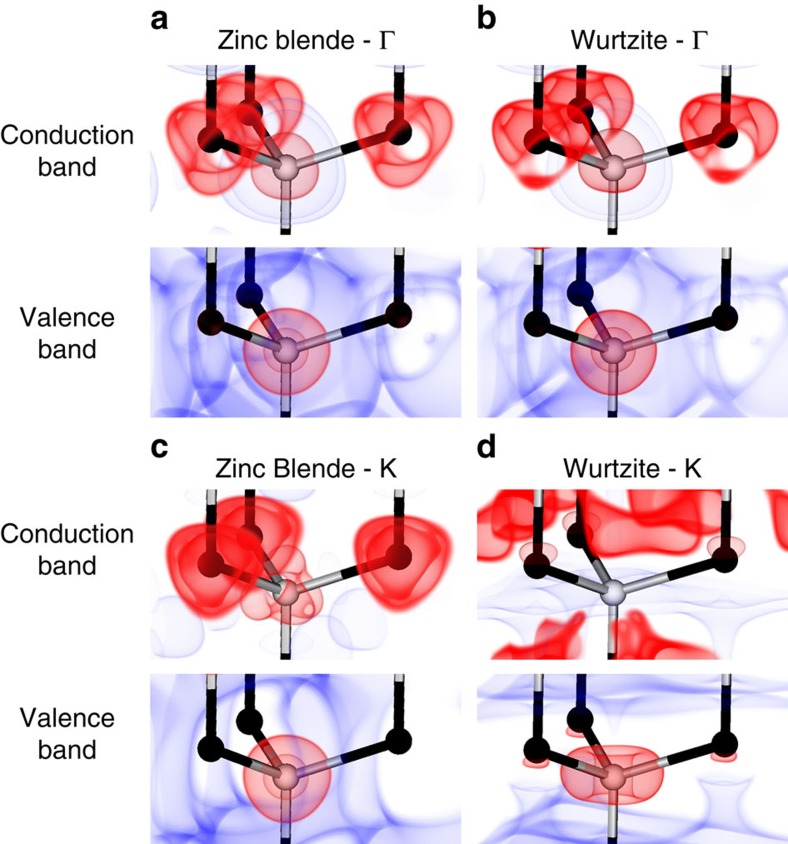
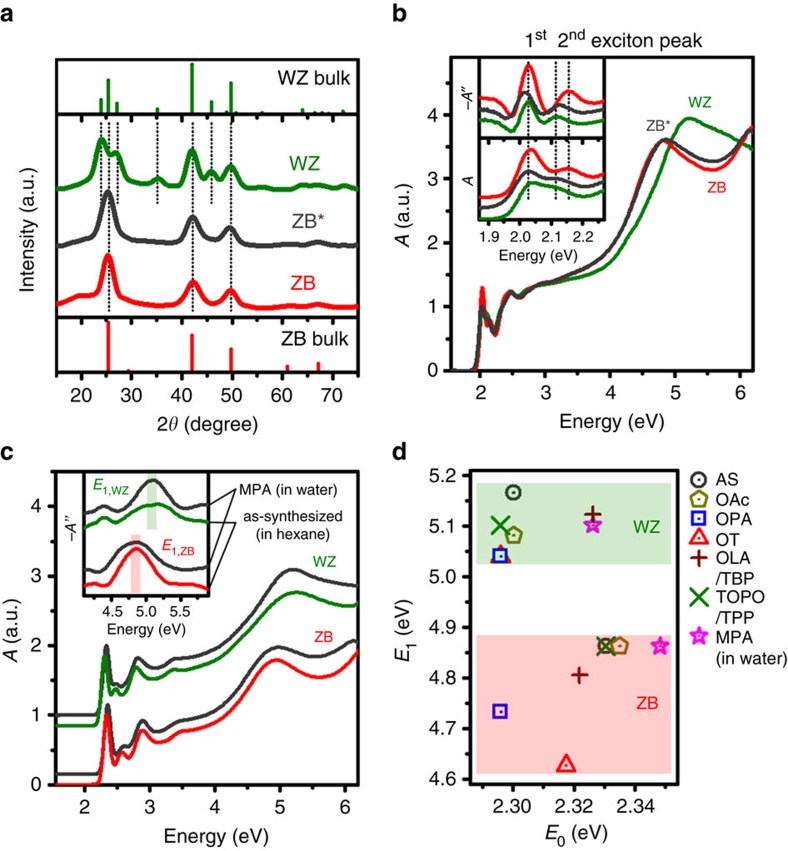
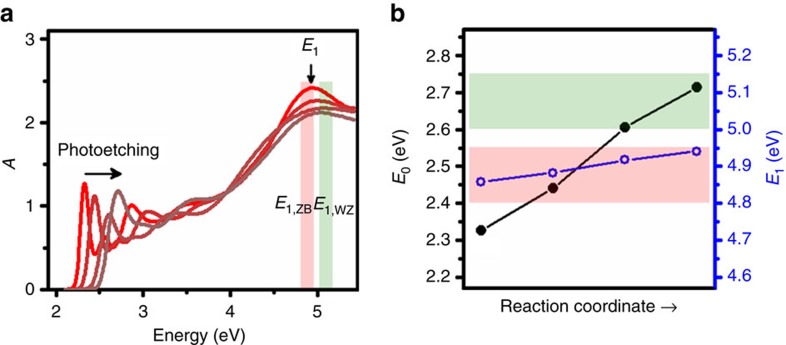
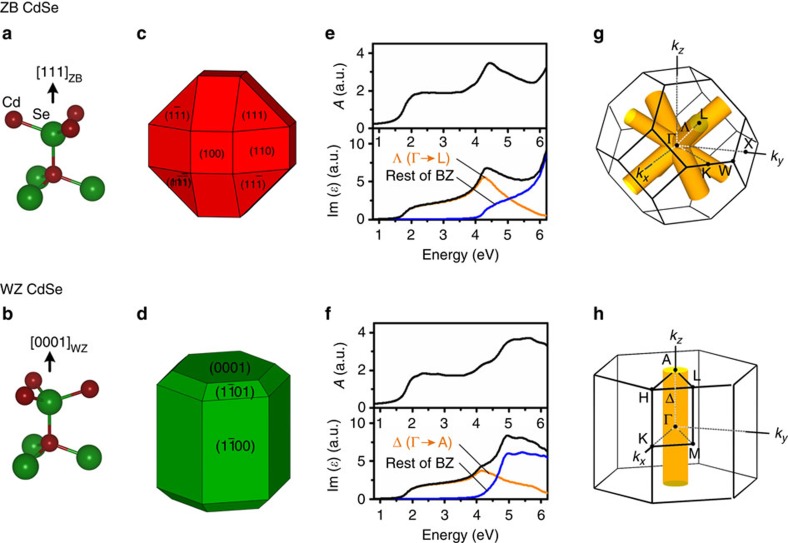
Optical, electronic and structural properties of nanocrystals fundamentally derive from crystal phase. This is especially important for polymorphic II-VI, III-V and I-III-VI semiconductor materials such as cadmium selenide, which exist as two stable phases, cubic and hexagonal, each with distinct properties. However, standard crystallographic characterization through diffraction yields ambiguous phase signatures when nanocrystals are small or polytypic. Moreover, diffraction methods are low-throughput, incompatible with solution samples and require large sample quantities. Here we report the identification of unambiguous optical signatures of cubic and hexagonal phases in II-VI nanocrystals using absorption spectroscopy and first-principles electronic-structure theory. High-energy spectral features allow rapid identification of phase, even in small nanocrystals (∼2 nm), and may help predict polytypic nanocrystals from differential phase contributions. These theoretical and experimental insights provide simple and accurate optical crystallographic analysis for liquid-dispersed nanomaterials, to improve the precision of nanocrystal engineering and improve our understanding of nanocrystal reactions.
纳米晶体的光学、电子和结构性质从根本上源于晶体相。对于 II-VI、III-V 和 I-III-VI 等多晶型半导体材料,如硒化镉,这一点尤为重要,因为它们存在两种稳定的相,立方相和六方相,每种相都具有独特的性质。然而,当纳米晶体较小时或呈多型性时,通过衍射进行的标准晶体学表征会产生模糊的相特征。此外,衍射方法的通量低,与溶液样品不兼容,并且需要大量的样品。在这里,我们报告了使用吸收光谱和第一性原理电子结构理论来识别 II-VI 纳米晶体中立方相和六方相的明确光学特征。高能谱特征可以快速识别相,即使在较小的纳米晶体(约 2nm)中也是如此,并且可能有助于根据不同的相贡献来预测多型纳米晶体。这些理论和实验的见解为液分散纳米材料提供了简单而准确的光学晶体学分析,以提高纳米晶体工程的精度,并加深我们对纳米晶体反应的理解。