Mullins Roger J, Diehl Thomas C, Chia Chee W, Kapogiannis Dimitrios
Laboratory of Neurosciences, Intramural Research Program, National Institute on Aging, National Institutes of Health (NIA/NIH)Baltimore, MD, USA.
Translational Gerontology Branch, Intramural Research Program, National Institute on Aging, National Institutes of Health (NIA/NIH)Baltimore, MD, USA.
Front Aging Neurosci. 2017 May 3;9:118. doi: 10.3389/fnagi.2017.00118. eCollection 2017.
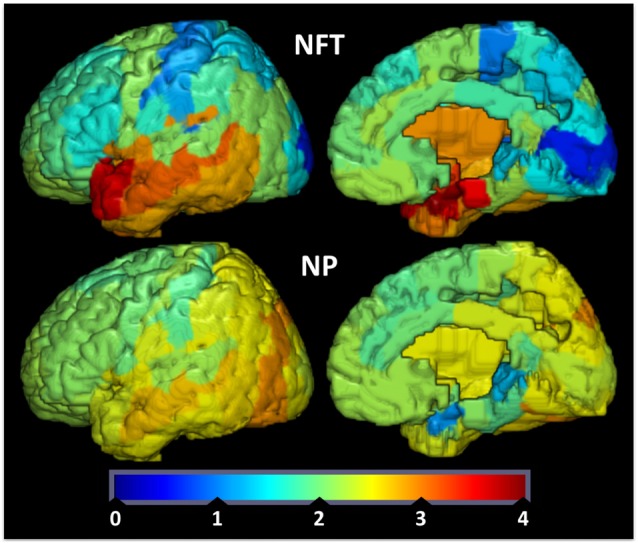
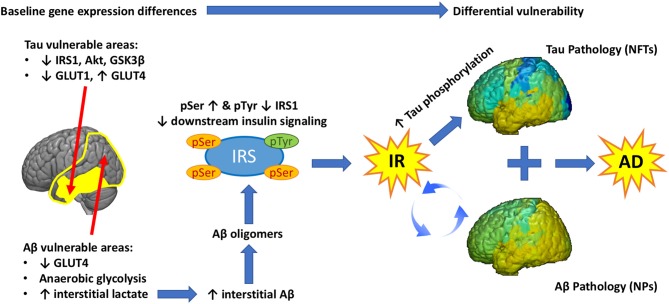
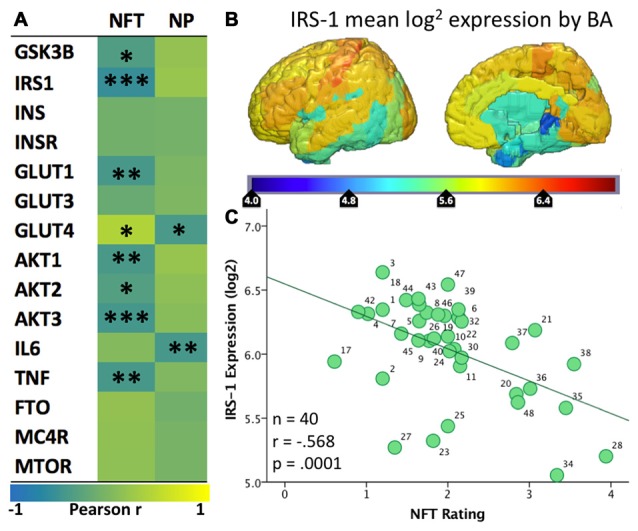
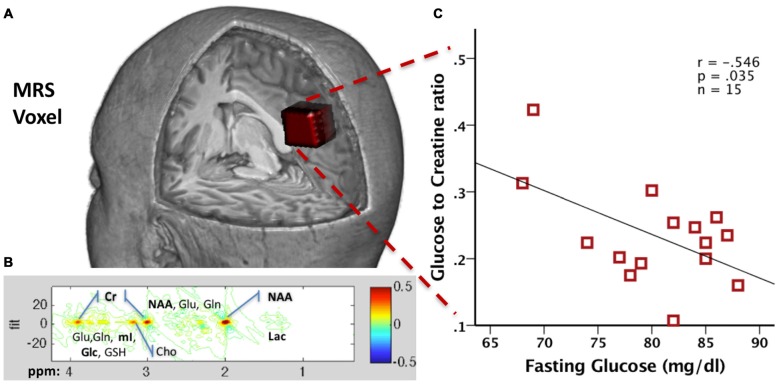
Current hypotheses and theories regarding the pathogenesis of Alzheimer's disease (AD) heavily implicate brain insulin resistance (IR) as a key factor. Despite the many well-validated metrics for systemic IR, the absence of biomarkers for brain-specific IR represents a translational gap that has hindered its study in living humans. In our lab, we have been working to develop biomarkers that reflect the common mechanisms of brain IR and AD that may be used to follow their engagement by experimental treatments. We present two promising biomarkers for brain IR in AD: insulin cascade mediators probed in extracellular vesicles (EVs) enriched for neuronal origin, and two-dimensional magnetic resonance spectroscopy (MRS) measures of brain glucose. As further evidence for a fundamental link between brain IR and AD, we provide a novel analysis demonstrating the close spatial correlation between brain expression of genes implicated in IR (using Allen Human Brain Atlas data) and tau and beta-amyloid pathologies. We proceed to propose the bold hypotheses that baseline differences in the metabolic reliance on glycolysis, and the expression of glucose transporters (GLUT) and insulin signaling genes determine the vulnerability of different brain regions to Tau and/or Amyloid beta (Aβ) pathology, and that IR is a critical link between these two pathologies that define AD. Lastly, we provide an overview of ongoing clinical trials that target IR as an angle to treat AD, and suggest how biomarkers may be used to evaluate treatment efficacy and target engagement.
目前关于阿尔茨海默病(AD)发病机制的假说和理论都高度认为脑胰岛素抵抗(IR)是一个关键因素。尽管有许多经过充分验证的全身性IR指标,但缺乏脑特异性IR的生物标志物仍是一个转化医学上的差距,阻碍了在活人身上对其进行研究。在我们实验室,我们一直在努力开发能反映脑IR和AD共同机制的生物标志物,这些标志物可用于追踪实验性治疗对它们的作用。我们提出了两种用于检测AD中脑IR的有前景的生物标志物:在富含神经元来源的细胞外囊泡(EVs)中检测胰岛素级联介质,以及用二维磁共振波谱(MRS)测量脑葡萄糖。作为脑IR与AD之间存在根本联系的进一步证据,我们提供了一项新的分析,证明了IR相关基因的脑表达(使用艾伦人类脑图谱数据)与tau和β-淀粉样蛋白病变之间存在紧密的空间相关性。我们进而大胆提出假说,即糖酵解代谢依赖、葡萄糖转运蛋白(GLUT)和胰岛素信号基因表达的基线差异决定了不同脑区对Tau和/或淀粉样β蛋白(Aβ)病变的易感性,并且IR是定义AD的这两种病变之间的关键联系。最后,我们概述了正在进行的以IR为治疗AD切入点的临床试验,并提出了生物标志物可如何用于评估治疗效果和靶点作用情况。