
循环核小体作为用于检测结直肠癌的新型血液生物标志物。
Circulating nucleosomes as new blood-based biomarkers for detection of colorectal cancer.
作者信息
Rahier Jean-François, Druez Anne, Faugeras Laurence, Martinet Jean-Paul, Géhénot Myriam, Josseaux Eléonore, Herzog Marielle, Micallef Jake, George Fabienne, Delos Monique, De Ronde Thierry, Badaoui Abdenor, D'Hondt Lionel
机构信息
CHU UCL Namur, Service d'Hépato-gastroentérologie, Université catholique de Louvain, Av. Docteur G. Thérasse 1, B-5530 Yvoir, Belgium.
CHU UCL Namur, Service d'Oncologie, Université catholique de Louvain, Av. Docteur G. Thérasse 1, B-5530 Yvoir, Belgium.
出版信息
Clin Epigenetics. 2017 May 15;9:53. doi: 10.1186/s13148-017-0351-5. eCollection 2017.
BACKGROUND
Colonoscopy is currently widely accepted as the gold standard for detection of colorectal cancer (CRC) providing detection of up to 95% of pre-cancerous lesions during the procedure. However, certain limitations exist in most countries including cost and access to the procedure. Moreover, colonoscopy is an invasive technique with risk inherent to the endoscopic procedure. For this reason, alternative screening tests, in particular, fecal occult blood-based tests, have been widely adopted for frontline screening. Limited compliance to colonoscopy and fecal screening approaches has prompted research on blood-based tests as an alternative approach to identifying individuals at risk who could then be referred for colonoscopy. Increased total levels of nucleosomes in the blood have been associated with tumor burden and malignancy progression. Here, we report for the first time, CRC-associated epigenetic profiles of circulating cell-free nucleosomes (cf-nucleosomes).
METHODS
Levels of 12 epigenetic cf-nucleosome epitopes were measured in the sera of 58 individuals referred for endoscopic screening for CRC.
RESULTS
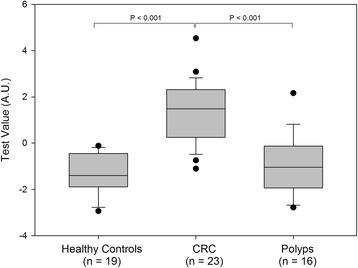
Multivariate analysis defined an age-adjusted panel of four cf-nucleosomes that provided an AUC of 0.97 for the discrimination of CRC from healthy controls with high sensitivity at early stages (sensitivity of 75 and 86 at 90% specificity for stages I and II, respectively). A second combination of four cf-nucleosome biomarkers provided an AUC of 0.72 for the discrimination of polyps from the healthy group.
CONCLUSIONS
This study suggests that a combination of different cf-nucleosome structures analyzed in serum samples by a simple ELISA is a promising approach to identify patients at risk of CRC.
背景
结肠镜检查目前被广泛认为是检测结直肠癌(CRC)的金标准,在该检查过程中可检测到高达95%的癌前病变。然而,在大多数国家,结肠镜检查存在某些局限性,包括成本和可及性。此外,结肠镜检查是一种侵入性技术,存在内镜检查固有的风险。因此,替代筛查试验,特别是基于粪便潜血的试验,已被广泛用于一线筛查。对结肠镜检查和粪便筛查方法的依从性有限,促使人们研究基于血液的检测方法,作为识别有风险个体的替代方法,这些个体随后可被转诊进行结肠镜检查。血液中核小体总水平的升高与肿瘤负荷和恶性进展有关。在此,我们首次报告了循环游离核小体(cf-核小体)与CRC相关的表观遗传谱。
方法
在58名接受CRC内镜筛查的个体血清中测量了12种表观遗传cf-核小体表位的水平。
结果
多变量分析确定了一个经年龄调整的由四种cf-核小体组成的检测组,其在区分CRC与健康对照时的曲线下面积(AUC)为0.97,在早期具有高敏感性(I期和II期在90%特异性时的敏感性分别为75和86)。四种cf-核小体生物标志物的第二种组合在区分息肉与健康组时的AUC为0.72。
结论
本研究表明,通过简单的酶联免疫吸附测定(ELISA)分析血清样本中不同cf-核小体结构的组合,是识别有CRC风险患者的一种有前景的方法。



 Zotero 插件