Department of Pancreatic Surgery, Pancreatic Disease Institute, Union Hospital, Tongji Medical College, Huazhong University of Science and Technology, Wuhan, China.
Department of Pharmacology, School of Basic Medicine, Tongji Medical College, Huazhong University of Science and Technology, Wuhan, China.
Cell Death Dis. 2017 May 18;8(5):e2806. doi: 10.1038/cddis.2017.189.
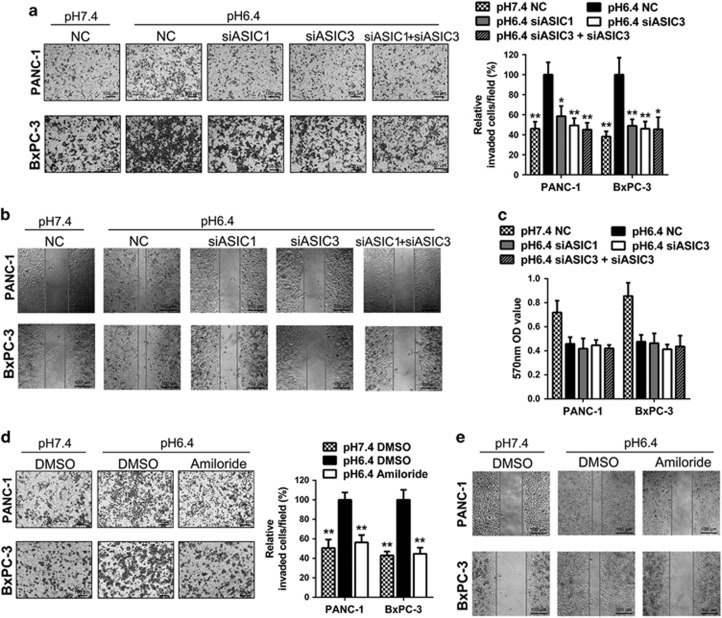
Extracellular acid can have important effects on cancer cells. Acid-sensing ion channels (ASICs), which emerged as key receptors for extracellular acidic pH, are differently expressed during various diseases and have been implicated in underlying pathogenesis. This study reports that ASIC1 and ASIC3 are mainly expressed on membrane of pancreatic cancer cells and upregulated in pancreatic cancer tissues. ASIC1 and ASIC3 are responsible for an acidity-induced inward current, which is required for elevation of intracellular Ca concentration ([Ca]i). Inhibition of ASIC1 and ASIC3 with siRNA or pharmacological inhibitor significantly decreased [Ca]i and its downstream RhoA during acidity and, thus, suppressed acidity-induced epithelial-mesenchymal transition (EMT) of pancreatic cancer cells. Meanwhile, downregulating [Ca]i with calcium chelating agent BAPTA-AM or knockdown of RhoA with siRNA also significantly repressed acidity-induced EMT of pancreatic cancer cells. Significantly, although without obvious effect on proliferation, knockdown of ASIC1 and ASIC3 in pancreatic cancer cells significantly suppresses liver and lung metastasis in xenograft model. In addition, ASIC1 and ASIC3 are positively correlated with expression of mesenchymal marker vimentin, but inversely correlated with epithelial marker E-cadherin in pancreatic cancer cells. In conclusion, this study indicates that ASICs are master regulator of acidity-induced EMT. In addition, the data demonstrate a functional link between ASICs and [Ca]i/RhoA pathway, which contributes to the acidity-induced EMT.
细胞外酸可对癌细胞产生重要影响。酸敏离子通道(ASICs)作为细胞外酸性 pH 的关键受体出现,在各种疾病中表达不同,并与潜在的发病机制有关。本研究报告 ASIC1 和 ASIC3 主要表达在胰腺癌细胞的膜上,并在胰腺癌组织中上调。ASIC1 和 ASIC3 负责酸度诱导的内向电流,这是细胞内 Ca 浓度 ([Ca]i) 升高所必需的。用 siRNA 或药理学抑制剂抑制 ASIC1 和 ASIC3,可显著降低酸度诱导的 [Ca]i 及其下游 RhoA,从而抑制胰腺癌细胞的上皮-间充质转化 (EMT)。同时,用钙螯合剂 BAPTA-AM 下调 [Ca]i 或用 siRNA 下调 RhoA 也显著抑制胰腺癌细胞的酸度诱导 EMT。重要的是,尽管对增殖没有明显影响,但胰腺癌细胞中 ASIC1 和 ASIC3 的敲低显著抑制了异种移植模型中的肝和肺转移。此外,ASIC1 和 ASIC3 与胰腺癌细胞中间充质标志物波形蛋白的表达呈正相关,与上皮标志物 E-钙粘蛋白的表达呈负相关。总之,本研究表明 ASICs 是酸度诱导 EMT 的主要调节因子。此外,数据表明 ASICs 与 [Ca]i/RhoA 通路之间存在功能联系,这有助于酸度诱导的 EMT。